BACK TO TOP

Aberpergwm coal mine extension debated in court

Today, 6th February 2024, Coal Action Network was back in court, this time appealing last year’s decision by the court that the Welsh Government couldn’t prevent an extension at Aberpergwm coal mine. Our legal team believes the Welsh Government can, and we believe it should, stop the Aberpergwm extension—keeping 42 million tonnes of coal underground. At stake in this case is an additional 1.17 million tonnes of methane and up to 120 million tonnes of CO2 would be released.

Barristers Estelle Dehon KC and Asitha Ranatunga (Cornerstone Barristers), supported by Matthew McFeeley (Richard Buxton Solicitors), argued that there is a difference between the authorisation for a coal mine and the licensing for one, particularly in the conditional form.

While the specific legal argument is complicated, the case is really a question of whether the Wales Act (2017) means the Welsh Government, rather than the UK Government’s Coal Authority, gets the final say on whether the Aberpergwm coal mine extension can go ahead.

A much debated section reads:

Aberpergwm deep coal mine supplies 70% of its coal to Port Talbot steelworks, which is expected to significantly reduce its coal demand as it decarbonises.

Welsh Government policy, while not without loopholes, does make a stand against the extraction of coal. Should the 3 appeal judges decide that Coal Action Network’s legal team is correct, the Welsh Government will need to decide whether to allow the extension to happen. A ruling is expected in the next 6—12 weeks.

Published 06. 02. 2024

EMR Capital’s other coking coal mine – Kestrel, Queensland

EMR Capital, the company that owns 81% of the proposed West Cumbria Coal mine, is currently operating another coking coal mine – Kestrel.

The Kestrel mine is an underground mine located in the Bowen Basin in central Queensland. The Bowen Basin contains the largest coal reserves in Australia.

The mine produces twice the annual output proposed for West Cumbria, at 5.56 million tonnes a year. The Kestrel coal mine is not without controversy, which could occur in West Cumbria if the mines started. See below for recent issues for workers, subsidence and with polluted water discharge which at Kestrel could affect the Great Barrier Reef or the coast at Cumbria.

There is not a strong campaign focus against Kestrel coal mine specifically, as in 2021, Australia had 94 operational coal mines, coal and a much lower population density than in the UK. The mine has operated since 1992.

Like the proposed West Cumbria Coal mine, Kestrel is not owned and operated by just one company.

“Both EMR and Adaro are keen investors in Metallurgical Coal.”[1]

Kestrel mine is owned by Kestrel Coal Resources (80%) and Mitsui Investments (20%). Kestrel Coal Resources is made up of 52% EMR Capital, with Adaro Capital Ltd owning the other 48%.

Location of Kestrel coal mine

Key facts

  • Coal type: coking coal
  • Location: central Queensland
  • Traditional owners of the land: Western Kangoulu [2]
  • Area: 17,000 hectares
  • Depth: 350m to 400m [3]
  • Seem depth: 3m [3]
  • Annual coal sales: 5.56 Mt (2021) [4]
  • Main markets: India, South Korea, and Japan [4]
  • Mining started: 1992 [5]
  • Expected closure: 2032 [5]
  • Reserves available until: 2046 [6]
  • Further expansion?: Likely [7]
  • Employees: approximately 660 [2]
  • Mine’s direct annual emission position in Australia (2019-2020) 9th [9] out of approx 94 mines [8]
  • Previous owner: Mitsui Investments (20%) and Rio Tinto (80%) share sold to EMR Capital and Adaro Energy in 2018.
Kestrel coal mine from https://www.mining-outlook.com/commodities/coal-mining-sector/kestrel-coal-resources-mining-for-a-legacy-worth-leaving/4

Controversy

Protests and disputes

There were workers disputes at the mine in 2022 over job contracts, including redundancy policies, health insurance policies and our incentive bonus policy. The Mining and Energy Union vice president criticized Kestrel over the ongoing saga. [10]

The mine was for sale in 2022. It does not seem to have found a buyer.

Threat at a local level

The traditional owners of the land are the Western Kangoulu people who co-operate to some extent with the miners, but say “the sectors activities also present a large threat to the protection of cultural heritage and values with extensive and irreparable damage being done to the land resources of the Western Kangoulu area.” [11]

Environmental issues

Lock the Gate has highlighted that “Central Queensland coal mines are releasing billions of litres of polluted water many times saltier than the receiving rivers in the catchment of the Great Barrier Reef, prompting concerns about the ecological health of impacted waterways.”

According to the Environment Department’s figures, Kestrel, in Jan 2023 was releasing the equivalent of an Olympic-sized swimming pool of water every eight seconds into Crinum Creek.

The Environmental Advocacy in Central Queensland director said, “It’s particularly galling that even coal mines that publicly claim to be ‘zero-discharge’, such as Kestrel, are releasing thousands of litres into Central [Queensland] creeks every second which will be carrying sediment to the Reef.” [12]

Subsidence

There has been subsidence at the Kestrel mine, this was likely planned. The area over the mines is mainly agricultural. Subsidence is where the ground sinks after coal mining has cleared an underground void and the rock roof is allowed to fall in, causing disruption at ground level.

At the Kestrel mine there is recorded subsidence of 1.6m to 2 m down the centre of the 250 m wide panels. These panels are approximately 4km long.” At the Kestrel site this affects the hydrology of the area. Similar subsidence, were it to take place, at the currently proposed West Cumbria coal mine, would cause disruption on the sea bed. If this is expected a license for the mine is required from the Marine Management Organisation. As “subsidence increase[s] permeability and porosity”. [13]

References

1 https://kestrelcoal.com/stakeholders/

2 https://www.mining-outlook.com/commodities/coal-mining-sector/kestrel-coal-resources-mining-for-a-legacy-worth-leaving/3

3 https://www.mining-outlook.com/commodities/coal-mining-sector/kestrel-coal-resources-mining-for-a-legacy-worth-leaving

4 https://www.adaro.com/pages/read/7/22/mining

5 https://www.gem.wiki/Kestrel_mine

6 https://www.mining-outlook.com/commodities/coal-mining-sector/kestrel-coal-resources-mining-for-a-legacy-worth-leaving#small-but-mighty

7 https://www.mining-outlook.com/commodities/coal-mining-sector/kestrel-coal-resources-mining-for-a-legacy-worth-leaving/7

8 https://www.ga.gov.au/digital-publication/aecr2023/coal

9 https://www.lockthegate.org.au/flatulent_narrabri_underground_expansion_would_be_most_polluting_thermal_coal_mine_in_australia_for_direct_greenhouse_emissions

10 https://www.couriermail.com.au/news/queensland/central-queensland/business/kestrel-coal-mine-dispute-over-employee-agreement-between-emerald-miners-and-kestrel-coal-resources/news-story/51458de7ad16d0214fc17426a2b9a1cf

11 https://lumburrabimbi.com.au/western-kangoulu/

12 https://lumburrabimbi.com.au/western-kangoulu/

13 file:///home/anne/Lechner2014Theimpactofundergroundlongwallminingonprimeagriculturalland.pdf Referencing Gullo D. 2006. Kestrel coal mine: subsidence and agriculture. Central Queensland Mining Forum. 18 October 2006. Fitzroy Basin Association, Emerald, Queensland, Australia., Booth & Spande, 1992; Potentiometric and aquifer property change above subsiding longwall mine panels, Illinois basin coalfield. Ground Water 30: 362–368., and Booth, 1998, Impacts of mine subsidence on groundwater. In Proceedings of Prime, Farmland Interactive Forum, Hooks CL, Vories KC, Throgmorton D (eds). Department of Agronomy, Illinois Agricultural Experiment Station, University of Illinois at Urbana-Champaign, University of Southern Indiana: Evansville; 143–148.).


Welsh position on a coal ban needs to change

A response from the Welsh Climate Change Minister

Open letter to the Welsh Climate Change Minister... and their reply in full

(Click for PDF)

Open letter

Minister's reply

Background

On 23 October 2023, over 30 Wales-based NGOs, businesses, and community groups signed an open letter to Wales’ Climate Change Minister, Julie James, calling for the Welsh Government to ban coal mining once and for all (sent by Climate Cymru). On 10th January 2024, Julie James wrote back—but claims a ban isn’t needed, even though 1.6 million tonnes of CO2 could have been prevented since 2022 if the Welsh Government had adopted a ban. That failure has caused 362 additional deaths from climate change related causes. Julie James’ claims just don’t stack up against those lives lost. Here’s why:

What the Minister didn’t respond to

The open letter to Julie James highlighted that an issue with the current policy is that it is riddled with caveats and exceptions. Carmarthenshire County Council’s Planning Officer even wrote in September 2023 that it was “difficult to know for certain how to interpret the coal policy”. Julie James failed to respond to this point entirely. A clear ban would remove the existing ambiguity that makes the current policy challenging to apply.

Julie James also did not respond to our point that Merthyr (South Wales) Ltd would not have been able to mine 500,000 tonnes of coal from Ffos-y-fran over the past 1.5 years if there was a clear ban on coal mining. The mining company exploited the exceptions in existing policies to secure a de facto extension. To protect against this climate assault recurring by closing the loopholes, a clear coal ban is needed now.

In the open letter to Julie James, it’s stated “A coal mine ban can be drafted is such a way that allows for the safe winding down of existing coal mines, and Coal Authority access to fulfil its regulatory duties”. That didn’t stop Julie James trying to use that against a ban anyway: “we also have a duty to manage the safe closure and restoration of existing and historic mining infrastructure”. Julie James accompanies this with a reason that’s even more bizarre: “The incidental extraction of limited coal may also be required during the construction of infrastructure projects”. Those wouldn’t be coal mines so wouldn’t fall under a ban—the Coal Authority even licences this differently as an ‘incidental coal agreement’. The burden and hazards of historic mines across Wales would diminish under a coal ban, rather than risk being added to—a very real risk in light of Ffos-y-fran.

The Minister's presumptions against a coal mine ban

Julie James says “…coal licences may be needed in wholly exceptional circumstances and each application will be decided on its own merits”. But this creates exactly the problem that Julie James lamented in her letter in October 2011 to then Minister for BEIS Kwasi Kwarteng: "both the developer and the Coal Authority committing significant resources respectively to preparing and determining applications... before Welsh policy can properly be applied”. A coal ban would end the pipeline of applications, and the private and public funds they waste.

Julie James twice hails “the presumption being against extraction” in current policies. We hope it’s not presumptuous to argue for a commitment stronger than a ‘presumption’ in the face of catastrophic climate change. What justification could opening a new coal mine have in the face of the 362 lives that’ll be cut short due to the Welsh Government’s refusal to ban coal mines up until now? Climate vandalism over the past year shows nothing short of a ban on coal mining can protect the lives and ecosystems at stake.

Finally, Julie James concludes her letter by claiming the “Welsh Government has adopted and implemented the strongest policy opposition to coal extraction across the UK Governments”. Even if that were true, the Welsh Government clearly needs to go further given current policies have failed to prevent 1.6 million tonnes of avoidable CO2 in the past 1.5 years. But it’s also not true. Julie James’ claim to be leading on a progressive coal policy is based on her comparison to a similar one set out in the Scottish Parliament back in November 2021. She ignores the de facto ban that the Scottish Government more recently introduced in October 2022—as referenced in the open letter to Julie James. If Julie James actually wants the Welsh Government to boast the strongest policy opposition to coal mining, she’ll have to be bolder by committing to a ban on coal mining in Wales.

Proposed Whitehaven coal mine campaign timeline

Main events

2014 Company directors buy Riverside Energy and change the name to West Cumbria Mining Ltd ( West Cumbria Mining Ltd).

2015 Cumbria County Council and  West Cumbria Mining Ltd hold internal discussions.

2016 Environmental Impact Assessment Scoping Report is finalised.

2017 Initial planning application is submitted.

2017 September. First demonstration against the coal mine - organised by Radiation Free Lakeland

2018 Major changes to the application are made and a new Environmental Statement submitted.

2019 March. Cumbria County Council planning committee holds hearing for the Whitehaven coal mine application, and approves it “subject to S106 legal agreement".

2019 April. Call in Request to Rt Hon James Brokenshire Secretary of State from Keep Cumbrian Coal in the Hole (a Radiation Free Lakeland campaign) around potential nuclear impacts of the proposal.

2019 June. A call-in request by SLACC is refused by Secretary of State (Secretary of State).

2019 October. Cumbria County Council planning committee holds second hearing and again approves the Whitehaven coal mine application “subject to S106 legal agreement".

2019 Judicial review launched by Leigh Day solicitors on behalf of Radiation Free Lakeland.

2020 May. Cumbria County Council planning committee sets aside (withdraws) previous “consent subject to S106”.

2020 June.  West Cumbria Mining Ltd submits revised application (claiming to no longer mine and sell the high sulphur “middlings” coal in the area).

2020 October. Cumbria County Council planning committee holds third hearing for the Whitehaven coal mine application, and again approves it “approval subject to S106 legal agreement".

2021 January. SLACC issue second request for the Secretary of State to call-in  West Cumbria Mining Ltd’s application.

2021 February. Cumbria County Council suspended approval decision because Climate Change Committee recommended the end of coking coal use by 2035.

2021 February. CAN petition with 110,000+ signatures is submitted to the UK Government for the Secretary of State to call in the mining application.

2021 March. SLACC launches judicial review against the Secretary of State’s failure to call in  West Cumbria Mining Ltd’s application.

2021 March.  West Cumbria Mining Ltd launches judicial review against Cumbria County Council and in opposition to SLACC’s judicial review of the Secretary of State.

2021 Secretary of State finally agrees to call in  West Cumbria Mining Ltd’s application and to hold a Public Inquiry into it.

2021 September. 11 groups commit to taking direct action to stop the West Cumbria coal mine if government approves it.

2021 September.  West Cumbria Mining Ltd make major change just ahead of Public Inquiry - tunnelling under the ancient woodlands.

2021 September. Public Inquiry is held.

2021 September. On the first day of the Public Inquiry, around 70 people gather outside the site of the prospective Whitehaven coal mine, and outside the Secretary of State’s office, Ministry of Housing, Communities, and Local Government.

2022 December. Michael Gove publishes decision to grant planning permission to the Whitehaven coal mine.

2022 December. Twitter storm erupts with the message “We reject the Whitehaven coal mine, #StopCoal @luhc @CoalActionUK”.

2022 December. Protests at the site and in other parts of Cumbria against the approval. At the site they continue monthly throughout 2023.

2022 December. 5 Santas deliver sacks of dirty ‘coal’ to the Secretary of State at the Department of Levelling Up, Housing, and Communities as he is on the (very) naughty list for approving the Whitehaven coal mine.

2023 Jan. SLACC and FOE request permission to legally challenge the Secretary of State’s decision in a Statutory Review.

2023 April. High Court refuse permission to appeal.

2023 April. FOE and SLACC apply for ‘Renewal’—similar to an appeal, which is granted.

2023 May. Legal challenges against the governmental decision are approved for SLACC and Friends of the Earth for a combined hearing. Originally due to be heard in October 2023, but delayed to await the outcome of a linked case, relating to oil extraction in Surrey.

2023 August. 25 large banners opposing the proposed new coal mine near Whitehaven with the words ‘NO TIME for a COAL MINE’ were unveiled along all the roads entering Cumbria on the same day.

2023 August. Earth First! Gathering occupied the site of the proposed Whitehaven coal mine for 5 days, with around 150 attendees, ran workshops on all things environmental and engaged with many local residents over the days.

2023 September. Global Day of Action against Fossil Fuels includes demonstrations against Lloyds of London Insurance companies which fail to rule out insuring the project.

2023 November. Protests at Mines and Money Conference in London over 2 days. We demanded that investors stop pouring cash into the mining sector, and instead invest in our collective future.

2024 July. The Government has accepted that there was an error of law in the decision to grant planning permission for a new coal mine in Cumbria - and will no longer be defending the claims.

2024 September. The Judge over turned the previous Government's decision to allow the mine. There is no planning permission valid for this application.

2024 July. High Court heard 5 reasons why the Conservative Government's December 2022 approval of the proposed mine was flawed, and the court was asked to make the government re-decide. Protests were held in Whitehaven and London supporting the court case.

Published: 28. 12. 2023

Ffos-y-fran, the UK's last opencast coal mine finally shut - we're not celebrating

We're not celebrating...

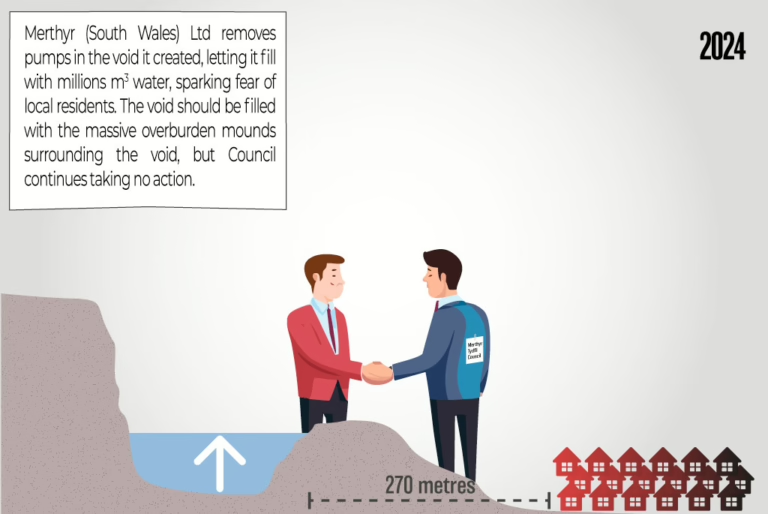
We're not celebrating the purported end of coal mining at Ffos-y-fran in Merthyr Tydfil, South Wales today. Because the abject failure of Merthyr County Borough Council to stop the past 15 months of illegal coal mining at Ffos-y-fran has resulted in:

  • Over 500,000 tonnes of illegal coal
  • Over 1.6 million tonnes of CO2
  • 362 additional deaths from climate change related causes
  • Dust & noise for locals
  • No agreement to fund restoration works

The Welsh Government, rather than stepping in to issue a stop notice to prevent the illegal coal mining, even transported the illegal along rail lines owned by the Welsh Government to customers...and continue to do so. The coal company has amassed a huge stockpile of coal at the rail terminal to continue selling off after 30th November - largely made possible by the Welsh Goverment's rail lines.

The Welsh Government's policies against coal mining are obviously not strong enough - why won't the Welsh Government take its place next to Scotland in issuing a clear ban on coal mining?

Job losses

There are around 150 workers at Ffos-y-fran who face redundancy today. Merthyr (South Wales) Ltd has let workers down. The company had many years of knowing when planning permission expired, and to retrain and support workers to find work in more sustainable industries for when that happens... but hasn't. To add insult to this injury, the company further let workers down by refusing to pay for the restoration that it's legally obliged to, and which would have provided many workers with years of work to come on site, in the green sector of nature restoration.

Restoration

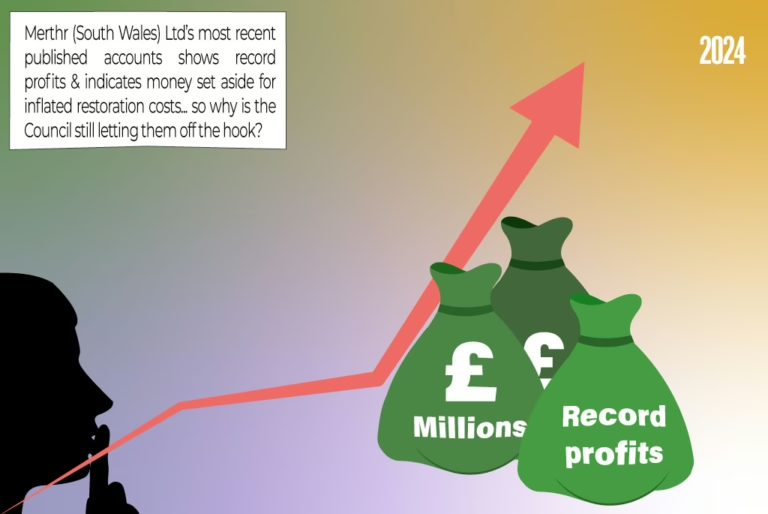
The final restoration plan promised to local residents since 2007 now hangs in the balance as the mining company makes off with bumper profits from both legal and illegal coal mining, but refuses to meet its obligation to pay for the restoration. It's siphoned MILLIONS of pounds of profits into related companies, and neither the Council nor the Welsh Government seems intent to challenge that. Local residents and the Welsh Government's own report warned the Welsh Government and Local Council nearly a decade ago of this exact risk - why wasn't that acted on? Sign our petition to demand the Welsh Government commits to delivering:

  1. a public inquiry into this debacle
  2. the original restoration promised in 2007
  3. the outright ban on coal mining in Wales that's clearly needed

We obtained a letter from the Coal Authority to the Merthyr Tydfil County Borough Council, in which the Chief Executive of the Coal Authority is scathingly critical of inaction within the Council and their handling of Ffos-y-fran. The Council must be held to account for its failings.

Protest charges

Extinction Rebellion Cymru protestors blockaded Ffos-y-fran illegal operation for over 24 hours - which is 24 hours longer than Merthyr County Borough Council managed to. Despite the illegal activities of Merthyr (South Wales) Ltd, its owner David Lewis has been left untouched. On the other hand, XR protestors were arrested, held in police cells, and have court hearings about for preventing illegal coal mining. Please donate to their legal fees crowdfunder against this gross injustice.

Published: 30. 11. 2023

Mines and Money Conference - ditch the dirty dollars, invest in our future!

We assume our invite got lost in the post...

People hailing from Cumbria to London, and everywhere in between, descended on the Mines and Money Conference in London across two days (28th-29th Nov 2023). We demanded that investors stop pouring cash into the mining sector, and instead invest in our collective future. Together with Fossil Free London and other groups, we greeted investors with flyers highlighting risks to investments in mining that mining companies want to hide—such as successful grassroots resistance to mining projects around the world.

We also heard on the grapevine that EMR Capital PTY, the ultimate owner of the proposed West Cumbria coal mine (WCM), was attending in the desperate hope of raising the £230 million still needed to start the WCM. So local campaigners from Cumbria came all the way to London to deliver a message to potential investors in WCM—steer clear! To further ruin EMR Capital PTY’s plans, they also handed investors a risk assessment, provided by BankTrack, outlining risks specific to the proposed WCM proposal. Two other coal mining companies were present at the conference too.

There’s many alternatives we must take instead of clawing the ground up to reach the minerals beneath, and that is where investment is needed. For example, we need:

  1. better closed-loop recycling and reuse
  2. new technologies and the efficiencies they can bring
  3. the eradication of planned obsolescence
  4. a reduction and prioritisation in what we consume

This would truly be ‘resourcing tomorrow’—the strapline for this year’s Money & Mining conference. Instead, the conference encourages investment in the rush for remaining minerals, fuelling human rights abuses, land grabs, destruction of local eco-systems, and climate change.

We call out the host of this disastrous conference, the Business Design Centre, which boasts its ethical ‘B-Corp’ status. You might want to raise your concerns with the certifying body about giving these hosts any kind of ethical certification (certification@bcorporation.uk), pointing out that at least three fossil fuel companies advertising coal mines and oil production were touting for investment at the conference (BHP, ADX Energy, and Teck).

Published: 29/11/2023

Q&A proposed West Cumbria coal mine questions

Concerned you don't have all the details to talk to people on the street about the proposed West Cumbria coal mine? This page gives suggestion answers to some of the more detailed questions campaigners get asked about West Cumbria Mining Ltd's plans for Whitehaven. Have a look and see if they help you feel more confident speaking about this campaign.

They serve as guide answers, you may have your own.

What is proposed?

West Cumbria Mining Ltd want to mine 2.78 million tonnes of coal a year until 2049. The company aims to produce around 64 million tonnes of coal in total, from a predominantly undersea mine.

This would result in 0.34 million tonnes of methane being released during the process of mining, and a further 200 million tonnes of CO2 when the coal is burned. The methane would account for almost 40% to the UK’s fossil production methane emissions by 2030, putting critical methane targets at risk. The CO2 is equivalent to the United Arab Emirates' total 2021 emissions.

Potential questions, with answers

"We need the coal for power stations"

The coal is destined for foreign steelworks, it’s not the type normally used in power stations. The UK got less than 2% of its energy from coal last year, we don’t need more coal to keep lights on.

"We need the coal for UK steel making"

Almost all the coal would be exported. Both the UK’s major steelworks – at Port Talbot and Scunthorpe – have confirmed they will close their coal-based blast furnaces and install electric arc furnaces which recycle scrap steel without coal. At present this scrap steel is exported to be recycled abroad and then recycled steel is reimported. There is plenty of scope to increase UK-based recycling.

"The coal would be high quality"

Coal from Whitehaven is high in sulphur and causes acid rain when burnt. So its use is restricted by the UK and European Union. This means the coal is most likely to be sold to Turkey, outside the EU – a major steelmaker with lower pollution standards.

In order to reduce the sulphur content of the coal, it would need to be either blended with low sulphur coal, like that mined in Australia, or it would need to be ‘ barrel washed’. There’s no information from West Cumbria Mining Ltd on how washing would be done, or where the polluted waste from washing would go.

"You can’t make steel without coal"

The main way that new steel is made currently uses coal, but already 9% of steel is made by Direct Reduction which doesn’t need to use coal. Direct Reduction can use hydrogen (or fossil fuels, inc. coal). Only hydrogen made from renewables can be considered green.

In the UK there are already 4 steelworks that recycle scrap steel in electric arc furnaces and 2 major steelworks with blast furnaces which use large amounts of coal. The latter are the UK’s 2nd and 3rd biggest single site emitters of CO2. The blast furnace operators have agreed to convert to electric arc furnaces and stop using coal within the next few years, with one expected to convert in March 2024.

The UK government has been investing in carbon capture and storage projects, which have been unsuccessful in capturing significant quantities of greenhouse gasses. The UK is behind other European countries on investment in new green steel technology. There are new primary steel manufacturing methods that use green hydrogen with direct reduction iron that can be utilised in the UK if there was political will.

"You still need coal in electric arc furnaces (EAF)"

Although the lobby group UK Steel says 9kg of coking coal may be used in EAF to produce a tonne of steel (versus 780kg for a tonne of blast furnace steel), other sources of carbon are possible to completely exclude coal use, using the same infrastructure.

"You can’t always use recycled steel"

In the construction industry, steel is often over-supplied by as much as 50%. We can use far less to build the same amount of things. We need to employ engineers to more accurately calculate what is needed, and reduce the amount of raw materials produced.

Steel must be part of the circular economy, alongside reducing use and reusing it before recycling, rather than extracting more materials to make ever more goods.

Companies like Volvo, and top-end manufacturers like Porche, are demanding green steel for their cars. Advances in technology mean ever more metal is able to be recycled and progress in design can reduce contaminants in scrap metal.

"It would be a carbon-neutral mine"

Coal mines are not carbon-neutral. They release methane, a powerful greenhouse gas whilst coal is being mined and release CO2 when the coal is later burned.

Once coal is brought above ground it will be burnt, as companies can make a profit. So coal mined in West Cumbria would worsen climate change through increased coal use. Mining coal in Cumbria doesn't mean it will be left underground somewhere else, as companies with planning permission will sell everything they can having already invested in mines.

The International Panel on Climate Change says that we cannot be net-zero by 2050 if we open any more fossil fuel extraction sites and that we have to close some of the existing ones.

Gold Standard is the carbon offsetting company that West Cumbria Mining Ltd intended to pay to offset emissions from its proposed coal mine by planting trees or supporting renewable schemes. However, Gold Standard responded to this intention by saying “Our claims guidelines make it clear that to make an offset claim organisations should prioritise the avoidance and reduction of emissions – something that is clearly impossible for a coalmine”. Even if an offsetting company wanted this business, the coal mine’s methane emissions would not be offset.

"The methane will be captured"

West Cumbria Mining Ltd doesn’t intend to begin collecting methane released from the proposed coal mine until 5 years after the project starts. The majority of this highly potent greenhouse gas is released when the mine is first created, so even if methane capture equipment caught and burnt 100% of methane released (which it won’t) it will be too little, too late.

"We need the jobs"

Whitehaven may need more jobs but the jobs in this mine, were it to go ahead, would be very different to those in previous local mines. The project would be technologically advanced and employ far fewer people that mines traditionally. Most likely the company would bring in foreign workers, such as Australian miners experienced with ultra-modern mines.

Unionised green jobs can be created in Whitehaven with the right government support, such as for trades people insulating the poor quality housing stock, or improving public transport and doing good for the area as well as creating work. A Just Transition for Cumbria is crucial and means that the community is put at the heart of decisions and workers are leading their industries.

"People from out of the area can’t tell us what to do"

People living in Whitehaven are also concerned about the ecological and climate impacts that this mine would have. If the mine goes ahead, the coal will worsen climate change which affects us all. No-one in Cumbria wants to be flooded by increasingly heavy rains washing away soil in fields and devastating homes, nor to experience droughts brought on by extreme temperatures. Climate change will bring both.

"It’s a local mining company"

West Cumbria Mining Ltd is 81% owned by EMR Capital, a private equity investment fund that manages various mines, with offices in Australia, the Cayman Islands tax haven, and Singapore. The head of EMR Capital used to work for the infamous Rio Tinto. The investors in the project are predominantly from Australia and the USA. There are no local offices or employees of WCM Ltd.

"Mining is our heritage"

We can be proud of our mining heritage and still want a different future.

Our world has changed since coal mining brought stable work and the community of the pits. We no longer need to risk people’s lives in mining coal seems that we know to be gassy and dangerous—we have other ways to make steel and to heat homes.

"Contamination in proposed area"

The Marchon Bank Chemical works was closed in 2005. It had been a detergent factory, as well as the largest single-site producer of sulphuric acid in Europe and the largest single-site producer of Sodium Tripolyphospate in the world. There were also phosphoric acid plants.

The land was registered as contaminated. Although nothing changed at the site, the status was removed in 2013 when the site was approved for a biomass plantation and public access.

If mining were to go ahead, it would involve removing large concrete pads locking in the contamination at the site, this presents a risk of airbourne toxins. This is a risk, especially to the people living in the hundreds of new houses built around the northern and eastern perimeters of the site.

"They only want to dump nuclear waste"

The company that is behind West Cumbria Mining Ltd, EMR Capital, is a holdings company which buys global mining projects (not just for coal) and extracts minerals. If all the permissions and contracts are in place and the project is financially viable then coal mining will happen here.

It may be possible that once the site stops being economically viable or is sold to another company, that nuclear waste from Sellafield or further afield could be dumped in the dug out areas. We can’t assume that the only reason they want permission to mine is to dump nuclear waste, the opportunity to extract coal and turn a profit is too big to be ignored for nuclear waste dumping alone.

"There’s nothing that can be done to stop it"

There is not a coal mine on this site. There is still everything to play for.

To operate the project likely needs a license for the undersea section from the Marine Management Organisation – which could take a year to get from the time of application. There are other permissions and there has to be companies – including investors and insurance companies - prepared to aid a new coal mine in the 2020s. A new government could stop the application or the current legal challenge against its permission may force a new decision.

There’s lots we can still do. The last underground coal mine to be permitted in the UK, New Crofton Co-operative Colliery, never started.

"A coal mine needs insurance"

Coal mines have to obtain insurance to operate. If there is no insurance then there is no coal mine.

Financial firms and big investors won’t put money into a project which doesn’t have insurance to ensure that their investments are protected.

Campaigning to stop the insurance of fossil fuels keeps them in the ground

More details

www.coalaction.org.uk/west-cumbria-mine/

https://slacc.org.uk

https://www.cacctu.org.uk/climatejobs

What next?

We've designed cards that you can print at home with short summaries of these answers in case you'd feel happier talking to people about the proposed mine with a reminder with you. Download here.

Good luck

5 Insurers Rule Out Insuring The West Cumbria Mine

On Friday September 15th, as insurers and banks faced a wave of national protest, Coal Action Network announced that five insurers have given guarantees that they will not provide cover for the planned controversial West Cumbria Coal Mine.

The insurers that have ruled out underwriting the mine are AEGIS Managing Agency, Argenta Syndicate Management, Argo, Hannover Re and Talanx. These are the first financial institutions to rule out any involvement with the project, and the win represents a new phase in the campaign to stop the project from going ahead.

Global Fight to End Fossil Fuels on September 15-17th saw half a million people joining protests across the globe to call for a just transition away from coal, oil and gas in history, making it the largest climate mobilisation since the start of the pandemic. Over 400 actions, marches, rallies, and events took place around the world, coordinated by more than 780 endorsing organisations with millions of participants taking part. In the UK Protests took place in London, Manchester, Leeds, Sheffield, Birmingham, York, Wrexham, Cardiff, Shrewsbury and Croydon. Hundreds of campaigners from Extinction Rebellion, Mothers Rebellion and Coal Action Network took to the streets assembling with banners and placards, at the doors of financial institutions, yet to rule out supporting the proposed mine.

They were joined by Buddhist and Quaker groups and other members of the local community. Some groups took part in theatrical actions, dressing as canaries to draw the link between the birds used in mines and the toxicity this mine will bring, while others held silent vigils.

Ffos-y-fran: timeline of illegal coal mining

Published 25. 05. 23 Updated 22. 10. 2025

Coalition backing a coal mining ban in Wales

Over 30 Welsh NGOs and businesses call on Welsh Government to finally ban coal mining on Welsh soil.

Over 30 Welsh NGOs and businesses have signed a letter to Welsh Minister Julie James and Deputy Minister Lee Waters, demanding they draw a line in the sand and announce ban on any further coal mines on Welsh soil. The letter was sent to the Welsh Government on 11th October 2023.

Application to extend coal mine highlights existing policies causing confusion

The Welsh Government already has policies against new and extended coal mines but these are caveated and confusing. The renewed call for a clear coal mining ban comes less than a month after existing policies would have failed to stop a recent bid to reopen the shuttered Glan Lash opencast coal mine in Carmarthenshire. The coal mining company, Bryn Bach Coal Ltd, applied to double the size of the coal mine over six years. Controversially, Carmarthenshire County Council’s Planning Officer advised Councillors in the Officer’s Report, and at the Planning Hearing, that "Overall, it is considered that the proposals would largely meet the criteria of the coal policy" (p66). Ultimately, the application was rejected on the grounds of local ecological impacts—but it has exposed the weakness of existing policies, with the Planning Officer adding that it is “difficult to know for certain how to interpret the coal policy” (p66).

Call to follow Scotland’s coal mine ban

The open letter coincides with the first anniversary of Scotland’s announcement of its own de facto ban on coal mining, in October 2022. Daniel Therkelsen, campaigner at Coal Action Network says “The Welsh Government faces a choice—align itself with the backtracking and flip-flopping of the UK Government, or regain its international leadership position alongside Scotland, as a progressive country of confidence and stability for green industry to thrive.

Minister Julie James recognises resources being wasted

Welsh Minister for Climate Change, Julie James, wrote a letter to the UK Government in October 2021, lamenting the current policy situation, which “results in both the developer and the Coal Authority committing significant resources respectively to preparing and determining applications”. NGOs and businesses that signed the open letter to Ministers Julie James and Deputy Minister Lee Waters are calling for a clear coal ban that clears up the confusion Carmarthenshire Council identified and the caveats that creates uncertainty and potentially wasted resources for coal mining companies, such as Merthyr (South Wales) Ltd, which also applied for an extension in September last year but was conversely rejected due to the Welsh Government’s coal policies by Merthyr Tydfil County Borough Council.

Opinion

Daniel Therkelsen, Campaigner, Coal Action Network: “The Welsh Government has said their position is ‘clear’, that ‘they want to bring a managed end to the extraction and use of coal’—but their jigsaw of policies on coal is as clear as the coal dust that continues to plague communities living around mines in South Wales, ban new coal mines and extensions and be done with it. Nothing about a ban would prevent access by the Coal Authority to address safety issues.”.

Extra reading...

Overview and key facts on Glan Lash opencast coal mine extension application. The extension application was to extract a further 95,038 tonnes of coal (more than the original coal mine, licenced for just 92,500 tonnes).

Key Welsh Government policies relating to coal extraction include:

Planning Policy Wales (Edition 11) s.5.10.14 “Proposals for opencast, deep-mine development or colliery spoil disposal should not be permitted. Should, in wholly exceptional circumstances, proposals be put forward they would clearly need to demonstrate why they are needed in the context of climate change emissions reductions targets and for reasons of national energy security.”

Minerals Technical Advice Note 2: Coal “Government policies and planning guidance on the provision of coal have previously been set out in Mineral Planning Guidance Note 3 (MPG3) published in 1994 for England and Wales. MPG 3 (1994), apart from the Annexes, was cancelled by MPPW. This MTAN supersedes the 1994 Annexes, which are hereby cancelled… This coal MTAN sets out how impacts should be assessed and what mitigation measures should be adopted, and seeks to identify the environmental and social costs of coal operations so that they are properly met by the operator.”

Coal policy statement, 22 March 2021: “The opening of new coal mines or the extension of existing coaling operations in Wales would add to the global supply of coal, having a significant effect on Wales’ and the UK’s legally binding carbon budgets as well as international efforts to limit the impact of climate change. Therefore, Welsh Ministers do not intend to authorise new Coal Authority mining operation licences or variations to existing licences. Coal licences may be needed in wholly exceptional circumstances and each application will be decided on its own merits, but the presumption will always be against coal extraction.”

Published: 10.10.2023