BACK TO TOP

The Planning Playbook:

A guide to challenging extractive applications near you

Download the PDF or scroll down to read online

FOREWORD

This guide draws on 18 years of organisational knowledge fighting opencast coal mine applications. This was always shoulder-to-shoulder with local communities trying to preserve their local environment, way of life, and often motivated by the looming threat of global climate chaos.

Coal Action Network has existed since 2008. It started out as a few committed activists, with a founder working many unpaid hours, living in their van, and staying in the communities we worked in. This guide is thanks to their dedication. At the start, we were opposing about 40 live applications for new opencast coal mines and extensions. Now there are none.

We have witnessed first-hand the power of committed local campaigns successfully stop applications despite the deep pockets of developers and a planning system tilted in their favour.

The threat of opencast coal mines in the UK is hopefully over – but many of the tactics we learned along the way can be used for most extractive planning applications, from a tungsten mine to a quarry. We offer this guide to any group navigating the planning system to oppose an extractive development in their community.

"Never doubt that a small group of thoughtful,
committed citizens can change the world: indeed,
it’s the only thing that ever has."

- Margaret Mead

Methods of opposition

Forming a local campaign group

A local campaign group is just a group of people coming together in an area to campaign on a shared issue. After the issue passes, the group can stop meeting – or can go on to campaign on other issues that might matter to the group. Below is a summary of advice for forming and maintaining your local campaign group – but there is lots of advice on the internet. We recommend this guide.

Fundraising

Unlocking the planning system

Pre-application

Application

Planning decision 'call in'

Judicial reviews

Getting legal advice

Published 23. 06. 2026

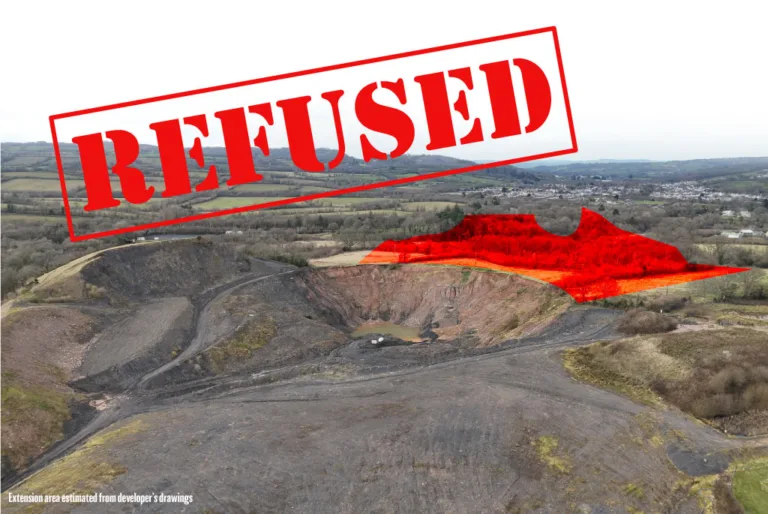
Glan Lash opencast extension refused...again

Carmarthenshire County Council has rejected Bryn Bach Coal Ltd’s second attempt to expand and extend the currently dormant Glan Lash opencast coal mine, amidst hundreds of hand-written and online objections from residents in the county (see below for a small selection). The decision reflects a clear, strategic commitment to climate leadership, rare habitat protection, and safeguarding the health of surrounding communities. There are no live applications for new coal mines, and only two active coal mines remain in the UK – a large, underground coal mine in Aberpergwm, Glynneath and a small underground coal mine called Ayle Colliery in Northumberland. There is further a proposal (pre-application stage) to mine the Bedwas coal tips of waste coal.

Emissions

The proposed expansion was the mining company’s second application following unanimous rejection by Councillors of the company’s first application in September 2023. The second application reduced the amount of coal to be mined from 95,000 tonnes to 85,000 over 5.4 years, with a slightly smaller area to be excavated. However, the latest application remained incompatible with Wales’ coal and protected habitats policies. Rejecting this application has prevented the release of hundreds of thousands of tonnes of CO2 and methane, as well as exhaust emissions from years of heavy machinery. The would-be commercial buyers of this coal – as listed by the mining company – sell anthracite coal to burn on the international market, and undermining the mining company’s claims that coal mined at Glan Lash would not be burned. Selling Glan Lash coal on the international market would fuel dependence abroad on the world’s number one dirtiest fossil fuel, whilst the UK itself transitions to greener, cleaner industry and air quality.

Habitats

Beyond emissions, an independent ecologist’s report outlines in stark terms how the mine expansion would have destroyed a further 2.5 hectares of woodland, including sections of listed ancient woodland, as well as over 400 metres of precious hedgerow habitat. It also would have delayed the excavated area’s restoration (which planning permission originally required to be delivered in 2019) by a further 5.4 years. The mining company originally committed to start restoring the site in 2018, but delayed this with successive attempts to extend mining instead. These delays have coincided with the deterioration of protected habitats on the site such as those supporting the threatened Marsh Fritillary butterflies, whose numbers have plummeted across the UK by 64% since just 2005. This refusal paves the way to finally require the company to return the land for the benefit of nature and local communities.

30m to the nearest house

With the closest homes just 30 metres from the edge of the opencast site, the application was also clearly incompatible with the 500-metre minimum buffer zone required by Welsh Government policy to protect surrounding communities from excessive noise, dust, and air pollution and disturbance.

Welsh and UK policy

Carmarthenshire Planning Authority’s decision reflects alignment with the Welsh Government’s positions on coal, climate, and nature recovery, the UK Government’s commitment to prevent new coal mining licences, and the international movement to phase out coal.

King’s Speech Summary: Support for coal tip mining ban

Earlier this month, the King’s Speech marked a major milestone for our campaign for the introduction of legislation which will ban new coal mines. The Government formally announced the Energy Independence Bill, and with it a commitment to ‘Implement the manifesto commitment to end new coal licenses’. This is a breakthrough that Coal Action Network has specifically been working towards for over two years and is a significant step forward, but our work is far from finished.

Coal tip extraction

The Bill, as currently framed, does not categorically include a ban on coal extraction from coal tips, despite significant support for its inclusion. Our legal advice shows clearly why clarification is needed with amendments to the Coal Industry Act and how to amend the Act with the upcoming legislation. Strengthening the Bill to include a full prohibition remains our top priority as it moves through Parliament.

King's Speech Debates

Following the King’s Speech, both Houses began several days of debates on the Government’s programme. Across the Commons and the Lords, MPs and Peers have not only welcomed the commitment to end new coal licences but have also highlighted the need for the legislation to go further by specifically addressing coal tip extraction. Their interventions show a growing cross‑party understanding that a credible coal phase‑out must cover all forms of extraction.

We are grateful to the following Parliamentarians for highlighting coal tips in their speeches:

Steve Witherden MP

"I welcome the commitment to ending new coal licences in the coal licences Bill. While Wales’s coalfield communities can rightly be proud of their heritage, it is vital that we now protect them from the environmental and social harms of further extraction. That is essential for those living near the Bersham colliery spoil tip in Rhostyllen, in my constituency. Given that private companies are now seeking to mine coal tips, which would inflict the same issues on communities, this type of extraction should also be prohibited."

Ann Davies MP

"The King’s Speech includes the new coal licensing ban, which is welcome. However, as I have raised before in Parliament, the proposed ban in its current form does not guarantee the prevention of commercial extraction of coal from coal tips in Wales. The Government should bring measures forward to close this loophole so that companies can never profit from the more than 2,500 tips, containing millions of tonnes of coal between them."

Lord Wigley

"Long-lasting bitterness arose when profits from coal were rarely used to Wales’s benefit, yet we were left to clear up the mess and live with dangerous tips. Please will the energy independence Bill ensure that the full costs of removing or securing remaining coal tips are not lumbered on to the Welsh Government, nor left to private companies to work residual coal in a largely unregulated way?"  


Published 25. 05. 2026

Ben Hodge-McKenna on reopening Welsh coal mines

As part of our Politics Unspun series we are unpacking politicians' public comments on coal to challenge any misleading or incorrect messages.

Todays' focus is on comments made in a BBC interview during the Senedd election campaign about coal mining in Wales. During the interview, Reform UK candidate in Afan Ogwr Rhondda, Ben Hodge-McKenna, made some statements about coal mining which we would like to address as part of this series.

Reviving coal mining in Wales would not support the UK’s future energy demands

Mr Hodge-McKenna claimed that reopening Welsh coal mines could help meet the UK’s energy needs. However, the UK no longer operates any coal‑fired power stations and the country’s energy strategy is now centred on renewables, storage, and electrification. Coal has not been a major part of the UK energy mix for almost a decade and Welsh coal cannot substitute for modern low‑carbon energy systems. Reopening mines would not contribute to UK energy security.

Sacrificing jobs in Wales – are we?

"It doesn't make sense for us to be sabotaging our economic policy and sacrificing jobs in Wales when you have other countries around the world that are ramping up,"

Reopening mines now would not recreate the large, long‑term workforces of the past. Modern mining is highly mechanised, and any jobs created would be limited and short‑lived, particularly due to the decreasing demand for coal in the UK. Aside from this though, the UK Government will soon legislate a prohibition of new coal mining licences, making new mining activities impossible approve in Wales or anywhere in the UK.

In contrast, Wales’s growing renewable energy sector offers larger, more stable employment opportunities which offer long term jobs in an expanding industry to workers today and in years to come.

Welsh emissions are lower than other countries – We should still act

Mr Hodge-McKenna said he understood the concerns about climate change, but the emissions that are produced in Wales on a global scale "are absolutely minuscule" meaning any changes would have "virtually no impact".

Regardless of other countries ramping up their coal production, it is in our own economic interest to pursue a clean energy future. All countries could, and some do, avoid taking action because of larger current or historic emissions being produced by another country. Wales can only control its own coal production and be the example to other countries as to how to transition in a just way which benefits workers, communities and the climate.

Safer contemporary conditions do not justify more emissions

"I don't think anybody's talking about sort of going back to the 70s or 80s and reopening mines in the conditions that they were previously. But if there are commercial opportunities to enjoy the natural resources that we have then we shouldn't be automatically closed off to any options without at least giving them a fair consideration,"

While safety standards in coal mining have improved, this does not address the core issue: coal is the highest‑emitting fossil fuel. The UK’s climate commitments require rapid reductions in emissions, and new coal extraction would run counter to those goals. Additionally, Wales still faces safety risks from legacy coal infrastructure, such as abandoned opencast sites and unstable tips which require ongoing management.

Improved safety conditions in mining do not change the environmental and climate impacts associated with burning coal.

Published 24. 04. 2026

Take action - End new English coal

The Government is reforming planning policy in England and thanks to thousands of our supporters asking for an end to coal extraction in the last consultation in 2024, they are now recommending that planners "should not identify new sites or extensions to existing sites for peat or coal extraction". The Government is now running a consultation on its latest draft which includes this wording.

So it's time for our supporters to take action again and prove that the Government is well supported to prohibit coal extraction. If we flood the consultation with supportive submissions for this particular policy, we will certainly drown out any pro fossil fuel voices seeking to change the Government's mind.

Please take two minutes of your time to send our template submission by the deadline of 10th March 2026.

Published on 27. 01. 2026

Mining company sells out local communities to keep record profits

Merthyr (South Wales) Ltd illegally mined coal at Ffos-y-fran for over a year, profiting from record coal prices. Now, it wants to keep all the profits by trying to downgrade the restoration plan, breaking its promise to the 60,000 residents of Merthyr Tydfil, South Wales.

Take action by 02/04/2026!

Your objection means much more if it's put in your own words why you want Merthyr Tydfil Council to refuse the application to downgrade this huge restoration project. Here's some points you might choose to include, or go straight to the objection form:

  1. Residents deserve not to worry about a million cubic metres of polluted mine water above them, with just a road between that and them.
  2. Residents deserve not to worry about 37 million cubic metres of colliery spoil across the 3 coal tips less than 3 miles from the 1966 Aberfan disaster.
  3. Residents deserve not to worry about their kids playing near a sheer cliff edge with 100m drop into a flooded mine.
  4. Residents deserve to receive the quality of restoration promised to them.
  5. Commoners deserve to have their rights and grazing land restored to them in full.
  6. The State of Nature Wales 2023 report outlined a nature emergency in Wales - we cannot afford this downgrade.

This will take you to the Merthyr Tydfil Council's short objection form.

Published: 28/02/2025  |  Updated: 09/01/2026

2026 must be the year that new coal extraction will be banned

In November 2024, the new UK Government announced its intention to legislate a ban of new coal mining licences – which we welcomed. Over a year later, the legislation is yet to be introduced, and the Government is not planning to include all types of extraction.

2026 needs to be the year that ALL coal extraction is banned. Here’s Why that is, and How it can be done:

WHY 2026 is crucial?

May’s local authority and devolved Government elections will possibly see gains for pro coal candidates. This could result in local authorities across the UK and possibly even the Welsh Government being run by Councillors and Members who are part of a party that has stated its aim to re-open coal mines. While this is impossible in many circumstances; Britain’s 5,000 coal tips are within reach.

The current Welsh Government’s Coal Policy adds a level of scrutiny to potentially prevent coal tip extraction, but a new Government could abandon this policy and approve many of Wales’ 2,590 coal tips to be mined if they have been given approval by local authorities. In England, only local authorities need to approve coal tip extraction- using the same framework which Cumbria County Council used to approve the West Cumbria coal mine.

With more local authorities likely to be led by pro coal Councillors, now is the time to ensure that ALL types of coal extraction are treated equally, banned nationally and that the ban is legislated before any coal tips are approved to be mined by local authorities.

HOW can it be done?

Coal Action Network commissioned leading environmental Barristers Rowan Clapp and Estelle Dehon KC to draft the precise wording of amendments to the Coal Industry Act 1994. This advice showed that relatively minor amendments could be made whilst legislating the coal licence ban to achieve this aim. This advice has been shared with the Government.

Referring to the coal policies of devolved Governments, Energy Minister Michael Shanks told us during a Westminster Hall debate in October; “Their firm view is that they can bring into effect the aim of the Welsh Government and the UK Government to make sure that extraction of coal is a thing of the past. Their view is that their existing powers do that.”

Coal Action Network does not agree that existing powers do prevent further extraction due to the reasons mentioned above. Therefore, we are reaching out to Westminster and the devolved Governments. The Welsh Government in particular needs to consider the wider implications of banning coal tip extraction across the UK. While their coal policy could prevent 2,590 coal tips in Wales from being exploited whilst it is adhered to by a Government which seeks the end of coal; their advocacy for the inclusion of coal tips in this Westminster legislation could almost double their impact by expanding that ban to the other 2,400 coal tips throughout the rest of the UK.

Elected Members can take action

Members of Parliament

  • Ask when the Government plans to introduce the coal licence ban legislation. Request that it is introduced in 2026 - particularly as Colombia hosts the world's first fossil fuel transition Conference in April.
  • Welsh MPs can write to the Welsh Government asking it to advocate for the Westminster coal licence ban to include coal tips.
  • English MPs can highlight to DESNZ that the National Planning Policy Framework (NPPF) could still allow the extraction of coal tips. Hence the need for the coal licence ban to include our suggested amendments.
  • Scottish MPs can write to the Scottish Government asking it to advocate for the Westminster coal licence ban to include coal tips.

Members of the Senedd

  • Ask the Welsh Government to advocate for the Westminster coal licence ban to include coal tips. They should do this for two reasons:
    • To expand the impact of the Welsh coal policy beyond Wales’ 2,590 coal tips to all 5,000 coal tips across the UK.
    • To safeguard against the possibility of pro coal parties taking power at local and national levels, in Wales and the rest of the UK.

Members of the Scottish Parliament

  • Ask the Scottish Government to advocate for the Westminster coal licence ban to include coal tips. They should do this for two reasons:
    • To expand the impact of Scotland’s position against coal extraction to protect all 5,000 coal tips across the UK from being mined.
    • To safeguard against the possibility of pro coal parties taking power at local and national levels, in Scotland and the rest of the UK.
Published: 3. 12. 2025

Where our coal comes from

UK industries still hooked on coal

Despite 2024 being a momentous year for UK coal mining and use, the fight's not over.

The UK steel and cement sectors (and to a lesser extent, bricks) are the largest users of coal following the closing down of the UK's last coal-fired power station in September 2024. But tried and tested alternatives to coal exist. Check out our coal dashboard for our most recent coal stats including an industry break-down. We support the UK Government's commitment to ban new coal mines opening in the UK - but this must be accompanied by a commitment to rapidly wean domestic industry off coal by adopting existing alternatives. Failing to do this simply off-shores the dangers and localised environmental harm of coal mining to where it's out of sight. This kind of practice marked the British colonial period, where some of the dirtiest and most grueling work was forced upon colonised countries, to supply and develop the UK. Continuing this pattern is called 'neo-colonialism', and the UK must avoid this by de-coaling domestic industry.

Consequences of importing coal

As the UK no longer produces thermal coal, the type used by the cement industry (and to a lesser extent in the steel industry), 1.78 million tonnes was imported in 2024 – primarily from Colombia and South Africa, two countries plagued with poor track records in coal mine-based health and safety, forced displacements of communities, and killings of environmental defenders. Without a plan to decisively and rapidly wean cement works off coal, the UK is open to accusations of perpetuating neocolonial patterns of trade.

Cerrejón coal mine, Colombia

How the coal arrives into the UK

Coal is shipped from abroad to the UK's major coal ports, then ferried up river to further inland coal stocking areas. From here, coal is loaded on trucks and cargo trains to cement works, Scunthorpe steelworks, and to coal merchants.

Major commodity traders are essential to global shipments of coal by organising logistics and buying coal from coal producers and selling it to consumers. These international traders include the likes of Javelin Global Commodities and Jera Global Markets. Sometimes there are additional middle-men such as Hatfield Energy, responsible for a significant amount of the coal imported into the UK - likely bought on the open market from international commodity traders. Unfortunately, banks' coal-exclusion policies open exempt commodity traders, meaning these cogs in the fossil fuel machine still receive £millions in finance.

How the coal is used, and its alternatives

Published 24. 11. 2025

A stainless future for steel?

WORLDWIDE

Carbon footprint

The steel industry produces 9-11% of the annual CO2 emitted globally, contributing significantly to climate change. In 2024, on average, every tonne of steel produced led to the emission of 2.2 tonnes of CO2e (scope 1, 2, and 3). Globally in 2024, 1,886 million tonnes (Mt) of steel were produced, emitting in the order of 4.1 billion tonnes CO2e (75% of which are direct emissions). This is largely due to the reliance on ‘coking’ coal in blast furnace primary steel production.

Coal-free steel pathways

Four of the five biggest global steel producers aim to reach carbon neutral steel production by 2050. This would be through a combination of using ‘electric arc furnaces’ (EAF) to recycle scrap steel into secondary steel products, and a newer technology called Direct Reduced Iron that replaces coal with natural gas or hydrogen in primary steel making. The hydrogen option could be generated from renewables but relies on the roll-out of much more renewable generation capacity and massive green hydrogen infrastructure, which has so far received little of the huge investment required. So where this new Direct Reduced Iron technology (also requiring significant investment) is being used, it’s generally with natural gas instead. Those steelworks could be switched to hydrogen in the future, if the price of green hydrogen drops to a competitive level and the infrastructure to get the hydrogen to steelworks is built.

Threats to coal-free steel decarbonisation

There is a global over-supply of steel, primarily generated by China which produced 54% of global output in 2023. This has reduced the price that steel can be sold for to the point that many steelworks are running at a loss, supported by government subsidies to continue operating. This threatens the very significant private sector investments needed into green steel production as the industry’s current position makes a profitable return on that investment unlikely. A blast furnace can continue for 15-20 years before undergoing a ‘relining’ (refurbishment) process to extend its life further. Relining can cost 25-50% of the cost of a new blast furnace, but still amount to hundreds of £millions. Due to the long life and large capital investments, it’s essential that investments now are in greener steel-making processes or the world will be ‘locked in’ to CO2-intensive steel-making for many years to come.

UNITED KINGOM

In 2024, UK steel production made up 32% of domestic consumption and was responsible for 13.4% of GHGs from manufacturing, and 2.2% of total UK greenhouse gas emissions. The vast majority of this footprint is due to the coal burned at Scunthorpe steelworks. With the UK Government rightly ruling out any new coal mining projects in the UK, it is vital that UK steelworks becomes coal-free. Switching domestic coal mining for coal mining abroad would perpetuate colonial patterns of trade where the impacts of extractive industries are off-shored.

UK primary steel-making is wholly dependent on imports for the two main resources needed to make steel: ‘coked’ coal and iron ore. Coal needs to be ‘cooked’ in ‘coking ovens’ before it becomes coked coal capable of burning at very high temperatures required in blast furnaces. The UK closed its last coking oven in Port Talbot in March 2024. Since then, UK primary steel-making has depended on other countries to process coal in coking ovens before being imported into the UK.

The UK’s largest steelworks, Tata Steel UK’s Port Talbot steelworks, recently closed its blast furnaces, which had come to the end of their operational life. With £500 million from the UK Government, Tata seized the opportunity to shift from making coal-based blast furnace primary steel to using electricity to recycle scrap steel into new secondary steel products instead.This technology is called an ‘electric arc furnace’ (EAF). Although the transition should have had more Union and worker involvement, the conversion to EAF is a pragmatic move given the UK’s scrap steel surplus, the financial losses being made in the blast furnace steel production, and the UK’s net-zero commitments. Four of the UK’s other steelworks also recycle scrap steel using EAFs. The fifth is British Steel’s Scunthorpe steelworks, which still produces coal-based primary steel, and so is the second biggest single site source of CO2 in the UK.

Scunthorpe steelworks

Scunthorpe’s blast furnace steelworks needs to decarbonise to remain competitive, improve local air quality, and avoid fuelling climate chaos. Before the UK Government took partial control of the steelworks around April 2025, the operators – Jingye Group – claimed financial losses of £700,000 per day. Additionally, customers – who will soon face mandatory carbon reporting – may increasingly choose to import lower carbon steel from other European countries like Sweden and Spain who are pursuing low-emission primary steel production. The current options for Scunthorpe steelworks are:

1) convert to Direct-Reduction Iron technology to produce primary steel

2) convert to recycling scrap steel in a EAF to produce secondary steel products.

Producing secondary steel option would be much cheaper, but politically difficult as it would mean the loss of many jobs and the loss of the UK’s primary steel-making capacity. Find out more about the technology options below:

Read more about coal in steel in our 2021 report.

The role of coal in different kinds of steel production

Blast furnace primary steel production: Metallurgical-grade coals converted to ‘coke’ which has a dual role in a blast-furnace, providing the required heat and creating a chemical reaction with iron ore reducing it to ‘pig’ iron which is heated with other additives (including small quantities of existing scrap steel) to make steel.

Electric arc furnace secondary steel production uses 99% less coal than blast furnaces per tonne of steel produced by using electricity to melt down scrap steel to make secondary steel products, with small quantities of coal added to remove certain impurities. In countries, such as the UK, which generates a large share of its electricity through renewables, EAFs have a much smaller carbon footprint than blast furnace steel production. The UK currently produces a surplus of scrap steel, exporting it to EAFs abroad. Having greater EAF capacity in the UK will keep the scrap here, and the jobs it supports. Steel is – in theory – an endlessly recyclable product, but when it’s fused with other metals and materials, or has other properties added to it, it can be challenging to recycle it in EAFs into high-grade metals needed for certain applications, even with small quantities of coal added to remove certain impurities.

Direct reduced iron (DRI) primary steel production: is an emerging alternative to blast furnaces where natural gas or hydrogen replaces the role of coal in heating and reducing high-grade iron ore down to iron, ready for primary steel-making in an electric arc furnace. There are successful commercial test-cases for this technology, such as HyBrit in Sweden which uses hydro-generated green hydrogen to make steel. However, green hydrogen is prohibitively expensive, currently, so DRI facilities tend to use natural gas whilst being “hydrogen ready”. DRI production also makes capture rates for CCS much higher than a blast furnace.

Action needed

It is vital that the forthcoming UK Government’s green public procurement policy for construction and Carbon Border Adjustment Mechanism should be sufficiently robust so as to support UK low-emission steel to compete with cheaper higher emission steel imports. Together, this should add confidence within the British steel sector that the UK Government’s public procurement pipeline will be a pipeline that supports domestic industry.

The UK Government must take action to secure the UK’s production of virtually coal-free secondary steel-making:

  • The UK Government’s steel safeguard Tariff Rate Quota expires in June 2026 – but the UK’s Carbon Border Adjustment Mechanism is not expected to be implemented until 2027. The UK Government should introduce stop-gap measures to prevent high-carbon steel imports causing carbon-leaking and undermining investment to produce greener steel in the UK.

  • The UK Government should engage in honest conversations now with unions and workers at the loss-making Scunthorpe Steel Works regarding the future of steel-making at the site. EAFs are currently the only financially viable technology to replace the coal-fed blast furnaces currently in operation. That would result in job losses but this can be a just transition with enough time to allow for proper planning, union and worker involvement, and funding. This should be followed with a commitment to add DRI primary steel production by mid-2035 as the technology and green hydrogen are expected to become more financially viable.

Published 12. 11. 2025

Westminster Hall debate - Coal tip safety & the coal licence ban

Westminster Hall debate about coal tip safety and the prohibition of new coal extraction licences

Last month we worked with Members of Parliament from various parties on a Westminster Hall debate about coal tip safety and the prohibition of new coal extraction licences.

The debate happened 59 years and one day after the Aberfan tragedy which killed 116 children and 28 adults. Rooted in this context, the debate highlighted the need to prioritise coal tip safety whilst also preventing the extraction of coal from these tips.

Welsh coal policy loophole

Plaid Cymru MP, Ann Davies, led the debate and highlighted that because of increasingly violent storms caused by climate change, we have experienced further coal tip slips’. This is an important point in this debate as the further exacerbation of climate change, via the extraction and use of more coal, would lead to further slips.

She added ‘The UK Government have pledged to ban new coalmining licences, but they have confirmed their belief that re-mining coal from the tips does not require a licence, meaning that such activity falls outside the scope of the proposed ban. Although the Welsh Government believe that their own planning policies will prevent re-mining, a loophole allowing coal extraction in “wholly exceptional circumstances” has raised concern’.

Failures of mining companies

Labour MP, Gerald Jones, discussed mining companies failing to comply with their legal obligations – a danger which could happen again with coal tip extraction. He used the example of the Ffos - Y - Fran opencast mine in his constituency: ‘When it first opened, the company running the mine, Merthyr (South Wales) Ltd, pledged to fully restore the site after it finished operations. I call on it to honour that pledge.’

Renewal not nostalgia

Liberal Democrat MP, David Chadwick, reflected on the Reform party policy to re-open the pits earlier in the year. A move which, in many cases is not possible, but would be a clear abandonment of our responsibilities to future generations. He said: ‘The people of the south Wales valleys have given more than enough, and we are still waiting for our new south Wales to emerge. We deserve safety, fairness and a future built on renewal, not nostalgia.’

A dangerous precedent

Labour MP, Steve Witherden, made a passionate and precise demand that the Government include coal tips within its coal licence ban: ‘Mining companies offering to remove coal tips in return for commercial access to coal is an easy answer to a difficult question, which we cannot allow, so I ask the Minister this. If the Government truly believe that the Welsh Government’s coal policy and England’s and Scotland’s planning policies are robust enough to prevent coal extraction, why do investors think otherwise? ERI Reclamation is actively seeking to extract 468,000 tonnes of coal from tips in Bedwas, Caerphilly. It clearly believes that the law allows that, and it is putting serious capital behind the belief. If this is approved—it is an “if”—it could set a dangerous precedent, whereby private profits determine which coal tips are removed and others, with less content, are left. It would be a precedent categorising coal tips by their value rather than their potential impact on public safety. Could we see landowners, burdened by maintenance costs, encouraged to sell access to these sites?

We cannot and must not rely on the private sector to make coal tips safe. That duty falls on us. The Government’s coal licensing ban must be strengthened to include coal tip mining.’

Amending the Coal Industry Act

Liberal Democrat spokesperson for energy security and net zero, Pippa Heylings MP, eloquently highlighted Coal Action Network’s legal advice which shows how to include coal tips in the coal licence ban: ‘In practice, extracting coal from a tip is no different from open-cast mining. The method is the same, the disruption is the same, the risks are the same and the emissions are the same. The contradiction can be easily resolved. Leading environmental lawyers, working with the Coal Action Network, have proposed an amendment to the Coal Industry Act 1994 to clarify that the mining of coal from coal tips also requires a licence. That small change would ensure that the Government’s coal ban is comprehensive and future-proof.’

The Government's view

Energy Minister, Michael Shanks MP, concluded the debate, summarising that ‘We acknowledge the suggestion to make this type of coal extraction a licensable activity under the MRA, which would allow for a licensing prohibition, but our view is that the current planning policies around the regulations set by devolved Governments already provide robust frameworks.

We are a Government who believe in devolution. We created devolution in Scotland, Wales and Northern Ireland because we believe in devolving power to those authorities, so they are closer to people and to individual circumstances. It is right that we take their lead on these questions. Their firm view is that they can bring into effect the aim of the Welsh Government and the UK Government to make sure that extraction of coal is a thing of the past. Their view is that their existing powers do that.’

Summary

While we at Coal Action Network hope that the Minister’s faith in devolved powers to make coal extraction a thing of the past is well founded; we fear that a different Welsh Government could have an opposing aim and would be able to achieve that under current circumstances. The English National Planning Policy Framework (NPPF) was also not considered by the Minister, which allowed the West Cumbria coal mine to gain planning permission and would also allow coal tip extraction throughout England’s coal fields.

We would like to thank each of the Members for taking part in the debate and making the case for banning coal tip extraction.

Coal Action Network will continue to campaign for the inclusion of coal tip extraction in the coal licence ban.

Published: 6. 11. 2025