We welcome everyone, regardless of life or organising experiences, in this space. We believe each of us has something to contribute to the struggle for climate justice, and much to learn from others.
We are committed to creating a space where everyone is treated as equal, and people are not afraid to speak, ask for questions, and contribute to discussions. We seek to see our differences as just that, differences not ways to drive us apart.
We define oppression as any behaviour that demeans, marginalises, threatens or harms anybody. We collectively commit to challenging it, whether it shows up in language, or actions. If anyone were to display such behaviour towards others, the organisers will take a course of action discussed between them and those who have suffered from the behaviour. This might include talking to the perpetrator, soliciting an apology, or - in some scenarios - asking the perpetrator to leave the space.
We are aware of the range of different identities that people might bring to this space, including - but not limited to - genders, races, religious, classes, sexualities, abilities. We don’t make assumptions about people. This is a trans-inclusive space, and we respect people’s chosen use of pronouns. If you are unsure about people’s names or pronouns, ask, offering yours.
In particular, we take into account these principles:
Consent. We do not assume that our own physical or emotional boundaries are the same as someone else’s. Ask for explicit consent before talking about sensitive topics.
Be aware of your own privileges. Societies has raised us with hidden hierarchies, which play up in organising spaces. Actively challenge them. Be aware of how much space you are taking, and who you are excluding as a consequence.
Calling out. If you are being called out because of your behaviour, listen and reflect, even though your first reaction might be of defending yourself.
Learning. Ask if you don’t understand something, but don’t expect an immediate explanation. Don’t assume that people with lived experiences of oppression will answer you. You might be redirected to a resource, such as a book or a website. We all have responsibility to do our own learning, and if able to, talk about it with others.
Labour. We are all expected to contribute something to our struggle. It is ok to make mistakes, and to ask for help if needed. Thank people for the work they have done. Also consider what tasks you are taking up, and why - those can be reflective of your privilege. For example, it is a societal expectation that women do housework, which can reflect into women taking up more tasks such as cleaning, or cooking.
Security. Take into account that online organising spaces are not safe. During physical gatherings, we cannot guarantee the absence of journalists, or even undercover police officers. Don’t talk about something that could put you or other people at risk of harm.
Community accountability. We are all accountable for respecting these principles. If you notice something in breach of this policy, raise it with the safer spaces policy rep: daniel@coalaction.org.uk
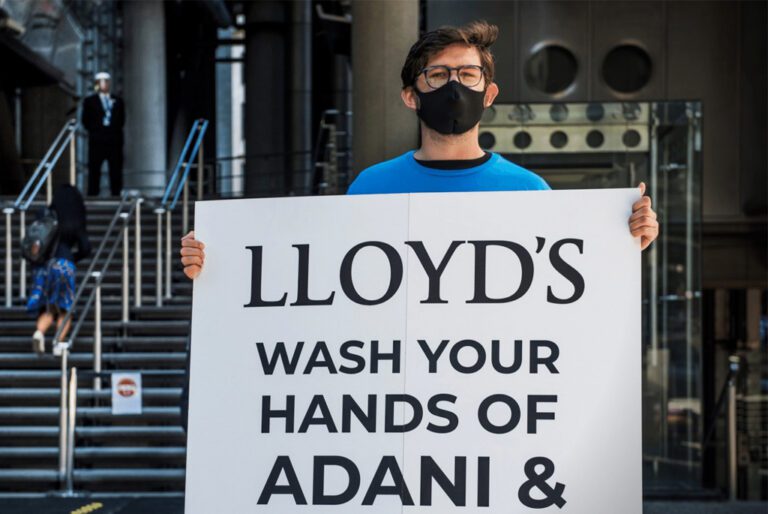
Right now, Lloyd’s of London is insuring climate wrecking coal mines, tar sands pipelines and power stations, across the world. Insurers can single-handedly stop fossil fuel projects, but have failed for decades to take action in the face of a climate emergency.
Lloyd’s accounts for 40% of the total global energy insurance premium and is a key influencer in the global insurance industry. Send Lloyd’s a message to act on the climate emergency, not act as the last refuge for climate wreckers to secure insurance!
Even in a year of lockdowns and restrictions, people across the world are standing up to Lloyd’s, and it’s working.
Leading the charge has been the #StopAdani movement in Australia. They have pushed most of Lloyd’s insurers to rule out insuring a coal mine that would open up the Galilee Basin and potentially more than double Australia’s current coal exports.
Adani's proposed coal mine is the most environmentally and socially contentious project in Australia's history, the object of years-long resistance from the Wangan and Jagalingou Traditional Owners and the broader community.
Just days after 750 people in the UK joined the Stop Adani movement by writing and calling Lloyd'd insurance companies, the extra pressure helped convince Brit to rule out insuring the Adani coal mine. Now the Stop Adani moment has asked us to pile the pressure on another key Lloyd's insurer - Hiscox.
Hiscox are rumoured to be sitting on an unreleased coal policy, that could see them stopping insuring all new coal mines. We want them to realise their policy ahead of the 3rd March, when they announce their annual profits.
Help #StopAdani get in touch with top Lloyd's insurer Hiscox now!
Get in contact via Hiscox via LinkedIn, Phone or even Google calenders!
Welcome to the bottom of the barrel! If you have a risky, slow, expensive project, the big insurance companies won’t insure you alone. So you go to Lloyd’s. Lloyd’s is an insurance marketplace. Within the marketplace are lots of small insurance companies. When you bring your project to Lloyd’s, Lloyd’s goes to each of the small insurance companies, cobbling together the insurance that you need, spreading the risk of your project out.
There are only a few Lloyd’s insurers who have failed to rule out insuring Adani, such as Arch, Brit and Hiscox.
Once you've signed up we'll give the numbers and a suggested script to help you with the call.
Some numbers are marked as LEAVE MESSAGE, these you won't speak to anyone but will have a chance to leave a message for when they get back in the office. If you are happy to speak to someone in person then you can call the ones marked SPEAK IN PERSON. If you have got time to both that would be great.
We're looking for a new team member to work with us October 2020 - April/May 2021!
You'll play a key role in accelerating the end of coal-fired power in the UK, in a way that strengthens the environmental justice movement and centres communities on the front lines of extraction.
You'll have experience of sustained grassroots campaigning and/or community organising with or in support of communities and have a proven commitment to climate justice.
We can train you up in practical campaign skills, and we hope we can learn a lot from you as well.
Before you apply
Please download the Recruitment Pack and read the Job Description and Person Specification carefully. We will offer you an interview based on the extent to which you meet the Person Specification.
RECRUITMENT PACK contains all the details about the role including the Job Description and Person Specification. Read this before you apply: Recruitment Pack_Campaigner Maternity_Coal Action Network
EQUAL OPPORTUNITIES MONITORING FORM: Please complete and return with your application: Coal Action Network Equality-and-diversity-monitoring-form
To apply
Please send the following to isobel@coalaction.org.uk no later than midnight 24.09.20
1. A covering letter (maximum 2 pages) to explain:
How you meet the Person Specification, giving examples of your experience.
Why you want to work with Coal Action Network as Campaigner (Maternity Cover)
2. Name and contact details of two referees
3. Completed Equal Opportunities Monitoring Form
Please do NOT send us a CV with your application.