On 15th September 2023, The Guardian reported that Tata Steel accepted Government funding to avoid closing its steelworks in Port Talbot, South Wales, by decarbonising it instead – but at a loss of up to 3,000 jobs.
The UK Government is providing £500 million, and Tata Steel is expected to provide another £725 million. Most of this money will go to converting the sprawling steelworks from its current Basic Oxygen Furnaces to Electric Arc Furnaces. The former produces virgin steel from iron ore, heavily relying on coal for the chemical reaction. Electric Arc Furnaces recycles scrap steel without needing coal. Currently, the UK exports a considerable quantity of scrap steel abroad (over 8 million tonnes in 2021), and scrap steel is expected to greatly increase in abundance globally.
Port Talbot steelworks is currently the 2nd highest source of CO2 from any single site in the UK. Transitioning this steelworks is expected to make a significant impact on the UK’s emissions. Steelworks around the world contribute 11% to global greenhouse gas emissions… rapid decarbonisation globally is essential to limit climate chaos and, alongside electric arc furnaces, alternatives are under development and testing that removes coal from the process of making virgin steel.
However, steelworks employ many thousands of people around the world, whose labour has been essential for everything from vehicles and renewable energy infrastructure to household appliances. It’s essential steel workers and their unions are centred in the changes needed to decarbonise steelworks to ensure a just transition that doesn’t leave these workers behind. The planned decarbonisation of Port Talbot Steelworks has been reported not to follow the principles of a just transition. Instead, the company has reportedly shut unions out of its negotiations with the UK Government and there aren’t any reported programmes of retraining or support packages to equip workers facing redundancy with realistic prospects of finding alternative work that suits their experience or ambitions.

Steel companies in Europe may be amongst the first to decarbonise their steelworks, so it is essential they set a good example for steel companies elsewhere to follow. European steelworks, therefore, must meaningfully engage with their workers and workers’ Unions from the outset of plans to decarbonise steelworks, focusing on those most impacted by potential changes. We are sceptical of top-down consultations on changes which often have foregone conclusions—engagement must be in the form of equal partners around the table. For workers, this can have the advantage of securing packages of support that are appropriate for their needs, whether that is to stay within the company or gain employment in another industry. Worker creativity may also reduce their own job losses and impacts—if they are able to meaningfully shape the transition process. Companies benefit from the creative capacity of workers who have on-the-ground expertise, greater trust in the changes ahead, reputational impacts, better worker morale and loyalty, and the wider fallout that structural unemployment can drive.
British Steel, the UK’s only other producer of virgin steel and operated by Jingye, is also considering converting its steelworks to electric arc furnaces in the hope of accessing hundreds of million in Government funding to decarbonise the steelworks. British Steel has secured a £100 million contract to build one of the world’s biggest offshore wind plants being built at Teesworks. We hope that Jingye actively involves workers at British Steel, and their unions, from the outset of any plans to transition its steelworks.
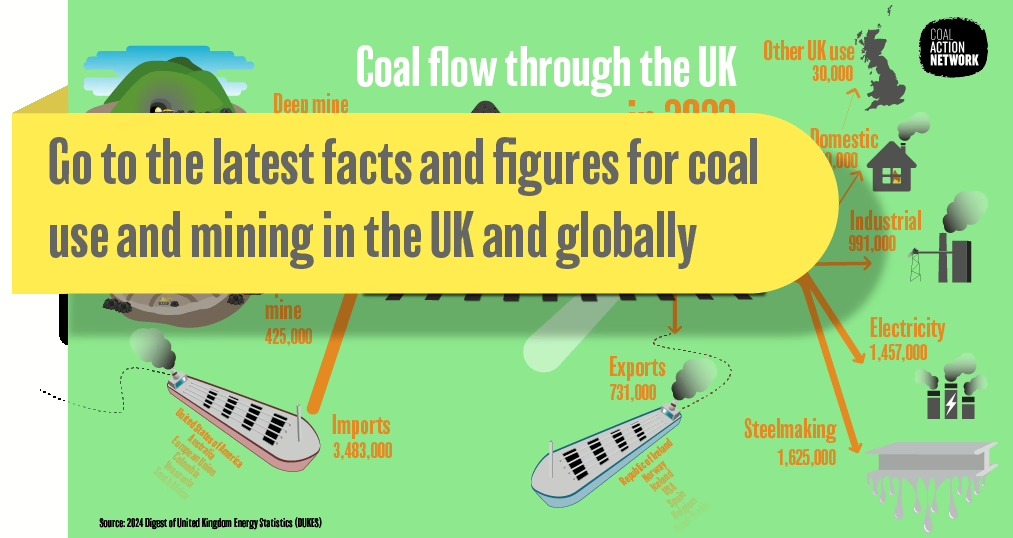
The recent Digest of UK Energy Statistics shows the coal situation for 2022. All unreferenced statistics come from this report and appendices.
Coal was bought by power stations last year in order to fulfil unexpected, short term contracts with the government worth £420 million to extend power station's lives while air quality environmental regulations were not enforced.
In 2022, coal mined in the UK mainly came from opencast coal mines. Production was down on previous years. Now, in September 2023, there is only one operating opencast coal mine, the illegal Ffos-y-fran mine. There is one significant sized deep coal mine; Aberpergwm colliery in Neath Port Talbot, which has been granted permission to expand. From this date there is only one coal power station available to generate electricity, down from 4 last year.
While overall energy demand in 2022 was stable compared to 2021, demand met by coal in the energy mix fell by 15% compared to 2021, to 1.60% of total electricity supply. Wind, solar and hydro energy production rose to a record high level due to increased capacity and more favourable weather conditions, but unfortunately consumption of both gas and nuclear energy were also up.
Coal use in power stations has dropped dramatically since 2012, when 43% of electricity in the UK grid was produced from coal combustion. However, 4 coal power plants remained operational throughout 2022. Drax and West Burton power station's coal units were due to be closed before the end of 2022, but the UK Government paid £420 million to extend the operational lifespan of the coal units over winter 2022 into 2023. Coal stocks were 10% higher than in 2021 to facilitate this. Drax didn't operate in 2022 and is now decommissioning its coal units. It remains a high carbon power station, though, as it burns imported wood as biomass.
4 coal power stations operated in 2022. Now only Ratcliffe-on-Soar remains available to the grid.
Ratcliffe on Soar power station is due to close in September 2024.
In early 2020, Drax power station said there would be "formal closure of the coal units in September 2022". Decommissioning actually started in 2023, after the UK Government paid the power station to be on standby with coal during last winter. Drax did n't operate in 2022 and is now decommissioning its coal units. It remains a high carbon power station as, though, it burns imported wood.
Kilroot coal and oil power station in Northern Ireland is to be converted to gas. It was expected to stop consuming coal in September 2023, but this may have been brought forward marginally (unconfirmed).
West Burton coal power station closed at the end of March 2023 delayed by the UK Government from September 2022.
Coal phase-out in the UK is expected by October 2024. Given that coal consumption in power stations is very low, with periods of no consumption, in the summer, the last generation could be April 2024.
In 2022, coal production fell by 39% to a record low of 0.6 million tonnes, with opencast coal mining producing more than underground mines.[1]
The Scottish Government announced a de-facto ban on coal mining in October 2022, in protest against the expected approval of the Whitehaven coking coal mine. We anticipate this stopped a deep coal mine application by Australian company New Age Explorations at Lochinvar in the Scottish borders. The company hoped to produce coking coal via underground mining until 2044.
Campaigns against proposed underground mines
Aberpergwm Colliery (Energybuild Ltd) in Neath Port Talbot had planning permission for a 42 million tonne extension to its underground (anthracite) coal mine approved in 2018. The Coal Authority issued the coal company a license to extract this coal in January 2022. Coal Action Network are taking legal action against the Welsh Government for failing to stop the mine extension being licenced.
Woodhouse Colliery proposed by West Cumbria Mining Ltd had its proposal for a new 1.78 million tonne per year underground coking coal mine off Whitehaven approved by the Secretary of State in December 2022. The planning approval is subject to 2 legal challenges which are expected to be heard by the High Court in early 2024.
There are now no legally operating opencast coal mines in the UK.
Glan Lash opencast coal mine, Carmarthenshire (South Wales), had an extension application rejected in September 2023.
In September 2022, Ffos-y-fran opencast coal mine in Merthyr Tydfil, was due to close after 15 years of operation. However, the mine has continued to operate with little action from the local council or Welsh Government. It is now expected to close at the end of Nove mber 2023, with no meaningful restoration of the land expected, as the company did not set aside the money to fulfil its contractual obligations in this regard. The guarantee bond of £15 million to be used in case this happens is far short of the estimated £120 million needed for restoration as per the original plan. The coal mining was originally approved by Welsh Government in 2005 as a way to restore a brownfield site at no cost to the public purse, an outcome that now appears remote.
Hartington opencast coal mine, Derbyshire closed at the end of Spring 2023.[2]
Coal imports rose 38% in comparison with 2021 to 6.4 million tonnes in 2022 as power stations rebuilt stocks after the UK Government payments over winter. The import quantity had been decreasing prior to this government intervention.
In 2022, the USA was the largest exporter of coal to the UK, supplying 39%. This was followed by the Russia with 16%. Russia’s proportion of total coal imports had fallen from being the largest supplier at 43% in 2021.
Coal from the USA was fairly evenly split between coking coal for steelworks and thermal coal for power stations.
Coal from Russia was largely for power stations.
Australia provided 12% of imported coal. 57% of which was for power stations, the rest for steelworks. 10% of coal came from South Africa, which was entirely for power stations. Colombia supplied 7% of imported coal all to power stations.
The European Union supplied 9% of all coal to the UK. This coal is unlikely to have been mined in the EU, it has most likely lost its identity as coal enters and leaves the main coal ports in Europe. Other countries made up the remainder of the imported coal.
There are 4 major UK steel producers, 2 of which are using coking coal and produce much higher emissions than the two which recycle scrap steel.
Tata Steel
Port Talbot steel works, in Neath Port Talbot, Wales, is the second biggest UK single site emitter of carbon dioxide.[3] The plant currently uses coking coal to make steel in blast furnaces. In 2022, Tata Steel said the plant had to decarbonise or close. In September 2023, Tata Steel accepted £500 million from the UK Government to transition to electric arc furnace, but job losses are expected.
British Steel
Currently, British Steel’s Scunthorpe plant can use a maximum of 25% to 30% recycled content using Basic Oxygen steelmaking. It currently uses coking coal but is also looking to secure governmental subsidies to build a new electric arc furnace to replace a blast furnace in efforts to decarbonise.
Liberty
Liberty Steel, which has sites in Newport and in Tredegar, has said it aims to become a carbon-neutral steel producer by 2030. The site currently uses Electric Arc Furnaces and recycles scrap metal so does not use coking coal.
Celsa
Celsa’s Cardiff steelworks uses 100% recycled scrap steel in its products and so does not need coking coal.
For more details see our report Coal in Steel.
[1] compiled from Coal Authority, "Production and Manpower Statistics" for 2022
[2] Gov.uk "Coal mining production and manpower returns received by the Coal Authority April to June 2023." (July 2023)
[3] Ember, Coal Free Kingdom (13th November 2019) and Drax Group, Enabling a zero carbon, lower cost energy future page 39 (2019)
Queries and media contact: info @ coalaction . org .uk (without spaces)
References
[1] compiled from Coal Authority, "Production and Manpower Statistics" for 2022
[2] Gov.uk "Coal mining production and manpower returns received by the Coal Authority April to June 2023." (July 2023)
[3] Ember, Coal Free Kingdom (13th November 2019) and Drax Group, Enabling a zero carbon, lower cost energy future page 39 (2019)
Queries and media contact: info @ coalaction . org .uk (without spaces)

On the 14th September, a crowd of local residents and supporters assembled on the steps of Carmarthenshire County Council offices. This was on the day of a key decision meeting on the application to extend the Glan Lash opencast coal mine by 6.1 years to mine a further 95,000 tonnes of coal.
So many people came in to the planning committee meeting that the Chair exclaimed “I can see the gallery is comfortably full and that hasn’t happened for many a year!”.
After some presentations, Councillors then voted unanimously to refuse the application, to loud applause. We celebrate that 6.5 hectares of trees, hedgerows, and fields were spared destruction in the refusal of this application. As Cllr Thomas said in the meeting, “Speaking as a farmer…nothing grows [after restoration], the structure is gone… History shows the land never comes back to what it was. I second this proposal to recommend refusal”. This refusal stops any further delay to the restoration of the area already opencast, and creates a commitment to a cleaner, greener Wales.
Cllr Peter Cooper said “We’ve had it for too many years to have the opencast. I’ve worked in opencast. Believe me, the dust - you clean your windows one day, and the next it’s bad again. It will affect them all. I don’t think it’s right that people should have to put up with this again, these people. It’s not necessary.”
Cllr Russell Sparks added “We have no alternative, given the evidence presented to us today to refuse the proposal.”
Coal Action Network will continue to monitor what happens next, but we hope Bryn Bach Coal Ltd will respect the expert conclusions about the local ecosystem destruction from an extension, local democracy, and the 826 written objections to the extension application from local residents. The company should begin work on restoring the site immediately to the specification promised.

The Planning Officer’s Report lends much weight to Bryn Bach Coal Ltd’s (BBCL) claim that most of the coal will be sent to non-burn end-use. BBCL has increased the proportion of coal it claims will go to non-burn end-use in successive versions of its application, without justification for these shifting proportions. The reality is that market conditions and the highest price would determine to which industry the coal would be sold. BBCL could at any time sell the mining rights to another company, as occurs at many coal mining sites, and that new company might choose to sell to other industries or export the coal as the Whitehaven proposal intends to. According to the BEIS Conversion Factors 2022, industrial application of the 94,900 tonnes of coal could total up to 229,000 tonnes of CO2.
Fugitive methane (a potent climate change accelerant) is released from directly from coal mines. Methane that escapes from coal mines globally must fall 11% each year until 2030 to meet IEA’s Net Zero 2030 Roadmap and avoid climate chaos. For each year of the proposed extension, researchers at Global Energy Monitor estimate 108 tonnes of methane will be released into the atmosphere at Glan Lash – totalling some 659 tonnes of methane. Increasing rather than decreasing this globally significant source of methane emissions breaches the IEA’s Net Zero 2030 Roadmap and does not conform to a globally responsible Wales.
The Planning Officer’s Report correctly identifies the shortcomings of the proposed replacement habitats, not least that new plantings are not commensurate with established habitats and the ecosystems they support, but the report stops short of pointing out that the habitats are unique and are not interchangeable and the criticisms of bio-diversity offsets. By way of crude analogy; someone who’s always lived in Carmarthen would not consider it the same if they had their house destroyed in Carmarthen but told they could move into another house in Merthyr Tydfil. We also highlight the Report’s reference to CCC’s independent ecologist’s point that equivalent biodiversity support from a newly planted woodland habitat (assuming it flourishes) will never catch up to that of the destroyed 2.48 Ha woodland habitat, had it not been destroyed – and that it would take 137 years to achieve what is currently supported. We question what the species of animals currently living in the existing habitat are to do for over a century in the intervening period. In a time of widespread habitat pressure, there isn’t clear evidence that animal life can be supported by neighbouring habitats to return later. Local populations, once wiped out, may never return. Growing climate change stresses on ecosystems necessitates established and robust habitats, existing biodiversity cannot wait 137 years for an established habitat. We do welcome the Planning Ecology Department’s determination that permitting this mine would be incompatible with both the Welsh Government and Carmarthenshire County Council declarations of a Climate and a Nature Emergency, as well as their respective responsibilities under the Well-being of Future Generations (Wales) Act 2015.
Over 600 letters from Carmarthenshire residents have been sent to the Council in opposition to the opencast coal mine application and a demonstration is planned outside the Council building on the day of the decision meeting to show local support for a greener, kinder future.
The Planning Officer’s Report refers to the company’s claim that the washery and coal mine would employ 11 staff (3 new jobs) for the duration of the proposed extraction and the restoration period following cessation. We want to emphasise that 8 of those jobs, as well as the indirect jobs, are not dependent on the proposed coal mine extension but rather on the washery which has been operating without Glan Lash coal for years. So just 3 new, time-limited, jobs in a declining industry are at stake, and these would be required to restore the site for a period anyway. Jobs planting trees over jobs ripping them up.
Published: 13/09/2023

As thousands of visitors travelled into Cumbria for the busy August bank holiday they were met with a powerful statement: 25 large banners opposing the proposed new coal mine near Whitehaven with the words ‘NO TIME for a COAL MINE’.
The banners, which targeted all the major roads leading into Cumbria on Friday 25th August were unfurled by new anti-coal action group ‘No Time for a Coal Mine’. Leaflets were handed out in in Kendal, Carlisle, Keswick, Kirkby Lonsdale and Penrith and fly posters also appeared.
It is the latest in a series of actions against the proposed 2.78 million tonne-a-year mine which has met with significant local, national and international opposition.
Continues...
Sarah McGowan who was born in Whitehaven and took part in the action says, "We can all see the impacts of climate change. In Cumbria the summer has been a washout since June, while on the Hawaiian island of Maui people escaped firestorms by jumping into the sea. Meanwhile the IPCC has said we simply cannot afford to permit any new coal mines, the UK government is flying in the face of reason. Our banners show the strength of feeling against the coal mine and our determination to keep the coal in the ground. The mine must be stopped.”
West Cumbria Mining Ltd is looking to extract a total of 67 million tonnes of coking coal from under the seabed off Whitehaven right up to 2049. The vast majority of this coal would be exported to foreign steelworks, as it is too high in sulphur to comply with UK and European air pollution regulations.[1]
Continues...


Of the two existing UK steelworks using coal, Tata Steel alone could tolerate small amounts of coal from Whitehaven. Tata Steel is currently negotiating with government for subsidies to decarbonise, ending coal use, or it has threatened closure. If the project goes ahead, the Cumbrian coal would emit more than 200 million tonnes of CO₂, primarily from its use in blast furnaces. Its extraction would result in the release of around 334,000 tonnes of methane even if mine methane capture equipment is used (901,000 tonnes without capture).
So far, 2023 has seen the hottest global temperatures for June and July in recorded history. Hundreds of millions of people across the USA, Europe and Asia have been hit by extreme heat while deadly wildfires have raged through southern Europe, Canada, Russia, Hawaii and beyond.
Continues...


The government’s approval of this proposed mine faces two legal challenges, that was due to be heard in the High Court in October 2023. This has recently been delayed pending the outcome of a recent Supreme Court case relating to the oil wells at Horse Hill, Surrey (Finch v Surrey County Council). Both cases relate to consideration of end-use emissions in the Environmental Impact Assessment. If the Supreme Court decides that end-use emissions should be considered, this would greatly increase the chance of the government’s decision on the proposed mine being revoked.
Increasing global temperatures threaten food and water security for many millions of people, endanger lives and will
increase mass migration as areas around the world become uninhabitable. Globally, it is those who have done the least to cause the climate crisis who are already suffering the most.
The banners show the strength of public feeling against the government’s coal proposal, and highlights that there are many people prepared to take action to ensure that the coal remains underground at Whitehaven.
Reference
[1] Cumbria County Council Executive Director - Economy and Infrastructure, Development Control and Regulation Committee Application Reference No:4/17/90077.17


FIRST... Coal mining ban proposed by House of Lords
With a margin of 3 votes (197 for vs 194 against) in the House of Lords on 17th April 2023, Lord Teverson amended the Energy Bill to include a new clause on the 'prohibition of new coal mines' (a ban on the Coal Authority licencing any new coal mining in the UK). This wouldn't stop any coal mines already licenced, and would only apply 6 months after the bill had been passed - but it would cut off the pipeline of new coal mine applications. Just one Conservative Lord voted for this amendment - Lord Deben, Chairman of the UK's independent Committee on Climate Change.
Lord Teverson referred to the Whitehaven coal mine, approved in December 2022, when proposing the amendment, saying "If that happens once, it can happen again - that is why this amendment is so important," he said. He had previously believed a ban was not necessary because it was "totally and absolutely obvious" that building a new coal mine "would be a really stupid thing for a country to do".
THEN... Coal mining ban stripped out by UK Government
Back in the House of Commons, the UK Government Ministers stripped out the amendment banning new coal mines at the Committee-stage, before the revised Energy Bill could be debated and voted on in the House of Commons. MP Caroline Lucas said the Government's approach was "well and truly stuck in the last century...after endlessly repeating the importance of no new coal at COP26, its words have proved to be meaningless". Shadow energy secretary Ed Miliband had said Labour would back the ban.
Opposing the amendment, minister Lord Callanan said the government was committed to phasing out coal but argued that an outright ban could cause a "severe weakening of our security of supply".
NOW... Coal mining ban re-proposed by MPs Chris Skidmore & Wera Hobhouse
In the report stage, Conservative MP Chris Skidmore and Libdem MP Wera Hobhouse have attempted to re-introduce the coal mine ban by tabling similar wording as Lord Teverson's amendment to be put back into the Energy Bill (clause N2). MP Chris Skidmore also seeks to strengthen the UK Government's earler commitment to phase out coal being used to generate energy by tabling another clause (N3) - a prohibition of energy production from coal by 1 January 2025. This would change put the UK Government's policy commitment into legally-binding legislation, making it much harder for this or successive Governments to back-track on that commitment.

Amongst other important ammendments, the wording of the two amendments your MP needs to support are:
NC2 Tabled by: Chris Skidmore & Wera Hobhouse
To move the following Clause—“Prohibition of new coal mines
(1) Within six months of the day on which this Act is passed, the Secretary of State must by regulations prohibit the opening of new coal mines and the licensing of new coal mines by the Coal Authority or its successors.
(2) Regulations under this section are subject to the affirmative procedure.”
NC3 Tabled by: Chris Skidmore
To move the following Clause—“Prohibition of energy production from coal
(1) The Secretary of State must by regulations provide for the UK to cease energy production from coal from 1 January 2025.
(2) Regulations under this section may amend primary legislation (including this Act).”
The report stage for the Energy Bill is currently scheduled for Tue 5th September 2023, the day after the House of Commons returns from summer recess, at which point MPs will debate the various amendments tabled to the Energy Bill. The amendment will almost certainly be debated, however there’s no guarantee that it will be pushed to a vote – this depends on a range of different factors, including MPs’ priorities and whether the amendment is selected by the Speaker for a vote.
THE ASK: write to your MP, asking them to speak in favour of amendment NC2 and NC3 during the debate, and to vote for it, if it is "pushed to a division".

We are now able to reveal correspondence between Welsh Minister for Climate Change, MS Julie James, and then UK Government Minister Minister of State for Energy, Clean Growth
and Climate Change, MP Greg Hands. In a letter dated 07 January 2022, Minister Greg Hands states:
"I do agree that the Coal Authority’s statutory duty to promote an economically viable coal industry, as set out in the Coal Industry Act 1994, is at odds with our climate leadership ambitions and policies on coal so we are looking at measures to review that duty. I understand our officials have agreed to meet to share our thinking on a future licencing regime that reflects our different administrations net zero and climate change goals."
The amendment(s) proposed by MP Chris Skidmore (and Wera Hobhouse) would achieve what Greg Hands admits is necessary to meet the Government's climate commitments. So why did the UK Government remove Lord Teverson's amendment to achieve the same? What has the UK Goverment done to change the "future licencing regime"?
Welsh Labour Minister for Climate Change in the Welsh Government Julie James wrote to then Secretary of State Department of Business, Energy & industrial Strategy Kwasi Kwarteng in the UK Government on 26 October 2021, stating:
"...we consider the statutory duty of the Coal Authority to develop and maintain a viable coal extraction industry must be removed if we are to achieve our policy ambitions." adding "I seek to understand how the [Coal Industry] Act will be amended to reflect the need for the Coal Authority to consider climate policy in its decisions". Julie James is looking for reform rather than dissolving the Coal Authority, saying "....the Coal Authority has an important role to play in rapidly winding down remaining mining operations and delivering long-term environmental protection. In doing so, the Coal Authority has an important role in ensuring those communities affected by the legacy of coal mining receive a just transition."
Welsh Labour clearly indicate the need to reform the Coal Authority in a way that would stop new coal mine applications being licenced and support existing operations winding down, with a just transition for workers involved.
The need for law change: This year, Coal Action Network took the Coal Authority to the Cardiff Courts in a judicial review challenging the Coal Authority's insistence that it cannot consider matters such as climate change in determining whether to award a coal mining licence. The judge agreed with the Coal Authority, which confirms that legislative reform of the Coal Authority is needed to bring its licencing function in line with climate commitments - such as that proposed in amendment NC2 to the Energy Bill.
Time's running out: Since senior UK and Welsh Government Ministers admitted the need to cut off the pipeline of new coal mining applications, both the UK and the planet experienced its hottest ever days (2022 & 2023), June 2023 was the UK's hottest ever, and July 2023 was confirmed the hottest month worldwide since records began, and this year the world has been rocked by wild-fires, flooding, and storms. So the sense of urgency to ban coal mining and use has become even stronger.
Security of supply concerns: Alongside increasing this escalating urgency, TATA Port Talbot steelworks announcing it will imminently transition to recycling steel or else face closure, and British Steel reporting it will close its coke ovens. A credible home insulation plan would remove any energy security issues for keeping warm this - and future - winters, rather than spending more of my tax money propping up dirty coal power stations again. These are the only significant consumers of coal remaining in the UK so there is no energy security case to be made for continuing to mine coal in the UK.


On 15th and 16th March, Coal Action Network took the Welsh Government and Coal Authority (UK regulator of coal mining) to the Cardiff Court in a judicial review over their respective handling of the Aberpergwm application to extend workings by up to 42 million tonnes of coal and until 2039.
On the 19th of May, The Hon. Mrs Justice Steyn DBE decided in favour of the Welsh Government and Coal Authority, but granted us permission to appeal the decision about the Welsh Government less than 2 weeks later, on 31st May. Our court hearing for the appeal will be 06th February at the Cardiff Court!
The grounds for this appeal are:

This drone footage shot on 06 April 2023 shows plainly the local environmental impact of the Glan Lash opencast coal mine, and sends a powerful message to Carmarthenshire's Councillors, expected to make a decision in the coming months on whether to allow this local environmental travesty to expand in size and continue for longer. See our quick read on the application. Want to go on a deep dive on the Glan Lash coal mine? Read our report.
The Glan Lash opencast coal mine has been dormant since 2019. Restoring the site will provide employment and environmental benefits. From Carmarthenshire? Email your Planning Councillors through our form below, urging them to make the right decision.
You did it! Permission was refused on 14/09/23 by unanimous vote, after 826 residents objected!
Completing our contact form sends your message to all 20 Councillors on the Carmarthenshire Planning Committee, Council, and us.
Will Councillors reject the application to expand and extend the Glan Lash opencast coal mine, learning from the huge challenges that Merthyr Tydfil County Borough Council is having with the illegal Ffos-y-fran opencast coal mine?
Put into your own words why you want Carmarthenshire Planning Committee to reject the application - here's some points you might choose to include:
Wrth gwbhau ein ffurflen cyswllt mae eich neges yn cael ei anfon i bob un o’r 20 Cynghorydd ar y Pwyllgor Cynllunio Sir Gâr, Cyngor, a ni.
Bydd y Cynghoryddion yn gwrthod y gais i ddatblygu ac ymestyn y pwll glo cast agored Glan Lash, dysgu o’r sialensau anferth mae Cyngor Bro Sir Merthyr Tydfil yn cael gyda’r pwll glo cast agored anghyfreithlon Ffos-y-Fran?
Rhowch yng ngheiriau eich hyn pam yr ydych chi eisiau i Pwyllgor Cynllunio Sir Gâr i wrthod y gais - dyma rhai pwyntiau gallwch ddewis i gynnwys:

The hearing of two legal challenges against the government's approval of a 2.78 million tonne a year coking coal mine has been delayed from October, likely into the new year.
Part of both challenges rely on the outcome of a separate judgement from the Supreme Court. A judgment is due on that landmark case, over the decision to allow oil drilling at Horse Hill in Surrey, brought by campaigner Sarah Finch on behalf of the Weald Action Group. The Horse Hill challenge was heard by the Supreme Court in June and the court has not yet given judgment.
According to Friends of the Earth "lawyers for Ms Finch argued that the environmental impact assessment (EIA) carried out by developers before planning permission was granted should have accounted for the climate impacts from burning the oil extracted at Horse Hill. These are known as ‘downstream’ or ‘Scope 3’ emissions and were not accounted for during the planning process."
"Downstream emissions are increasingly being left out of environmental impact assessments when planning applications are made for fossil fuel projects, despite the huge climate impacts these projects will inevitably create, the mounting climate crisis and the UK government’s stated commitment to net zero."
"If Ms Finch’s challenge is successful, with the court potentially ruling that decision makers need to take into consideration downstream emissions before approving planning applications, the outcome of the Horse Hill case could have major implications for the future of the Whitehaven coal mine. It could open up new grounds for lawyers to argue against the mine’s approval on the basis that downstream emissions were not considered."
"The Supreme Court is not expected to give its judgment until autumn 2023 at the earliest. When that does eventually happen, the High Court will then set a date for the Whitehaven hearing, but there is likely to be a gap of at least ten weeks between judgment and hearing. Lawyers for Friends of the Earth and SLACC therefore believe a 2024 Whitehaven hearing is increasingly likely." Further details from Friends of the Earth can be read here.
Originally the two legal challenges by South Lakes Action on Climate Change (SLACC) and Friends of the Earth were rejected. Then it was decided that the cases will be heard at what’s known as a ‘rolled up’ hearing which in practice this is the same as a trial. As long as permission is given in day one, the trial will last for three days. This was planned to take place 24th to 26th October 2023. This will now not be heard until a later date.
Friends of the Earth and SLACC launched their legal challenges in January 2023 after Michael Gove, Secretary of State for Levelling Up, Housing and Communities, gave planning permission to the new coking mine in December 2022. The organisations were the 2 main parties opposing the coal mine at the planning inquiry which took place in September 2021.
SLACC and Friends of the Earth contend that Mr Gove failed to account for the significant climate impacts of the mine, including the acceptability of carbon credits to offset the mine’s emissions, the international precedent that opening a new mine would set and the impact of opening the mine on the global coal market. For further details of the challenges see https://www.coalaction.org.uk/2023/01/27/legal-challenges-whitehaven/
With support from the Good Law Project, we have filed for a Judicial Review against both the Local Council and Welsh Government’s continuing failure to stop Ffos-y-fran, the UK’s biggest opencast coal mine, selling off over 1,000 tonnes of illegal coal each day right under their noses and to the harm of local residents, the surrounding environment, and our climate.
Even more scandalously, the Welsh Government has been profiteering by transporting this illegal coal along its railways over the past 11 months, to be burned by various customers in direct breach of its own climate commitments and policies against coal extraction.
Good Law Project has joined the fray, and are supporting us to finally stop the environmental onslaught of Ffos-y-fran with a judicial review. This has allowed us to assemble a crack legal team from Richard Buxton Solicitors, and Barristers’ Toby Fisher and James Maurici KC. Please share and donate to Good Law Project’s Crowdfunder (and check out their website, we could gush over all their work).

We are optimistic the legal pressure we’ve just heaped on will finally put a long-overdue end to what should never have happened in the first place. As with our judicial review (and now appeal!) of Aberpergwm deep coal mine, we shouldn’t have to undertake costly legal action to force the Welsh Government to fulfil its obligations to the current and future generations, in Wales and across the world.
See our Statement of Facts and Grounds (PDF) summarised below -
Coal Action Network is seeking to have judicially reviewed:
The grounds of claim are:
Coal Action Network is seeking a hearing on the first available date after 20 August 2023 to determine the following remedies:
After that, we’ll be campaigning for:
But what we must do now is to stop the daily environmental onslaught of the coal mine, producing equivalent to c4,000 tonnes of CO2 every day – or the average daily emissions of 175,000 people living in Wales, which is around 3x the population of Merthyr Tydfil itself! Imagine burning 1.75 MILLION litres of petrol every single morning – that’s the amount of CO2e this coal mine has been allowed to add to our atmosphere every day so far, illegally and without consequence.
Together, you, us, local residents, Good Law Project, and a network of Welsh groups like FOE Cymru, Climate Cymru, and XR Wales will prevail and put an end to this climate calamity any way we can. Let’s show the Council and Welsh Government how it’s done – time to roll up our sleeves and shut this mine down.

Let’s get it done