Coal on trial in Wales: the right to choose a coal-free future
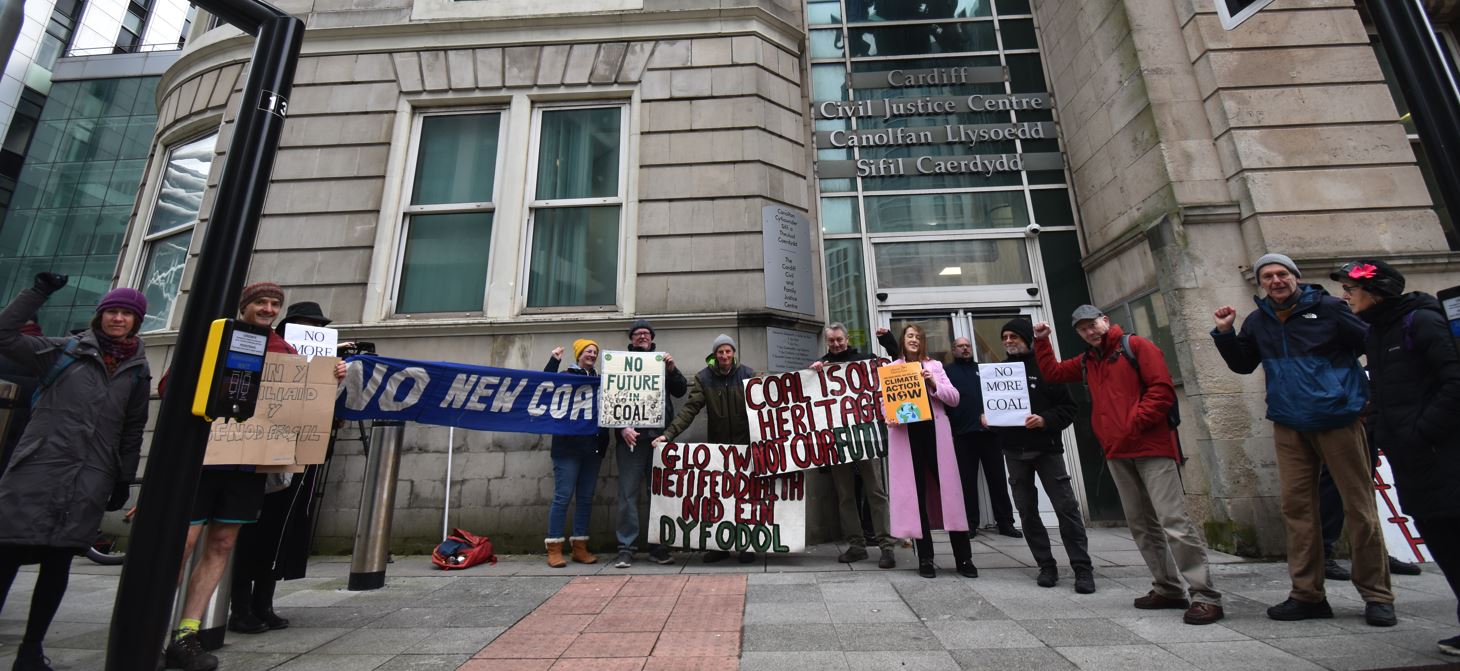
We arrived outside the Cardiff courts to press teams and a strong demonstration in support of our case for a more sustainable future in Wales and the UK—one that cannot have coal in it. Welsh people are standing up to say they want to carve out a future that doesn’t carve up more of their land for coal mining, and don’t want Wales to fuel further climate chaos – the effects of which are already being felt there with flooding and storms.
Recommended background: illustrated guide to how a coal mine gets permission in the UK.
Coal Action Network’s Barrister, Estelle Dehon KC—with Richard Buxton Solicitors—opened on the morning of 15th March with a blistering argument laying out what has happened and why:
- The Welsh Government’s approval is needed for the Aberpergwm coal mine extension full licence to be valid.
- The Coal Authority can consider factors beyond a narrow set of criteria when deciding the outcome of a coal company’s application for a conditional or full coal mining licence.
In the afternoon, the Welsh Minister’s Barrister set out their argument for why the Welsh Government’s approval is not required for the Aberpergwm extension full licence to be valid, and that the Wales Act 2017 cannot be applied.
The arguments centred on:
- If the Welsh Government’s approval is applied to the original conditional licence which dates back to 1996, or to the deconditionalisation/authorisation of a (full) licence in 2022.
- If the wording in section 26(5) of the Coal Industry Act, that says the Coal Authority can “take into account all such factors as it thinks fit in determining whether, and subject to what conditions, to grant a licence under this Part” means the Coal Authority can apply any considerations it thinks is relevant when deciding on a coal mine application.
What’s at stake
Case against Welsh Government
We win:
If the judge accepts that the Welsh Government’s approval (or lack of) applies to the authorisation, then the Wales Act 2017 is applicable, and the Welsh Government’s approval will be needed for the Aberpergwm coal mining licence to be valid.
We lose:
If the judge instead decides that the Welsh Government’s approval applies to the original conditional licence, then Welsh Government approval isn’t required as the conditional licence dates back to 1996 prior to the Wales Act coming into force.. That would mean that the Aberpergwm coal mine can mine under the new licence, adding up to 100 million tonnes of CO2 and 1.17 million tonnes of methane to our atmosphere.
Case against Coal Authority
We win:
If the judge accepts that the Coal Industry Act does indeed give the Coal Authority the power to apply other considerations to a coal mine application. The Coal Authority may have to redecide the Aberpergwm application, and it would then be hard for the Coal Authority to ignore that the Welsh Ministers have stated the coal mine extension would be incompatible with Welsh climate targets.
We lose:
If the judge decides, however, that the Coal Authority can only consider a narrow list of criteria when deciding a conditional or full licence as wider considerations were given in 1996 or 2013. UK law would need to be changed in Westminster to bring the Coal Industry Act in line with the UK Government’s own climate commitments.
Our experience of the hearing...
A Coal Action Network staff member present at the hearing described said: “It was a real privilege to watch our legal team, Barrister Estelle Dehon KC of Cornerstone Barristers and Matthew McFeeley of Richard Buxton Solicitors, perform with such skilful articulation and clarity in the courtroom today. The case presented showed the flaws in the Welsh Ministers’ and the Coal Authority’s arguments and the barrister for the Welsh Ministers was reduced at one point to arguing to the judge that “her lady should not get caught up on the wording of the law and licence…” (this is literally what the law is based on). We feel confident that our legal team has made convincing and consistent arguments rooted in the law to persuade the judge to find in favour of our claim. We want to thank everyone that supported our crowdfunder to make this hearing possible—we couldn’t have done it without your support”.
Cornerstone Barristers and Richard Buxton Solicitors both provide great summaries of the legal case.
Published: 16/03/2023
Fingers crossed for you.
This is a big deal – and not just for Wales.