Coal mining has long been a part of Welsh heritage but it would be wrong to suggest that a small 11-person private coal mine has any potential to make a positive contribution to the culture of the area… as over 600 letters from Carmarthenshire residents opposing the mine extension in 2023 indicates. As one South Wales resident said “Coal is our heritage, but it cannot be our future”.
The Glan Lash opencast coal mine was originally granted planning permission in 2012 on the condition that it would be restored by 2018. But an extension was approved by the Council in 2018 to mine until 2019, on the condition that the site would be fully restored by March 2020. But Bryn Bach Coal Ltd tried again to extend its coal mine in 2019, claiming it can’t honour its promise to restore the site until it gets a decision as it’d waste resources to dig up the earth it’d just filled in. Well, it’s application was rejected in 2023…and, over a year later, still no restoration.
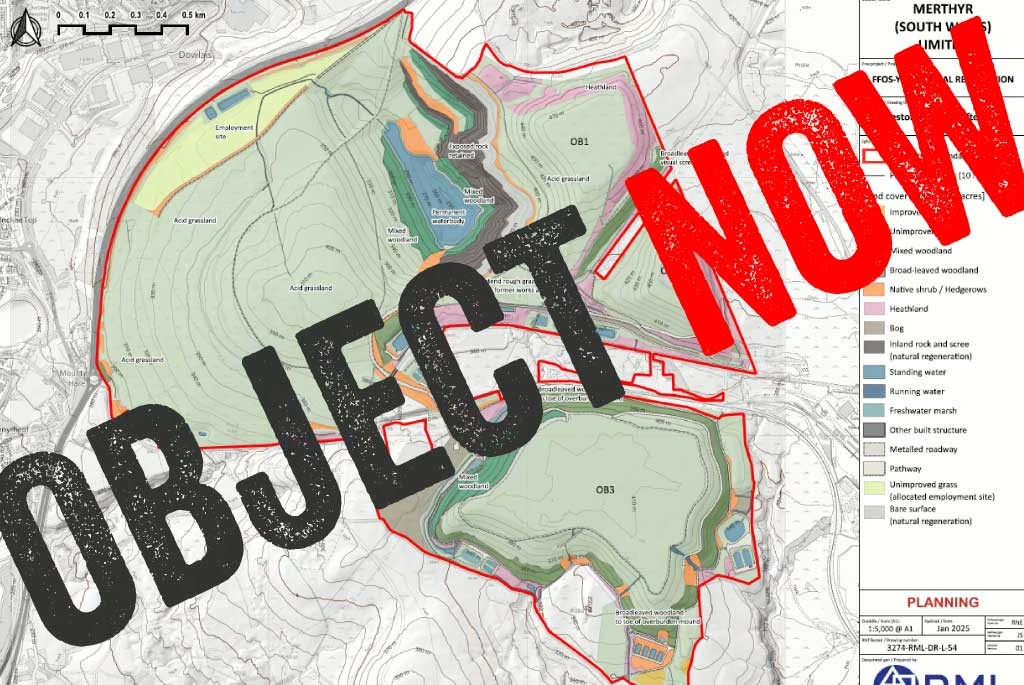
Instead, Bryn Bach Coal Ltd is trying again to extend the coal mine, claiming “Due to the compact nature of the mine site only a limited area of progressive restoration will be possible before the completion of coaling.”. The extension would delay restoration yet again, this time by over 5 years. That’s 12 years of delays since restoration was originally promised to be completed by. And history indicates it’s likely Bryn Bach Coal Ltd would apply for yet another extension after this one – will the site ever be restored?
This clearly flies in the face of Wales’ MTAN 2 policy “As a part of any application for extension, the operator is encouraged to demonstrate that this does not delay progressive reclamation of the principal part of the existing site.”. It’s long overdue that Bryn Bach Coal Ltd makes good on its promise to the local community in Ammanford, as well as to the nature it destroyed and displaced in 2012, that it restores the site without further delay and to the agreed standard.
Our understanding is that of the 11 full-time jobs engaged in the coal washery and proposed coal mine extension, only 3 of those jobs would be new jobs. Eight of those jobs, as well as indirect jobs, are not dependent on the proposed coal mine extension, but rather on the washery which has been operating without Glan Lash coal for years. So, in reality just 3 new, time-limited, jobs in a declining industry are supported by the proposed Glan Lash extension – which cannot be considered to make any material ‘positive contribution to the prosperity of Wales’.
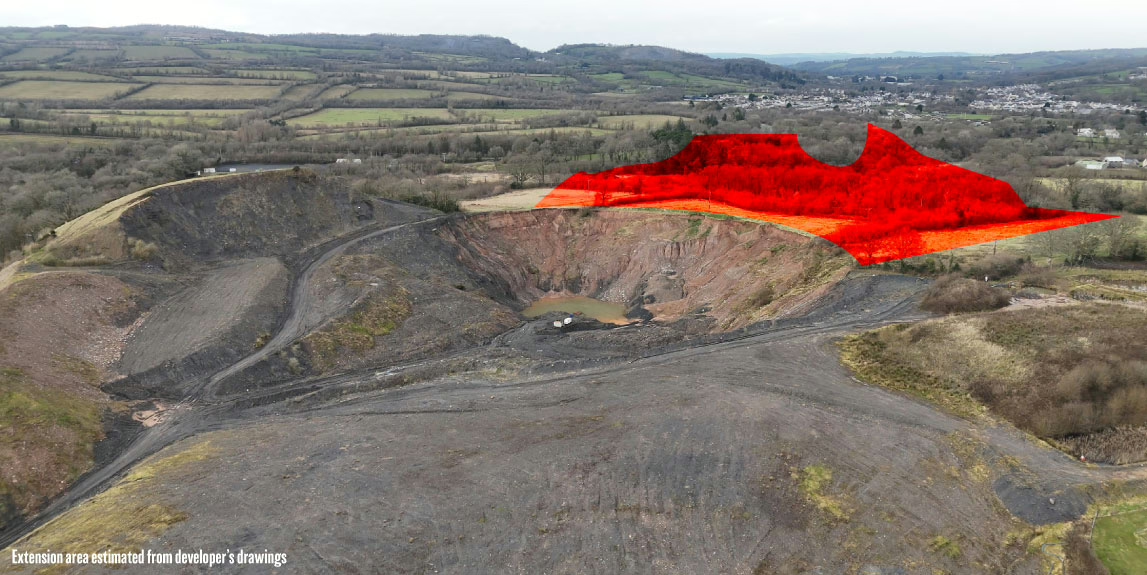
Bryn Bach Coal Ltd claims some of the closest residents live some 440 metres east from the centre of the Glanlash Extension Revised site. This is misleading – the closest residents live just 200 metres from the edge of the proposed extension’s void, with hundreds of tonnes of overburden dumped by large machinery within 180 metres of their back gardens. Wales’ MTAN2 policy is clear: “coal working will generally not be acceptable within 500 metres (m) of settlements”.
The closest residents to the existing site appear to live just 30 metres from its boundary, further jeopardising restoration works. MTAN2 policy requires “Strong evidence of the necessity for remediation, including the evaluation of options, is required to justify working within 200 m of a settlement, and the social and environmental impacts on the affected settlement must be carefully weighed.”.
The Marsh Fritillary butterfly is protected under the Wildlife and Countryside Act 1981 and its habitat is protected under the EU Habitats Directive. The butterfly is also a UK & Wales Biodiversity Action Plan Priority Butterfly Species. The proposed destruction of the Marsh Fritillary butterfly habitat to the north of the existing void at Glan Lash was one of the main reasons for rejecting the application to extend the coal mine in 2023. Despite the clear value and urgency given to this species and its habitat, the environmental impact assessment indicates that “During the seven years since the 2017 Marsh Fritillary site condition survey the habitat has received no management and has continued to deteriorate” (p74) under the ownership of Bryn Bach Coal Ltd. Restoration of this site was originally promised to be completed by 2017, but delays due to mining extensions have resulted in this deterioration. It would seem none of the “progressive restoration” described by Bryn Bach Coal Ltd has touched the most ecologically vital part of the site, and throws into question the company’s ecological stewardship and commitment to restoring the site to a high standard.
It could be read that the Bryn Bach Coal Ltd goes on to use the decline it’s overseen of this vital habitat as a bargaining chip to leverage approval of its new extension proposal that excludes this habitat from destruction, with its environmental impact assessment recommending “The early granting of planning permission for the mine extension would allow an early start to the proposed habitat restoration and management scheme which is becoming increasing urgent as time passes.” (p74). The urgency is of Bryn Bach Coal Ltd own negligence, and there is nothing preventing the company from addressing that urgency now. Indeed, its failure to do so until now, there is no reason to disbelieve the company’s claim that “The habitat will…subsequently be managed to maintain the habitat in good condition for the duration of the mining operation” (p6, Green Infrastructure Statement).
Trees can host nesting birds and protected bat-life, as well as be ecologically important in their own right. Therefore a thorough tree-by-tree assessment is needed – but despite proposing to destroy 80% of a woodland, the environmental impact assessment for the proposal admits the a woodland survey is incomplete: “It was not possible to gain access to measure all trees due to bramble or scrub growth around their bases… no bat-roost use of the central scrub woodland was found but it must be noted that direct-observation of these trees during the surveys was restricted by the impossibility of accessing the woodland” (p48, p50, p57).
Bryn Bach Coal Ltd claims the remaining 20% of woodland along the edge of the void will have its roots area fenced off, but this won’t protect the trees, or their roots, from the reduced availability of water resulting from the void excavated nearby.
Hedges are considered to have huge habitat value, providing essential wildlife corridors, and, as such, are protected by law in the UK. Bryn Bach Coal Ltd proposes ripping up over 440 metres of this critical wildlife habitat, admitting “all hedgerows within the application site qualify as Important Hedgerows under the Hedgerow Regulations 1996”. The company claims the hedgerows mechanically ripped out will be “subject to special treatment to permit their re-use during site restoration and, as far as possible” – but with no details of what that treatment is, and just how far that is possible, these claims are met with scepticism.
There is growing awareness, concern, and action around fugitive methane emissions from active and abandoned opencast and deep coal mines around the world. The methane is release from the act of mining, not from the use of the coal later. There is very little mitigation possible against fugitive methane emissions from opencast coal mining. Bryn Bach Coal Ltd, also fail to detail any mitigation measures for emissions from its site operations such as heavy machinery.
‘Monitoring’ or ‘measurement’ does not amount to mitigation, and it would be misleading to list that activity under any heading of mitigation.
There are shortcomings in the proposed replacement habitats, not least that new plantings are not equal to the established habitats and the mature ecosystems those habitats support. Last year, when Bryn Bach Coal Ltd applied to extend Glan Lash opencast coal mine, the Council’s independent ecologist also pointed out that equivalent biodiversity support from a newly planted woodland habitat (assuming it flourishes) will never catch up to that of the destroyed 2.52 Ha woodland habitat, had it not been destroyed – and that it would take 137 years to support for the existing ancient woodland currently supports. That’s because, habitats are living, evolving, and interdependent ecologies that gain richness as they mature. Simply a larger area does not necessarily equate to more habitat for the wildlife it is intended to support.
The idea of ‘replacing’ a habitat, often not even on the same site – but rather a site some distance away and across two roads – ignores that habitats are unique and are not interchangeable and criticisms of bio-diversity offsets. By way of crude analogy; someone who’s always lived in Ammanford would think much is lost if they were forced out of their home and community, told they must never return, and were moved into a flat in Aberystwyth instead.
One of the more fanciful claims within Bryn Bach Coal Ltd’s environmental impact assessment is that the wildlife, like the nationally protected dormice, would be disturbed by mining activity, get out of harm’s way, then navigate half a kilometre around the opencast coal mine, to the Tirydail coal tip restoration area…despite the fact that on page 59 of the same assessment, the report admits that dormice only travel up to a maximum of 250 metres from their nests.
Bryn Bach Coal Ltd claims “…the survey evidence and the records of casual observations indicate that there is no intensive or regular Badger activity within the application site boundary.” (p10, Green Infrastructure Statement) and “No signs of Badger were found during the surveys although the drier land is likely to occasionally be used by foraging animals.” (p4, Ecological Impact Assessment).
Yet, on a single visit in late 2022, a photographer captured fresh badger prints in mud along the very edge of the void at the Glan Lash site, and shared the photo with Coal Action Network at the time. Unless this was an incredible coincidence, it suggests there is regular badger activity into the very centre of the applicant site boundary, and that surveying has been inadequate.
Bryn Bach Coal Ltd claims multiple places that “The loss of the Site’s ecology is temporary” – but there is nothing temporary about the destruction of ancient woodland, hedgerows, and the lives that depend on these habitats. The company’s own environmental impact assessment only claims some of a select few protected species would translocated into an unfamiliar habitat with unknown survival outcomes. This idea of the nature, and lives within it, that will be killed by this extension is somehow ‘temporary’ because at some later point a new habitat will be installed which may host nature in the future is a peculiar fiction.
In 2023, the planning officer claimed that the negative visual impacts of the extension’s operational phase would be mitigated as they are ‘temporary and relatively short term’. Firstly, a period of 6 years may for many not be considered short-term. Secondly, Bryn Bach Coal Ltd could apply again for a further extension when this planning permission has expired, just as the company is doing now. Unless a further extension is ruled out in a binding way, relying solely on the timespan of this extension risks approving an overall period of coal mining that is unlikely to have been approved originally due to the timespan of impacts. The total timeline of mining impacts should therefore be considered, past and future together—rather than each time extension in isolation, or else decision making risks being based on incrementality rather than material planning considerations, balancing the total cost with the total benefit of the application.
Bryn Bach Coal Ltd claims that the coal is “premium” anthracite coal at every opportunity. But ‘premium’ isn’t an industry grade of coal, and the company doesn’t provide any independent mineral analysis to back up that claim. Furthermore, claims of quality often relate to the carbon content of the coal, with higher-carbon coal being considered higher quality. It does not mean that it is in any way environmentally better — in fact, higher carbon coal such as anthracite emits even more CO2 when burned.
Bryn Bach Coal Ltd goes on to purport that none of the coal excavated from Glan Lash would be burned, which is when the majority of CO2 is released. The company originally claimed 50% would be burned, then 25%, and now 0%...is it just saying what the Council wants to hear whilst knowing that planning permission in the UK cannot control who the company sells the coal to, or if it is burned? Once it has planning permission, Bryn Bach Coal Ltd can sell Glan Lash coal to whoever pays the highest price. Even if sufficient non-burn markets do exist for all of the coal mined from an extension to Glan Lash, it must be assumed that in the absence of any restrictions, Bryn Bach Coal Ltd will sell the coal to whichever market pays the highest price for it. Which market that will be in the future cannot be accurately predicted, so the prudence requires that the Council cannot accept the company’s claim that the coal from the Glan Lash extension will not be burned. Where Glan Lash coal is finally used may also be impossible to trace as the coal processing plant opposite the coal mine also processes coal from other coal mines in Wales and beyond.
This creates a problem for approving the application in light of the Finch Vs Surrey Council High Court judgement earlier this year, which found that when deciding a fossil fuel project, a Council must consider the downstream use of that fuel. This recent judgement also bears on the Planning Officer’s 2023 view that run-of-mill coal will be processed in the washery rather than the coal mine void, and is therefore excluded from consideration of the extension application (despite the fact that the washery is adjacent to the coal mine) so dust generated from processing the coal becomes relevant to MTAN2 paragraph 151.
Where non-energy generating industries continue to rely on coal, it is critical that these industries transition to alternatives as the UK’s decarbonisation progress begins to dangerously veer off the necessary trajectory to avoid catastrophic climate change. Feeding an abundance of readily available coal and maintaining the security of supply disincentives companies to invest in research and infrastructure to cut coal out of their processes, instead ‘locking in’ companies’ continued reliance. There are already known anthracite coal alternatives to water filtration such as sand, gravel, pumice stone, iron, aluminium, and manganese. Although some of these alternatives would also have serious localised environmental consequences, not all would – and none would cause the fugitive methane (a potent climate change accelerant) release, which is possibly the most significant difference between using anthracite coal or its alternatives.
To mine coal in the UK, a company requires both a full coal licence issued by the Coal Authority, and full planning permission granted by the Local Planning Authority.
Following an FOI request to the Coal Authority, we found out that the current licence to mine coal at Glan Lash appears to have been issued in 2019, and expire on 10th August 2025. Given the UK Government’s public and uncaveated commitment not to issue any new licences for coal mining, and that Welsh Ministers would subsequently need to approve it if it was issued, it can be assumed that mining at Glan Lash must permanently cease by the date of its current licence, which is incompatible with the 5.4 years of coal mining it’s proposing.
The 2023 planning officer’s report for the original extension proposal at Glan Lash claimed “the proposal would help to ensure that any coal being used from the site will have been won in a way that is conscious of health and safety regulations and worker conditions”. This statement relies on 3 unspoken and unevidenced assumptions:
- The Glan Lash mine would follow national health and safety regulations and provide good worker conditions.
- that standards are lower in countries where the anthracite coal may otherwise be imported from – with the USA being a major source of anthracite coal.
- That by mining the coal at Glan Lash, it would sponsor a switch to that quantity of coal being mined in better conditions. This relies on the substitution argument that the coal mined from Glan Lash would not be mined elsewhere in the world. This is a logic that the Welsh Government ultimately rejects in its Coal Policy Statement of March 2021, and was most recently and resoundingly rejected in the UK High Court by Mr Justice Holgate in the West Cumbria coal mine legal case.
Each of these assumptions would need to be investigated and evidenced before it is reasserted for the new Glan Lash coal mine extension application by the Planning Officer.







This is a backward looking unnecessary project producing large amounts of CO 2 emissions and methane gas, blighting the local community and producing very few jobs.,