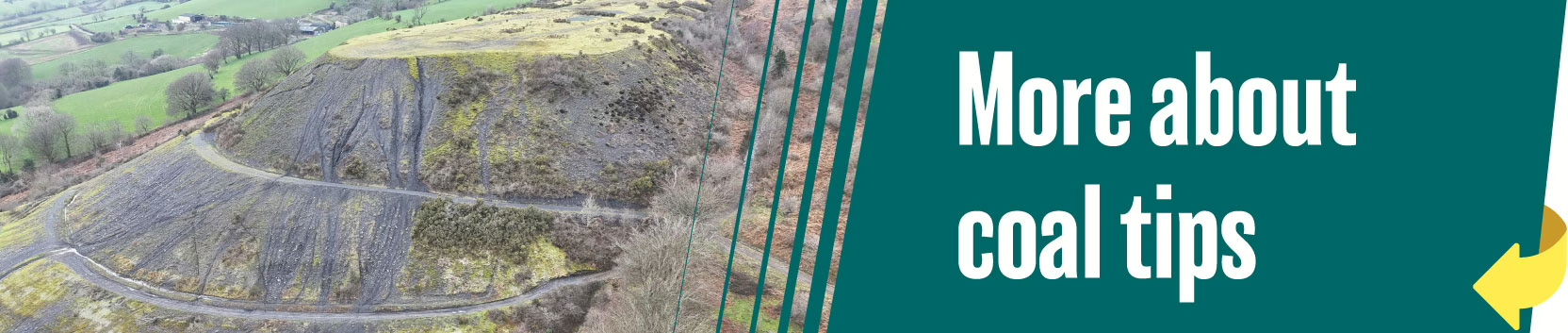
Deep (AKA underground) coal mines have a long history in the UK dating back some 400 years. On the other hand, opencast coal mines only became common between 1940 and 60, becoming the dominant mining method in the UK as deep coal mining entered rapid decline. Opencast coal mining techniques were largely imported from the USA (Hansard, 1950) together with the heavy machinery they required. In 1942, the UK Government established the Directorate of Opencast Coal Production under the Ministry of Works to exploit coal seams near the surface (National Archives, n.d.) that were too shallow or fragmented for deep-mining techniques (Ritchie & Roser, 2019). The UK Government encouragement of opencast coal mining was partly the result of a need to boost coal production and a wartime shortage of labour to do it (British Geological Survey). Opencast coal mining was cheaper and used less labour - it also did not require the specialised skills that deep coal mines do. Although opencast coal mining was introduced as an emergency wartime measure, it persisted due to its economic viability compared with deep coal mining. Yet, despite this transition from deep to opencast coal mining, as of 2026, deep coal mines have outlived opencast coal mines as the only active mines remaining in the UK - namely, Aberpergwm in South Wales and the relatively small Ayle Colliery in Northumberland.
The Opencast Coal Act 1958 provided the first comprehensive legal framework for the industry, regulating land acquisition and restoration requirements as the practice moved from emergency status to a long-term economic strategy. However, today we see that this legislation and subsequent legislation was not strong enough to secure restoration of the sprawling opencast coal mines.

We worked with media outlet, Nation.Cymru, to ask where the main political parties in Wales stands on restoration issues ahead of the Welsh election on 07th May 2026. This is a key issue for many people, but particularly those who live near under-restored opencast coal mine sites. These sites need Welsh Government support to bring them more in line with the quality that was promised to local residents. It's also vital that Wales learns lessons from its scarred landscape. We hope that these political parties remember these pre-election commitments when it comes to determine the called-in Ffos-y-fran ex-opencast restoration planning application. Reform was the only party not to respond - but this is a summary of what the other political parties of Wales had to say:
(see the Nation.Cymru article for the full account)
Industry Accountability: Strengthening "polluter pays" laws to ensure companies that profited from heavy industry are legally responsible for land restoration.
National Remediation: Implementing a nationwide strategy to monitor and restore every coal tip, while demanding Westminster fund the clean-up of pre-devolution hazards.
Community Planning: Reforming land-use planning to balance development with nature restoration and better public access to green spaces.
Justice First: Mandating that polluters pay for all prevention and repair, ensuring environmental damage is never subsidized by the public.
Ecological Regeneration: Focusing on long-term ecological repair of mining sites rather than short-term safety fixes to deliver environmental justice.
Fundamental Access: Treating high-quality nature access as a fundamental right, prioritizing new green spaces in communities historically affected by industry.
Pollution Reform: Introducing a new Clean Water Bill and a dedicated watchdog to crack down on water pollution.
Tip Safety: Establishing a "Disused Tips Authority" in Merthyr Tydfil to secure 400+ sites and exploring solar energy or mine-water heating on reclaimed land.
Green Renewal: Expanding on the 4,000+ green spaces already created by launching an urban rewilding taskforce.
Aggressive Enforcement: Taking tough action on sewage and industrial dumping, ensuring big companies—not local taxpayers—foot the bill for clean-ups.
Green Opportunity: Moving past "empty nostalgia" by transforming former coal sites into hubs for green industry, housing, and skilled work.
Land Reclamation: Partnering with councils to turn derelict land into parks, tree-filled areas, and safe walking or cycling routes.
New Oversight: Scrapping Natural Resources Wales and replacing it with a new independent regulator to enforce environmental rules.
Conservation Funding: Establishing a £20m "Wildlife Wales Fund" to support conservation efforts and community green spaces.
Economic Focus: Prioritizing economic transformation in coalfield areas while protecting heritage and improving site safety.
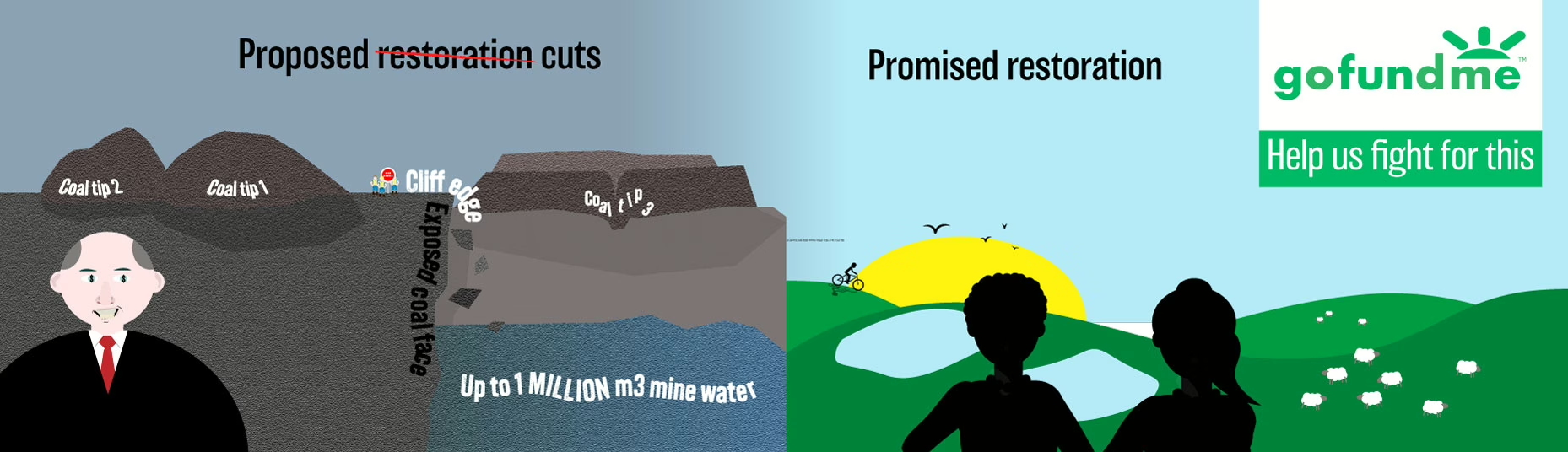
Merthyr (South Wales) Ltd illegally mined coal at Ffos-y-fran for over a year, profiting from record coal prices. Now, it wants to keep all the profits by trying to downgrade the restoration plan, breaking its promise to the 60,000 residents of Merthyr Tydfil, South Wales.

Your objection means much more if it's put in your own words why you want Merthyr Tydfil Council to refuse the application to downgrade this huge restoration project. Here's some points you might choose to include, or go straight to the objection form:
This will take you to the Merthyr Tydfil Council's short objection form.
Ironically, the original approval of the opencast coal mine was to fund the restoration of the area which had been scarred by previous iron ore and coal mining. Key to the agreed restoration plan is that the huge overburden mounds (coal tips), currently dumped in 3 mountainous piles around the site, would be returned to the void, both of which were created by the opencast coal mining. That would return the site to the undulating landscape it was before and in sync with the rest of the lanscape in that area. Merthyr (South Wales) Ltd agreed to this restoration plan in 2015, when it took over operations at the site - but is now trying to wriggle out of that contract.
We got internationally renowned foresnic accountants, C. Lewis & Company, to analyse mining company Merthyr (South Wales) Ltd's accounts. Guess what? Not only can the mining company afford the full restoration, it has even set the money aside for it, and it can't legally spend it on anything else... unless the Council agrees to downgrade the restoration by granting the company's cut-price restoration application.
It's a stitch up! Don't let it happen
The new proposal was published on Merthyr Tydfil County Borough Council's website on Friday 21/02/2025. It is a plan to do as little as possible that would justify the company getting its hands on the £15 million currently held by the Council in an ESCROW account. But that £15 million was only intended to cover the barest necessities to make the site safe in case Merthyr (South Wales) Ltd goes bust. Merthyr (South Wales) Ltd hasn't gone bust though, and should be stumping up around £75-110 million to pay for the restoration.
The 218-page environmental impact assessment for the new plan is overflowing with greenwash. The assessment even claims that the lack of restoration it's now proposing for the opencast coal mine will be an 'educational resource' and testament to the area's mining history - more like a permanent reminder to Merthy Tydfil residents of broken promises and rampant profiteering at their expense.
The assessment fails to account for the impact that a loss of land and associated loss of carbon sequestion will have over the decades. The State of Nature Wales 2023 reveals the devastating scale of nature loss across the country and the risk of extinction for many species. This is not the time to cut the restoration budget by around 80-90% of a huge site - much of which has been off-limits to nature for too long.

Coal Action Network has obtained new legal advice from expert Barristers Estelle Dehon (KC) and Rowan Clapp of Cornerstone Chambers, London. Examining relevant legislation from 1990s, the Barristers argues that mining coal previously discarded in coal tips require a licence from the UK’s Mining Remediation Authority (national regulator). This backs up previous legal advice we’ve received from Barrister Toby Fisher of Matrix Chambers, London.
Currently deep and opencast coal mines require a licence from the national regulator, in addition to planning permission. The national regulator recently refused a licence for the West Cumbria coal mine, preventing the project from starting. But the national regulator and DESNZ both deny that legislation means mining coal tips requires a licence.
Section 25 (1) states “coal-mining operations” shall not “be carried on by any person except under and in accordance with a licence”. In plain speak, this means a ‘coal mining operation’ needs a licence. So how is a coal mining operation defined?
Section 25 (2) defines ‘Coal mining operations’ as the “winning, working and getting” of coal. It’s only relevant if it’s in the UK and if it’s not just to move coal out of the way to do something else, like build foundations for a house.
The legislation includes within ‘Coal mining operations’ things like dumping soil that was removed during coal mining, even if this happens later and outside of the mine. If the act of making a coal tip is included, then mining that coal tip should be included too.
Mining coal tips for previously discarded coal within them is clearly ‘getting’ coal, putting it within the legal definition of Coal mining operations’. For that matter, mining coal tips also fits within case-law definitions of “winning and working”. The Welsh Government’s Minerals technical advice note (MTAN2) also backs this up, defining ‘coal working’ as including the “recovery of coal from tips”.
Section 336 of the 1990 Act defines a ‘mineral working deposit’ to mean "any deposit of material remaining after minerals have been extracted from land or otherwise deriving from the carrying out of operations for the winning and working of minerals in, on or under land" – which easily encompasses coal tips.
Section 55 (4) (a) (i) defines a ‘mining operation’ as the “removal of material […] from a mineral-working deposit.”. As coal tips amount to a mineral-working deposit, it follows that mining coal tips amounts to ‘mining operation’. The 1990 Act requires any mining operation to get planning permission – accordingly, mining coal tips requires planning permission under this definition, which has been accepted since the Act was introduced.
This planning law is aligned with Barristers’ Estelle Dehon’s (KC), Rowan Clapp’s, and Toby Fisher’s interpretation of the The Coal Industry Act 1994, which came 4 years later.
The Mining Remediation Authority (MRA) has stated that it does not consider coal tip extraction to be a ‘coal mining operation’ because it claims that coal tip extraction does not meet any of the requirements listed within the s.65(1) of the 1994 Act definition of a ‘coal mining operation’ or a ‘coal mine’. As a result, the MRA states that it has no power to licence or not licence mining a coal tip. And DESNZ adds that it does not plan to make any changes so that coal tip mining projects would require a licence from the MRA in future (based on the understanding it is not currently required, which is against our Barristers’ understanding).
This boils down to a difference in interpreting some heavyweight law that’s over 30 years old. Some of the argument hinges on whether you read a sentence such as “to be a thing, it must include the following: X, Y, ‘and’ Z” to mean it needs to be all of X,Y,Z to be the thing, or it’s enough for it just to be Y, for example. The only way to settle the argument is a costly court case with our Barristers on one side and UK Government Barristers on the other side – and the UK Government has much deeper pockets than us.
The civil servants within the UK Government are right now busy cooking up new legislation to ban the MRA from issuing any new licences for coal mining – which is great news because all coal mining needs a licence…so that means no new coal mining projects (existing licences can still be used). The problem is that it won’t ban mining coal tips, because of the MRA’s belief that this doesn’t require a licence in the first place. That means, once this new legislation passes, the only place coal can be mined in the UK is coal tips – which will still be fair game, undermining the intention of the coal ban to stop coal mining.
This is a particularly absurd situation as mining previously discarded coal from coal tips or mining new coal from opencast coal mines involves the same processes – moving large volumes of soil around with HGVs, separating spoil from saleable coal, transporting that coal etc. and generating the same local environmental and community impacts such as noise, dust, and disruption. It will also have the same climate change effects when burned. Mining coal tips is an industry that dates back until at least the 1980s. With over 5,000 coal tips around the UK and a live proposal to mine two coal tips in South Wales of over 400,000 tonnes of coal, we begin to understand why it matters whether coal tips are included within the new legislation to ban coal mining.
PLAN A
The easiest option would be for the civil servants beavering away at the new coal ban legislation to simply include an amendment requiring coal tips to need a licence (via clarification or change to existing legislation). This would bring coal tip mining, opencast mining, and deep mining all within the same requirement for a licence – which the new legislation would then ban in one swoop. Find out more about the simple legal wording our Barristers have suggested including to do this.
PLAN B
If Ministers and civil servants refuse to explicitly include coal tips within the new legislation, we are going to have to consider a legal challenge to the UK Government’s belief that mining coal tip doesn’t need a licence. If we win that, then mining coal tips would be banned within the new legislation by default. We hope you’ll support our fundraising efforts if we are forced to do that.
On July 1st, 2025, CAN organised an impactful drop-in session at the Senedd to reinforce the urgent need for action on Wales' coal legacy issues. The event, sponsored by Delyth Jewell MS, saw strong cross-party engagement, with Members of the Senedd (MSs) from Labour, Plaid Cymru, the Conservatives, and the Liberal Democrats in attendance.
Framed as a call to action on two interconnected issues—the future of coal tips and the restoration of the Ffos-y-fran opencast site—the session demonstrated growing momentum for change across the political spectrum.


CAN supported Delyth Jewell’s proposed amendment to the Disused Mine and Quarry Tips (Wales) Bill, which would rule out the sale of coal from disposed land for the purpose of burning. This simple but powerful clause would ensure that coal removed during the management of old coal tips cannot be fed back into fossil fuel supply chains—closing a loophole that could otherwise undermine climate commitments.
We also spoke with MSs to urge the Welsh Government to work constructively with the Department for Energy Security and Net Zero (DESNZ) in Westminster to ensure the UK-wide coal mine ban currently under development includes coal extraction from coal tips. As it stands, tip-extracted coal is not covered—a glaring omission that risks opening the door to a new phase of coal exploitation under the guise of legacy management.
Merthyr (South Wales) Ltd, which operated the Ffos-y-fran coal mine, is seeking to drastically reduce its contracted restoration obligations by up to £110 million. This is despite public filings showing £91.2 million already allocated for the site's restoration by the mining company. MSs attending our drop in session spoke with local residents we invited, viewed our gallery images of the coal mine site, and explored it for themselves via our 360 drone photos.
This raises serious concerns about transparency and risk—particularly given the site's proximity to local communities and the significant safety and environmental hazards involved. See our brief to find out what actions MSs can take today to deliver justice for Merthyr Tydfil.


Attendance at the drop in session by every Senedd party shows there is political appetite for action. Members across party lines recognised the urgency and legitimacy of the issues we raised. This is not about party politics—it’s about public safety, environmental justice, and the integrity of our climate commitments.
We thank every MS who took time to attend, engage with our materials, and listen to affected communities. We will continue to campaign so that Wales does not repeat the mistakes of its past but instead leads the way in managing its coal legacy responsibly.
Coal Action Network was invited to attend Westminster where we gave evidence to the Welsh Affairs Committee in their inquiry about the environmental and economic legacy of Wales’ industrial past, alongside Friends of the Earth Cymru.
This inquiry was opened in December 2024 to examine the environmental legacy and economic impact of Wales’ historical heavy industries. You can find our written evidence here.
In our submission, we focused on the consequences today of old coal mines. Whilst we recognise the wealth it generated, much of that was kept by the Directors of mining companies whilst abandoning their restoration responsibilities to host communities. Our 2022 report ‘Coal mine restoration in South Wales’ documents this pattern in Wales’ recent past. We also highlighted the threat of new coal mining under the guise of remediation, as proposed in Bedwas, South Wales.
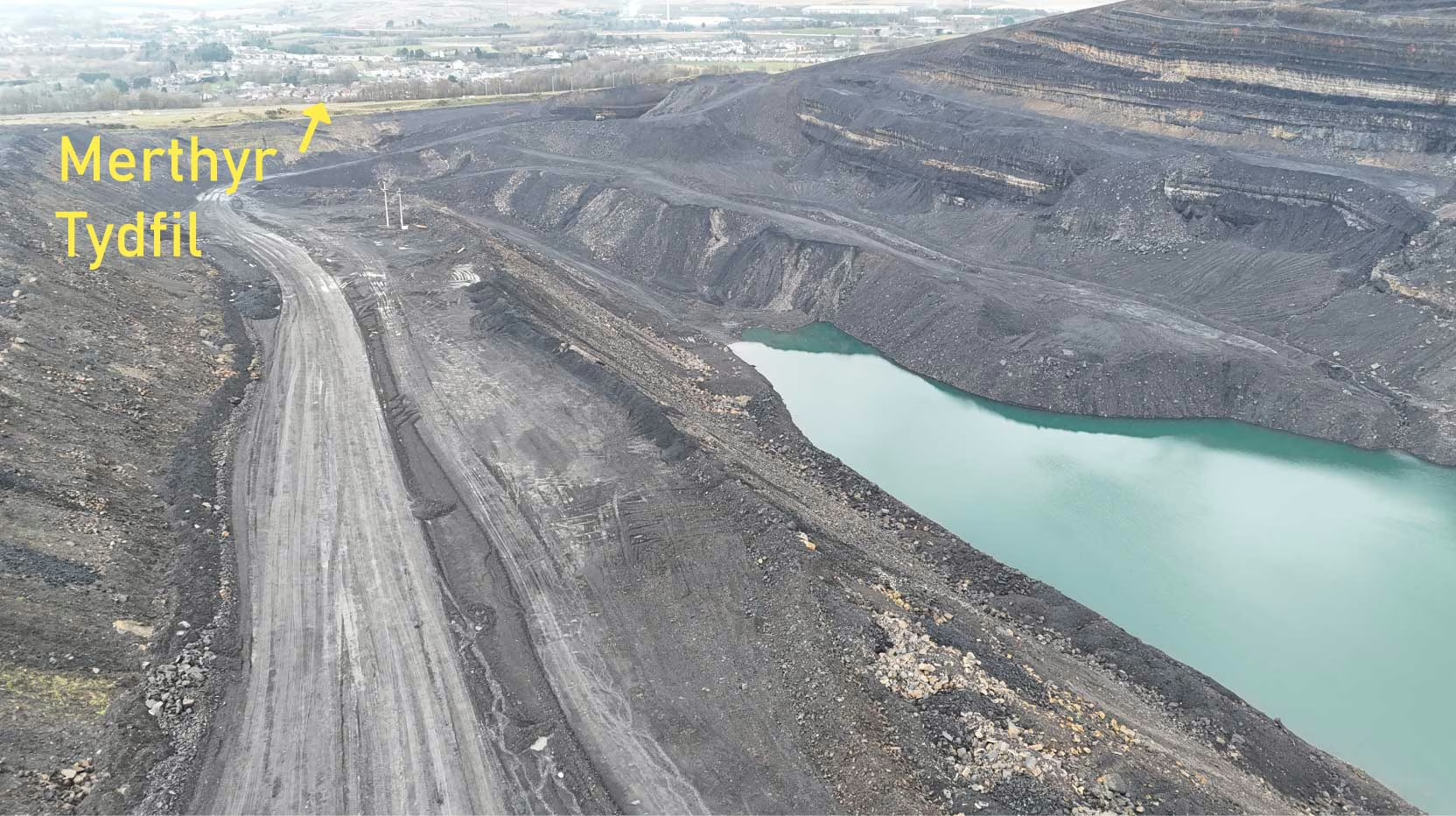
Merthyr (South Wales) Ltd operates the recently closed sprawling Ffos-y-fran opencast coal mine, next to the town of Merthyr Tydfil - home to around 58,000 people. In 2015, Merthyr (South Wales) Ltd agreed a restoration plan with Merthyr Tydfil Council, which - after coal mining ended - would see the landscape put back to before coal mining began and with extensive habitat improvement to support nature to return to the area. But as soon as Merthyr (South Wales) Ltd saw there was no more profit to be made, it claimed that it had failed to set aside enough of its profits to fund the restoration plan it agreed to deliver back in 2015. Rather than taking Merthyr (South Wales) Ltd to court over what would be a breach of contract and trust, Merthyr Tydfil Council invited the company to gut that restoration agreement by around £85 million in works, and with no punitive action against the company. This is despite all public records indicating Merthyr (South Wales) Ltd actually can afford the original restoration plan.
Within the last decade, Celtic Energy Ltd - another mining company, evaded well over £100 million in restoration costs and made a high quality restoration impossible at 4 opencast coal mines across South Wales. Communities living close to these sub-standard restorations still pay the price for Celtic Energy Ltd's profiteering. In fact, the Welsh landscape is littered with over 2,500 coal tips - abandoned by coal mining operations and now forming a huge burden estimated to cost £600 million to deal with.
Merthyr (South Wales) Ltd's attempt to evade the cost of the restoration it agreed to at Ffos-y-fran is therefore just the most recent instance of an industry that continues to cost some of the poorest communities in South Wales more than it ever gave them. But all is not lost for the 58,000 residents of nearby Merthyr Tydfil. We're standing alongside vocal campaigners in the area against this attempt by Merthyr (South Wales) Ltd to short-change the town of Merthyr Tydfil by £91.2 million in restoration funds. You can help us by taking 2 min to object to this application on the local council's website.
Restoration plans are supposed to return the land back to a better state than before coal mining began. In reality this rarely happens, but it somehow still convinces planners to grant permission for mining. The new plan to downgrade the restoration tries to shift this 'baseline' state of the land by 17 years from before coal mining began to just after coal mining stopped. This is so the new restoration downgrade only has to improve a Mordor-like landscape ravaged by 16 years of coal mining, drastically lowering the threshold. But there's no justification for setting this new starting point.
The new downgrade proposes to permanently leave huge health and safety hazards in a landscape that is in easy walking distance from the population of Merthyr Tydfil, even encouraging the public into this area. There are tangible risks to life and limb from a very deep flooded void, to a sheer cliff edge and massive coal tips, one of which has already suffered large slip. All of these hazards are supposed to be removed from the landscape at the end of coal mining, but Merthyr (South Wales) Ltd is putting its profits before people's lives.
The flooded quarry, Dorothea in Talysarn, Gwynedd is an abandoned quarry left in a similar state to what is now being proposed for Ffos-y-fran. But since 1990, there's been over 20 tragic deaths at Dorothea quarry.
3 colossal coal tips were supposed to be removed at the end of coal mining but the coal company wants to leave them where they are, despite the fact they leach toxic metals into the surrounding ecosytem, which it admits is home to protected Great Crested Newts. To make it worse, one of the many cuts to the previously agreed restoration plan is to stop maintaining the ponds which capture "chemical loads" from rainwater running off the colossal coal tips, admitting that they may 'silt up', which would potentially harm the endangered Great Crested Newts, as well as spread the "chemical loads" further into rivers and streams.
In one of the most blatant greenwash attempts we've seen in a while, this coal company suddenly cares deeply for minimising CO2 emissions. This, it claims, is why it proposes to leave the 37 million cubic metres of mine waste, soil, and rocks in the three massive dumps its created, rather than refill the opencast void with it - as was the original plan. Earth-moving requires HGVs burning deisel... but the emissions spared by leaving behind 3 colossal coal tips overshadowing 58,000 people would amount to just 2% of the illegal coal mining Merthyr (South Wales) Ltd did over 15 months after its planning permission expired. If the void is filled in with the coal tips, it'll also provide a greater carbon sink cancelling out that CO2 of these earthworks even more. This isn't about CO2, its about money - which Merthyr (South Wales) Ltd want to turn into even greater profits.
One of the main cuts to the original restoration plan is to leave 37 million cubic metres of mining waste, soil, and rocks in 3 colossal coal tips scattered around the site and towering above nearby residents of Merthyr Tydfil by up to 210 metres, disfiguring the landscape forever. One of these coal tips, nearest to residential homes, has already suffered instability with a recent and large coal tip slip 2024. The combined pressures of climate change, illicit scrambler bikes, and time could create further instability and dangers.
Many coal tips require regular maintenance and all disused coal tips must be monitored for instability. Long after the coal company, Merthyr (South Wales) Ltd, has left with its tens of millions in profits, there will be ongoing maintenance costs likely to amount to millions and likely to be funded by tax payers.
Against official guidance, the aftercare period being proposed for nature restoration is just 5 years. Guidance recommends double this to 10 years to ensure tree and hedge plantings are successful before the coal company is allowed to wash its hands of responsibility. 5 years does not give long enough to see what plantings need to be replaced and to support the growth of those - instead, failed plantings will either be abandoned or the tax payer will have to pay for replanting and maintaining those areas.
Prior to opencast coal mining, the area formed part of the Gelligaer and Merthyr Common, an upland area of rough grassland grazed by sheep, cows and horses. Commoning is a way of life with a rich history dating back to 1066 and enshrined in the Magna Carta (1215).
The cuts to the original plan mean leaving behind a huge flooded mining void and 3 colossal coal tips. This will severely reduce the ability for Commoners to exercise their historic rights to graze their animals on the land. It also represents a broken promise to return this land to the Commoners after coal mining. Instead, the hazards that would be left behind pose risk of injury and death to the Commoners' livestock.
A whole way of life and a living part of our history is threatened by the cuts proposed to the original restoration plan, as well as the preservation of native Welsh breeds of sheep and cows like the South Wales Mountain Sheep, or Welsh Black cows.
Through the thick layer of greenwash, the real reason for trying to cut every corner on the original restoration plan is admitted by the company's representative: "It was established that there are insufficient funds available to achieve the 2015 restoration strategy and therefore an alternative scheme is required.". But it's a matter of public record that this is not true, with £91.2 MILLION set aside by the company to fund the original restoration plan. Merthyr (South Wales) Ltd even claimed tax discounts on this from HMRC.
We were invited for the second time to give oral evidence to the Climate Change, Environment, and Infrastructure Committee of the Welsh Parliament (Senedd) on 05th February 2025. We shared the panel with Haf, Director of FOE Cymru, to provide our opinion on the weaknesses, strengths, and improvements that need to happen for the Disused Mine and Quarry Tips (Wales) Bill to deliver real benefits for Welsh people living in the shadow of coal tips.
We emphasised that the The Disused Mine and Quarry Tips (Wales) Bill, in its current form, carries the very real risk that it could encourage 'remining' so-called waste coal from coal tips under the guise of making those coal tips safe. There is a live proposal to do exactly this for two coal tips in Bedwas, Caerphilly. Read more about coal tip re-mining and safety.
Our message to the Senedd Committee: include a provision in this new Bill prohibiting coal extraction for commercial gain from disused coal tips.
Watch our session with the Committee to find out how the pros and cons of the new Bill, not least encouraging 'remining' coal tips which contain up to 643 million tonnes of coal, emitting up to 1.7 BILLION tonnes of CO2.
In April 2024, we were invited to give oral evidence on Welsh coal mine restoration, with a focus on Ffos-y-fran opencast coal mine. Check out this video of our debut session with the Climate Change, Environment, and Infrastructure Committee.

Mining company: Merthyr (South Wales) Ltd (MSW) is the current operator of the sprawling opencast coal mine, Ffos-y-fran, in Merthyr Tydfil, South Wales.
Claim: MSW claims "It was established that there are insufficient funds available to achieve the 2015 restoration strategy and therefore an alternative scheme is required." (EIA Scoping Report, July 2024). It is on this basis that a new application will be considered by Merthyr Tydfil County Borough Council. This claim is disputed by independent forensic account.
MSW's 'solution': To downgrade the restoration scheme promised to surrounding communities to one that amounts to doing as little as possible. Even returning the tens of millions of cubic metres of coal tips to fill in the gaping void the company created and allowed to flood is considered "not feasible or economic" (EIA Scoping Report, July 2024). If this downgrade is agreed to by the Council, MSW is off the hook for the original restoration cost. An independent forensic accountant reports this is the easiest ploy for MSW to evade up to £105 million in restoration costs.
Why MSW is offering to do any works: Merthyr Tydfil County Borough Council holds £15 million in an Escrow account that it forced MSW to pay into (by court order after MSW refused to!). This was never intended to fund the original restoration agreement costed at £75-120 million, but that is what's happening now as MSW is claiming the company doesn't have the finances to pay for the restoration it previously agreed to fund. MSW wants this £15 million so is proposing a massively downgraded restoration plan and presenting this as the only option so the Council will pay this out to them. The Council is afraid the company will walk away if it is compelled to honour its contractual agreement to fund the restoration itself. If that happens, the Council would have to pay a new company to come in to restore the site, which'd cost more.
Our recommendation: Merthyr Tydfil County Borough Council has refused to pursue MSW to deliver on the contractually agreed level of restoration, and is poised to consider a downgraded plan by MSW which would affect surrounding communities living in Merthyr Tydfil for generations. Haven't they put up with enough after 16 years of coal mining, dust, and noise pollution? The Welsh Government urgently needs to launch an inquiry MSW finances and the Council's actions, issuing a 'holding directive' to prevent the Council approving the downgraded plan in the meantime.
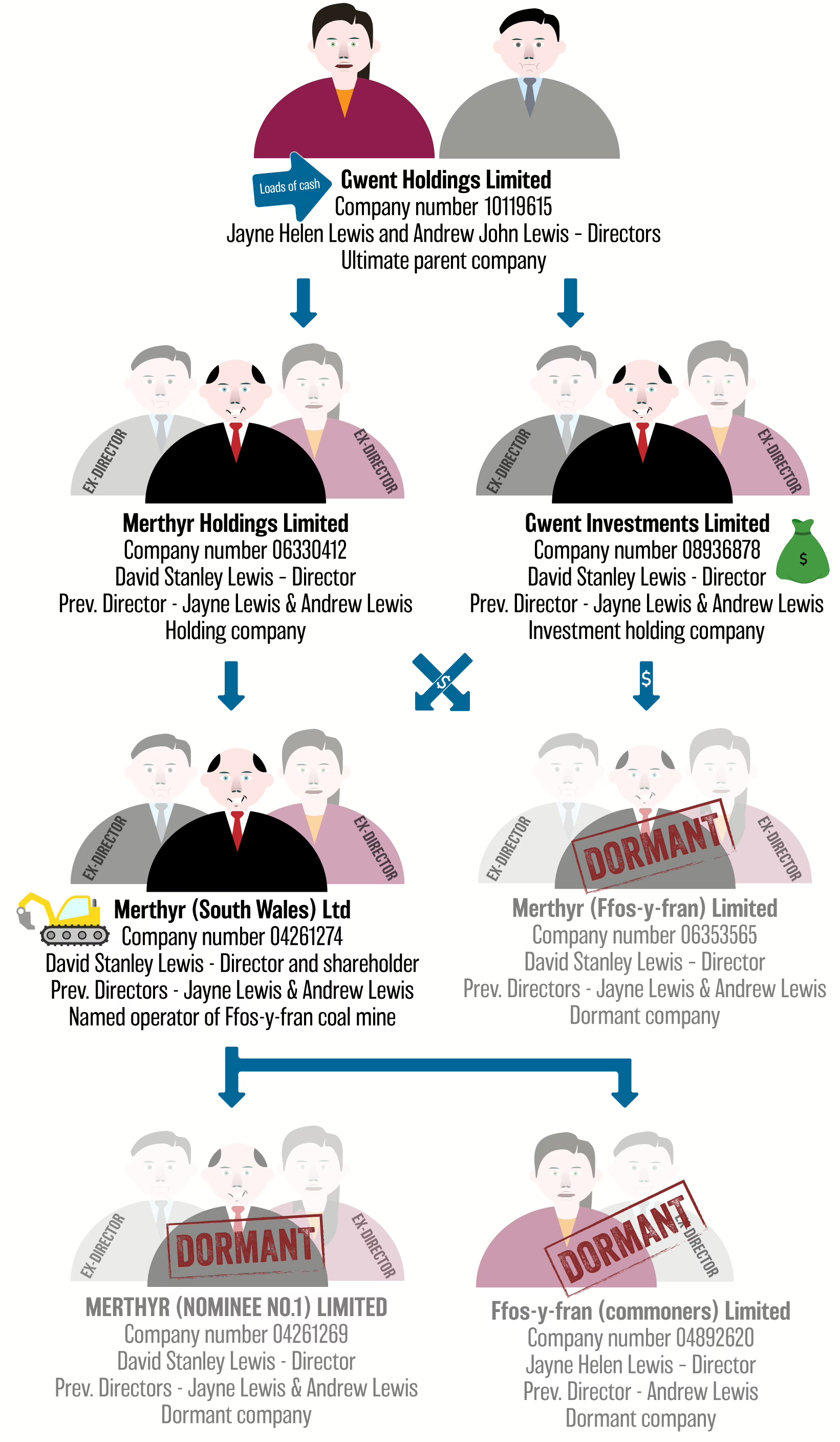
To our knowledge, there has been no evidence submitted by MSW that it cannot fund the full restoration it is contracted to undertake. On the contrary, MSW's most recent, publicly available, financial statement on Companies House says "during the year the directors again reassessed the restoration provision based on current operating costs in particular diesel prices which have decreased significantly and increased plant hire costs, which as a result increased the restoration provision by £0.2m to £91.2m", by 31 Dec 2023, admitting record profits the year before, with its ultimate parent company, Gwent Holdings Ltd, reporting "The average coal price achieved increased by 94% to £151.66 per tonne" in its 2022 filing. This funding for restoration was based on Ffos-y-fran closing at the end of its planning permission in September 2022 - but it continued illegally mining coal for over a year after that, and even outside its licenced area, selling an extra 640,000 tonnes of coal - driving profits even further.
It's been claiming tax discounts to HMRC each year by phasing expected restoration costs that it now refuses to pay. This report goes on to say "The total costs of reinstatement of soil excavation and of surface restoration are recognised as a provision at site commissioning when the obligation arises. The amount provided represents the present value of the expected costs.".
This very much sounds like the company able and prepared to pay the restoration costs, and had already claimed tax discounts for it. So why is the company being allowed to duck tens of millions in what it owes?
As is typical of the mining industry, operations and financing is done through a complicated constellation of interconnected companies owned by family members (depictions of which are illustrative only and not based on any likeness). This kind of practice could help evade liabilities - though we're not suggesting that was the intention here. The following information is accurate to the best of our knowledge, please refer to Companies House for confirmation/further details:



David Lewis has already been convicted of criminal fraud, with Judge Durham-Hall telling Lewis: "When the truth was put before you you wriggled, twisted and whinged" and described Lewis as "a pathological gambler who demonstrated pathological dishonesty", concluding "What he did was unlawful, crass, stupid and dishonest." *we believe this article refers to the same David Lewis that is currently Director of MSW but will consider evidence to the contrary, so get in touch before you threaten to sue us again David 😉
The Disused Mine and Quarry Tips (Wales) Bill (‘the Bill’) was prompted by a series of coal tip landslides that occurred in Wales following storms’ Ciara and Dennis in 2020, including a major landslide of a disused coal tip in Tylorstown. The Bill seeks to update the Mines and Quarries (Tips) Act 1969, to more effectively manage the 2,573 coal tips and over 20,000 non-coal tips within Wales so they do not threaten human welfare, by reason of their instability. To drive this management framework, the Bill proposes to create a new public body – the Disused Tips Authority for Wales (‘the Authority’), which would assess, register, monitor and manage disused tips.
To prevent disused tips from threatening human welfare through instability. The aim is for the Bill to be preventative and proactive rather than reactive. The first section of the Integrated Impact Assessment discusses the need to anticipate impacts of climate change on tip stability, such as the trend of increasing rainfall and storms. It seeks to do this by:
The current categories of R,A,B,C, and D would be replaced by a simpler two-step assessment process. The first step would be a desk-based risk assessment, the results of which may recommend a subsequent full assessment.
Key changes introduced by the Bill include:
Context 1
The Integrated Impact Assessment claims the Bill does not deal with coal tip remediation, and does not increase the likelihood of movement and potential combustion of coal that can accompany coal tip remediation. The Assessment goes further to state that the Bill’s preventative action will reduce the need for coal tip remediation and works required after coal tip slips. Coal Action Network believes these claims to be sincere but inaccurate.
Coal tip remediation involving coal removal and earthworks is presented as a solution to permanently prevent future coal tip instability. It does not substantively differ from other actions such as irrigation to prevent instability.
The UK Government’s proposed coal licencing ban wouldn’t currently prevent ‘re-mining’ coal tips. Additionally the patchwork of laws and policies in Wales is failing to prevent mining companies extracting coal or bringing new applications for coal mining and extensions in the past few years, with Local Planning Authorities shouldering the burden. This Bill may inadvertently increase pressure on resource-strapped Local Planning Authorities by fuelling a new wave of coal extraction applications, such as the current proposal by ERI Ltd to ‘re-mine’ two coal tips in Bedwas in a practice that dates back to at least 1984.
ERI Ltd is a private company offering to permanently remove tip stability risks at no charge to the landowner (Caerphilly Council) in return for selling the extracted ‘waste coal’, which we believe would be an attractive prospect to other landowners facing coal tip liabilities under the new Bill too.
Our recommendation 1
To prevent the unintended potential for the Bill to encourage an industry oriented towards ‘re-mining’ disused coal tips under the guise of preventing future instability, we recommend that the Bill includes a provision prohibiting coal extraction for commercial gain from disused coal tips.
Context 2
In our context to recommendation 1, we outline how – in practice – the Bill may fuel an industry oriented towards ‘re-mining’ coal tips. As a result, the decision to exclude a full Climate Change Impact Assessment and Carbon Impact Assessment from the Bill’s Integrated Impact Assessment should be reversed.
Our recommendation 2
The Bill should be accompanied by a full Climate Change Impact Assessment and Carbon Impact Assessment, given the potential of the Bill in its current form to encourage applications for coal tip ‘re-mining’.
Context 3
Over 85% of disused coal tips (and 90% of coal tips with higher stability risks) in Wales are located in the South Wales valleys, and – according to the Welsh Indices of Multiple Deprivation – are based in communities classed as amongst the 10% most deprived in Wales. As the Government’s Integrated Impact Assessment outlines, preventing coal tip slips would benefit lives, land, and housing in these areas.
Our recommendation 3
To realise this benefit, it is vital that the design and execution of stability works on coal tips prioritise minimising potential impacts on the wellbeing of these socio-economically disadvantaged communities – for example in operating hours, HGV movements, flora clearance, restriction of public access to green spaces etc.