Disused Mine and Quarry Tips (Wales) Bill
Summary
The Disused Mine and Quarry Tips (Wales) Bill (‘the Bill’) was prompted by a series of coal tip landslides that occurred in Wales following storms’ Ciara and Dennis in 2020, including a major landslide of a disused coal tip in Tylorstown. The Bill seeks to update the Mines and Quarries (Tips) Act 1969, to more effectively manage the 2,573 coal tips and over 20,000 non-coal tips within Wales so they do not threaten human welfare, by reason of their instability. To drive this management framework, the Bill proposes to create a new public body – the Disused Tips Authority for Wales (‘the Authority’), which would assess, register, monitor and manage disused tips.
Our recommendations
- The Bill should include a provision prohibiting coal extraction for commercial gain from disused coal tips to prevent the unintended potential for the Bill to encourage an industry oriented towards ‘re-mining’ disused coal tips under the guise of preventing future instability,
- The Bill should be accompanied by a full Climate Change Impact Assessment and Carbon Impact Assessment, given the potential of the Bill in its current form to encourage applications for coal tip ‘re-mining’.
- It is vital that the design and execution of stability works on coal tips prioritise minimising potential impacts on the wellbeing of typically socio-economically disadvantaged communities – for example in operating hours, HGV movements, flora clearance, restriction of public access to green spaces etc.
Legislative aim
To prevent disused tips from threatening human welfare through instability. The aim is for the Bill to be preventative and proactive rather than reactive. The first section of the Integrated Impact Assessment discusses the need to anticipate impacts of climate change on tip stability, such as the trend of increasing rainfall and storms. It seeks to do this by:
- monitoring registered disused tips, with inspections increasing in frequency relative to their risk levels.
- maintaining tips to promote stability.
The Authority
- Set up as a ‘body corporate’ (a form of company with its own distinct legal entity, and could be any of five possible types of company)
- Activities: oversees the assessment, registration, monitoring, and oversight of disused tips
- Scope: human welfare put at risk due to tip instability or threats to tip stability
- Powers includes:
- to require a landowner to make tips stable or prevent tip instability
- for the Authority to make tips safe
- obtain (via a contribution order) and make payments (in compensation) relating to coal tip stability and instability issues or events
- entry to land to undertake its activities
- requiring and sharing information
- Enforcement: the Bill creates related offences to make the regime enforceable
Tip categorisation changes
The current categories of R,A,B,C, and D would be replaced by a simpler two-step assessment process. The first step would be a desk-based risk assessment, the results of which may recommend a subsequent full assessment.
Additional to the Mines and Quarries (Tips) Act 1969
Key changes introduced by the Bill include:
- Creates a distinct Authority
- Lowers the threshold to intervene in coal tip stability
- General duty to ensure the safety of coal tips
- Power to require tip owners to carry out preventative maintenance to prevent a tip becoming a danger
- Allows local authorities to carry out tip works
Our analysis
Context 1
The Integrated Impact Assessment claims the Bill does not deal with coal tip remediation, and does not increase the likelihood of movement and potential combustion of coal that can accompany coal tip remediation. The Assessment goes further to state that the Bill’s preventative action will reduce the need for coal tip remediation and works required after coal tip slips. Coal Action Network believes these claims to be sincere but inaccurate.
Coal tip remediation involving coal removal and earthworks is presented as a solution to permanently prevent future coal tip instability. It does not substantively differ from other actions such as irrigation to prevent instability.
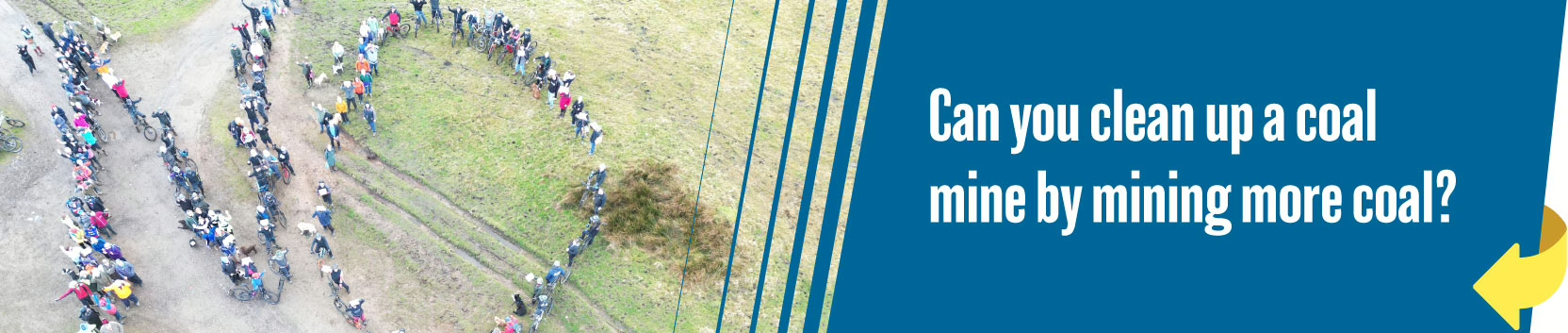
The UK Government’s proposed coal licencing ban wouldn’t currently prevent ‘re-mining’ coal tips. Additionally the patchwork of laws and policies in Wales is failing to prevent mining companies extracting coal or bringing new applications for coal mining and extensions in the past few years, with Local Planning Authorities shouldering the burden. This Bill may inadvertently increase pressure on resource-strapped Local Planning Authorities by fuelling a new wave of coal extraction applications, such as the current proposal by ERI Ltd to ‘re-mine’ two coal tips in Bedwas in a practice that dates back to at least 1984.
ERI Ltd is a private company offering to permanently remove tip stability risks at no charge to the landowner (Caerphilly Council) in return for selling the extracted ‘waste coal’, which we believe would be an attractive prospect to other landowners facing coal tip liabilities under the new Bill too.
Our recommendation 1
To prevent the unintended potential for the Bill to encourage an industry oriented towards ‘re-mining’ disused coal tips under the guise of preventing future instability, we recommend that the Bill includes a provision prohibiting coal extraction for commercial gain from disused coal tips.
Context 2
In our context to recommendation 1, we outline how – in practice – the Bill may fuel an industry oriented towards ‘re-mining’ coal tips. As a result, the decision to exclude a full Climate Change Impact Assessment and Carbon Impact Assessment from the Bill’s Integrated Impact Assessment should be reversed.
Our recommendation 2
The Bill should be accompanied by a full Climate Change Impact Assessment and Carbon Impact Assessment, given the potential of the Bill in its current form to encourage applications for coal tip ‘re-mining’.
Context 3
Over 85% of disused coal tips (and 90% of coal tips with higher stability risks) in Wales are located in the South Wales valleys, and – according to the Welsh Indices of Multiple Deprivation – are based in communities classed as amongst the 10% most deprived in Wales. As the Government’s Integrated Impact Assessment outlines, preventing coal tip slips would benefit lives, land, and housing in these areas.
Our recommendation 3
To realise this benefit, it is vital that the design and execution of stability works on coal tips prioritise minimising potential impacts on the wellbeing of these socio-economically disadvantaged communities – for example in operating hours, HGV movements, flora clearance, restriction of public access to green spaces etc.
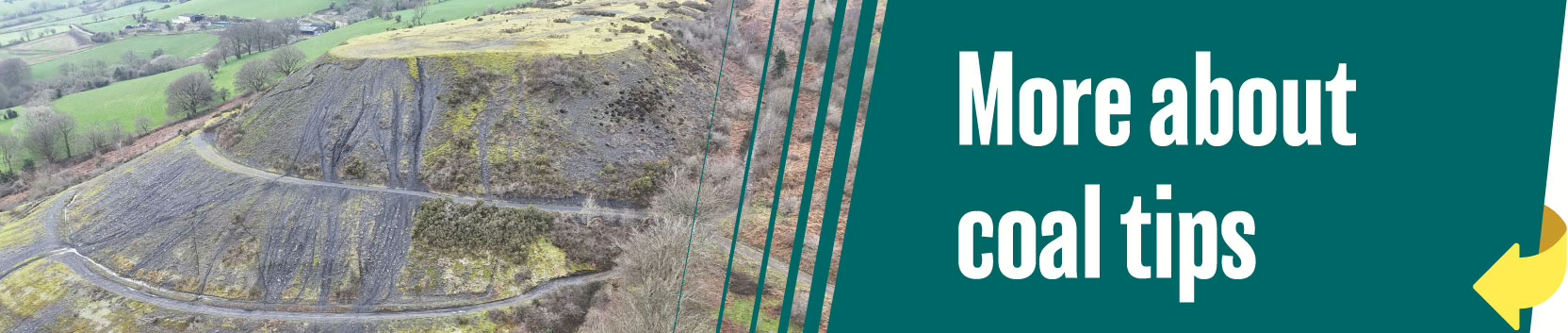
It is very important to prevent further damage to health when making coal tips safe. This is important for the workers employed to arry out the job, and for people living nearby, who have already suffered enough from the coal industry.