We sometimes hear from people that they are worried coal may be a necessary evil to keep us warm this winter. But the worst effects of this energy crisis was, and to some extent is, avoidable. Low-hanging fruit include home insulation, community-owned renewable energy generation, and an effective windfall tax on profiteering energy companies. These measures can be rapidly deployed, and we’ve seen from Covid what the Government can achieve big changes when there is political will to. Coal is not, and for the sake of our future, cannot be, the answer to how keep warm this winter. That is why half the demands of the Warm This Winter campaign centre around renewable energy and excluding fossil fuels as the way we will access affordable energy this winter and in future years.
The Warm This Winter campaign’s 3rd demand is access to cheaper energy—“Clean, renewable energy is now nine times cheaper than gas and can be brought online quickly”. Subsidy-free solar, in particular, has been demonstrated as cheaper than its fossil fuel alternatives. Prices have fallen dramatically for renewable energy since introduction – whereas fossil fuels continue to rely on huge Government subsidies, infrastructure, and underwriting of risk.
The 4th demand of the Warm This Winter campaign is to cut out fossil fuels as “it keeps us locked into an unaffordable energy for far longer than necessary”. The UK Government sells our natural resources to companies that extract it and sell it back to us at unaffordable prices to generate huge profits for themselves—never more so than in 2022.
The energy crisis has created a swing in vocal public support for coal mining since the energy crisis, and with it, political support for coal mine applications has grown in the highest echelons of Government. The Government has sent mixed signals recently on whether it will approve or reject the Whitehaven coal mine application, which has now been delayed by a further month to before the 9th December 2022.
It is particularly clear that the Government is using the energy crisis as an excuse to abandon its climate commitments wholesale since it’s citing the energy crisis for renewing its support for coal mine applications… that have nothing to do with power generation. All the current coal mine applications are to mine coal for industry—not power generation.
The Government will hand over £420 million in tax money to profiteering energy companies to keep old coal power stations, like West Burton, and coal units, like Drax, chugging along this winter. These power stations and units were scheduled for closure in 2022, but now these dirty, dusty relics will be stoked with thousands of tonnes of imported coal, paid for with our taxes. In fact this move is expected to generate so much pollution that the Government has instructed the Environment Agency to ignore its responsibility to enforce pollution limits when it comes to coal fired energy production this winter. People living locally to these power stations will pay the price in potentially dangerously poor air quality, but we will all pay the price in our taxes and in our future compromised by the climate change a reliance on coal fuels.
Rolling out home insulation tackles the energy crisis and bills not just this year, but for many years to come—and the impact is immediate. It would also help the Government get back on track with its climate commitments as housing is responsible for 19% of the UK’s carbon emissions. This should be a top priority for Government in tackling the cost-of-living crisis and energy crisis together this winter.
In 2012, the UK insulated 2.3 million loft or cavity walls. But a shift in Government policy saw uptake drop by 90%. This Government decision to cut support for home insulation after 2012 has cost taxpayers, like me and you, £1 billion in energy bills this year. If the Government had maintained the same level of support, nearly 50% of UK homes could have been insulated by now. A more recent scheme by the UK Government collapsed, and was blasted by the Audit Office for being “botched”. This would have significantly reduced the energy crisis this winter, along with our bills. Households living in homes with poor efficiency ratings will pay around £1000 more this winter.
The British public overwhelmingly support the rollout of renewables, with 78% supporting solar power, 75% offshore wind, and 70% onshore wind. Unlike non-renewable sources of power like nuclear power stations, renewable energy infrastructure can be rapidly scaled up and brought online. With clear public support, the Government could rapidly accelerate renewable energy roll-out that isn’t vulnerable to shifts in geopolitics and global supply chains.
Because renewable energy is modular—one wind turbine or one solar panel can be bought and set up, or 1000s—its more affordable for communities buy their own equipment and become power generators, with the profits returning to those communities rather than disappearing into the pockets of big business. The Government acknowledges the value of community-owned renewable energy, but isn’t doing enough to encourage it. Instead, the Government dropped the Social Investment Tax Relief for community energy and has failed to provide the financial guarantees it provides to other energy projects like nuclear power stations. If the UK faced this winter with a resilient network of renewable energy zones, our dependence on gas and fossil fuels would have been much lower, and energy prices would be more insulated from Russian sanctions, geopolitics, and global demand and supply shifts.
The Government imposed a windfall tax in May 2022 as a one-off tax on the record profits made by energy companies that are due to lifted Covid restrictions and supply concerns around Russia’s invasion of Ukraine. However, BBC reported: “BP reported its biggest quarterly profit for 14 years, making £6.9bn in the three months to June. Shell recorded even higher second quarter profits of £9bn and made £8.2bn in the following three months. The majority of the April to June takings won't be hit by the government's windfall tax, as it only applies from 26 May”. The Guardian reported “Shell has paid zero windfall tax in the UK despite making record global profits of nearly $30bn (£26bn) so far this year”. Yet the Government has resisted pressure to tax these record profits and redistribute to cushion energy prices, so less of the UK have to choose between food and heating this winter.
Today (Sat 15th October 2022) the Scottish government has stated that the “era of coal is over”. Lorna Slater, Co-leader of the Scottish Greens, announced at their party conference the preferred position against coal mining, for all types of coal.
This is essentially a ban on coal mining in Scotland, similar to the one on fracking. The Scottish Government doesn’t have ultimate say on mineral extraction, but the preferred position means that local councils won’t be able to permit new coal mines under Scottish policy.

Image credit: the Guardian
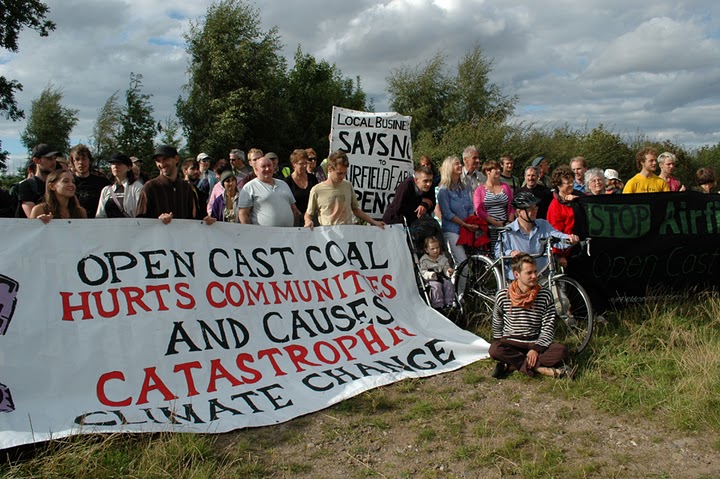
Scotland was once the heartland of UK coal mining, as the above 2008 image shows, Scotland dominated the UK in its extraction of coal via opencast mines. The last deep Scottish coal mine, Longannet pit, in Fife, closed in 2002 and the final coal load was transported from an East Ayrshire opencast coal mine in 2020. Longannet coal power station closed its doors in 2016, ending electricity production from coal in the country. However, in recent years there has recently movement towards an application for a new underground coking coal mine in Dumfries and Galloway.
At a site called Lochinvar an Australian company, NAE Ltd wanted to extract up to 33.7 million tonnes of coking coal for steelworks in the rest of UK and beyond (there are no major Scottish steel works using coal) NAE Ltd wanted to mine between 2025 and 2051, under a massive area under Canonbie near Gretna, in South West Scotland. This would have emitted around 73 million tonnes of CO2 and around 750 thousand tonnes of methane, a powerful climate change accelerant. This announcement should stop this application from ever progressing.

The area of the proposed Lochinvar coking coal mine
Coal Action Network strongly supports the Green Party’s position that, “I’m calling on the UK Government to follow us. To make the right call for once. To ban coal extraction for good.”
The UK government is still deliberating on whether to prevent an underground coking coal mine starting at Whitehaven, a decision is due this autumn. The Coal Authority has been taken to Judicial Review by Coal Action Network in the hope that it will reverse its decision on Aberpergwm underground coking coal mine extension. There are also two Welsh opencast coal extension proposals.
The UK government has been keen to be seen to say the right things regarding coal, but has failed to take the many opportunities to stop the mining industry to date.
Today’s decision has been hard won by the communities, campaigners and organisations such as Coal Action Scotland who fought opencast coal mine applications in Scotland and created the foundations for this decision.
Consultation question: Considering the information presented in this call for evidence paper, and your own knowledge and experience, what are your views on the extraction of coal in Scotland?
Our response: The Welsh Government's most recent policy statement on coal should provide a starting point for the Scottish Government to build upon (https://gov.wales/coal-policy-statement-html) in developing its own policy, as there are clear and relevant parallels between both Governments.
Both Wales and Scotland has a long legacy of suffering the localised impacts of environmental blight and hazardous conditions of coal mining, with nearby communities rarely seeing a significant share of the economic benefits. Wales is still littered with unrestored or poorly restored coal mines. It was reported that only this year are the final abandoned coal mines in Scotland being restored - again, often to revised, lower standards that what was promised nearby communities due to insufficient restoration bonds.
Now more is known about climate change, both Wales and Scotland have led the way in developing progressive policies and practice to realise their ambitious targets. This cannot include viably include coal, which is worse in CO2 emissions than natural gas and oil in its conversion factor to energy. The EIA Pathways to Net-Zero report make this very clear, underscoring that no new coal mining for any purpose can be part of a pathway to Net-Zero by 2050.
A critical part of that report is no new coal mining for any purpose. The report goes further to explicitly include coking coal for steel in this prohibition. Port Talbot Steelworks in South Wales and British Steel in England are the 2nd and 3rd largest single-site sources of CO2 in the UK - because they burn coal. Any policy that differentiates between the extraction of coal for energy production and coal for steel production, ignores this growing threat to meeting climate targets across the world. It would also ignore the rapidly escalating developments around the world in decarbonising the steel industry. Green steel is on its way, with the first delivery of commercial quantities made from Sweden in 2021. Unfortunately, once investors have opened a coal mine, they will seek return on that investment and find alternative markets for the coal, or laggard steelworks that still rely on coal in the future. So permitting new coal mining for steel will prop up the biggest polluters and discourage transition to new technology and practices.
There is no viable future for any of us that relies on coal to get us there. Scotland should be using its just transition fund to skill its inhabitants in the industries of the future, not ploughing people into the industries that destroy that future.
Coal Action Network is concerned by the content of the proposals:
The independent verification of applicants’ fossil fuel emissions was to be introduced to improve the reliability of this important information, and give confidence to the data reported by companies given access to the UK energy generation market. The postponement of this introduction therefore lengthens the doubts cast over the claims made by applicants to the capacity market. The Government claims the reason for the postponement is that there may not be enough independent verifiers in time for applicants to meet this condition. This is a failure in preparation on the part of the UK Government, to rigorously implement the climate policy it created and meet its own targets. We would expect this to be resolved well before the next capacity market auction as non-independent accounting for carbon emissions cannot become normalised or it will risk under-representation of the emissions of the CMUs and the UK overall.
The amendment to allow mothballed plants to bid in the upcoming capacity market auction is concerning where it may increase the potential for recently mothballed coal power plants to come back online and result in a higher proportion of coal within the UK energy mix 2023-24, until the 2024 coal phase-out date begins to have effect. We categorically oppose any move that slows down or reverses the declining use of coal for power in the UK—including the recent announcement by BEIS to delay the scheduled closure of West Burton coal fired power station. The UK Government states that it is necessary to allow mothballed power stations to participate in the upcoming capacity market auction to increase competition, which it hopes will reduce the cost of electricity generation—particularly when there are greater demands on the grid, such as during the winter months.
If the UK Government invested in renewable technology development and deployment to the same extent that it historically subsidised the fossil fuel industry, competition might realistically be fulfilled by renewable power generators instead. The current challenges are due, to an extent, the policy failure of this government and successive governments to put glib speeches on climate change into action. Moving forward, we urge the UK Government to avert this energy generation challenge recurring with a package of climate-friendly measures, including:
We are concerned that the 2024 coal phase-out date is being used by the UK Government to deflect criticism for its support of using coal up until that date, when what we need is the most rapid phase-out of coal that is possible as the UK careers further from its climate targets. This attitude has been captured in comments made this year by two leading cabinet Ministers, “Net zero is by 2050. We are not at 2050 yet.” – Jacob Rees-Mog, and “Give over. We’re still committed to phase out by Sept 2024.” – Kwasi Kwarteng (in relation to extending the coal powered operations at West Burton).
Finally, as we have commented before in previous consultations, the 2024 phase-out date should be legislated on, to ensure that it happens. As this consultation and other recent moves by this government show, this or any future administration is not currently prevented from taking steps which cast doubt on or undermine that commitment.