BACK TO TOP

Take action - let planners say no to new coal mining

TAKE ACTION

The public consultation window for the National Policy and Planning Framework represents the first opportunity since the new UK Government was formed to stop any new coal mine application winning planning permission across England. This sweeping change would go a long way to ruling out any new coal mines in the country.

BACKGROUND

For the last year we have been working behind the scenes to persuade political parties to commit to banning new coal mines in the UK. Thanks to our work, 5 major parties in Parliament committed to this in their manifestos, including the new UK Government.

One of the first actions the new Government is taking is to reform the National Planning Policy Framework. Their main focus is on building more houses and renewable energy projects. But one part of the NPPF advises local planning authorities on whether they should grant permission to applications for more coal extraction. Currently, the guidance is vague which and open to expensive legal challenge from mining companies which can make planners wary to refusing permission to new coal mine applications.

We know new coal extraction must be stopped, and we want the UK Government to ensure that happens in this reform by providing the clear direction planners need to confidently say NO to new coal mine applications.

The Government is running an open consultation on their proposed reforms until September 24th. The more folks who write in, the harder it'll be for the UK Government to ignore your collective call to draw the line in the sand right here, right now. Help us end coal mining in England by using our form to respond.

Published: 13. 09. 2024

Senedd Committee reports ‘Missed Opportunities’ in Restoring Nature at Opencast Coal Mines in Wales

Key report findings

The Senedd’s Climate Change, Environment, and Infrastructure Committee (CCEIC) has released a critical report on the management of opencast coal mining in Wales, particularly focusing on Ffos-y-Fran, one of the last opencast coal mines in the region. The report describes Ffos-y-Fran as a “symbol of the system's failures”, highlighting significant shortcomings in oversight.

The CCEIC specifically calls out Merthyr Tydfil County Borough Council (MTCBC) for its inaction regarding illegal mining activities that continued after the mine's license expired in September 2022. The report questions whether MTCBC could have done more, noting the Coal Authority's concerns about the lack of a robust closure plan.

Local residents have expressed deep concerns about their treatment by public authorities. The committee emphasized the need for improved transparency and engagement, urging MTCBC to involve residents in the revised restoration plan.

Campaigner Chris Austin welcomed the report, stating it offers strong recommendations for policy changes regarding coal mine restoration. He expressed hope that the findings would lead to better outcomes for Ffos-y-Fran and prevent future issues.

We praise the CCEIC for investigating the failures that allowed illegal mining to occur without repercussions. The focus now must be on the Welsh Government and Merthyr Tydfil County Borough Council implementing the committee’s concrete recommendations to restore justice to affected communities.

Among the 26 recommendations (see below for a full list), the CCEIC calls for the Welsh Government to ensure that policies on opencast coal mining are robust and protective of local communities. The Coal Action Network advocates for a clear ban on coal mining in Wales, similar to Scotland's 2022 decision, to prevent mismanagement in the future.

The report serves as a crucial reminder of the need for accountability and proactive measures in managing natural resources in Wales.

CCEIC recommendations

  1.  The Welsh Government must ensure that policies regarding opencast coal mining and other mining activities are robust, up-to-date, and provide appropriate protections for local authorities and communities.
  2. The Welsh Government must clarify its policies relating to coal tip remediation with the aim of ensuring that the negative impacts of opencast mining are not repeated.
  3. Planning Policy Wales says that coal extraction can be permitted “in wholly exceptional circumstances”, where the proposals “demonstrate why they are needed in the context of climate change emissions reductions targets and for reasons of national energy security”. The Welsh Government should clarify the criteria that must be used when assessing proposals in this regard.
  4. The Welsh Government should make the Coal Authority’s best practice guidance recommendations into statutory requirements.
  5. The Welsh Government must consider how the best practice guidance can be applied more broadly, particularly for coal-tip reclamation.
  6. The Welsh Government must engage with the UK Government and Local Government to determine how to address the funding shortfall for site restoration.
  7. The Welsh Government should commission an independent review to assess the extent of the funding needed to restore opencast sites to an acceptable level. The independent review should consider what constitutes an “acceptable level” in consultation with local authorities and communities.
  8. The Welsh Government must clarify the roles of local authorities, the Coal Authority, and Natural Resources Wales in the restoration of opencast sites, with particular emphasis on their responsibilities in the decision-making process, and make this information publicly available.
  9. The Welsh Government should require local authorities to ensure all Planning Officers’ reports are available online alongside associated planning documents, including revised restoration plans, where relevant.
  10. The Welsh Government must engage with local authorities to assess and meet the future staffing needs of local authorities for specialist roles such as mineral planners.
  11. The Welsh Government should reconsider the proposal from the 2014 report to establish a virtual “Centre of Excellence” for restoration planning, particularly in light of potential coal-tip reclamation proposals, and lead discussions with local government on how to implement this.
  12. The Welsh Government must engage with the UK Government with the aim of removing the Coal Authority’s statutory duty to maintain and develop an economically viable coal mining industry.
  13. The Welsh Government must consider making a degree of community ownership a requirement for opencast sites and similar developments, including coal tip reclamation sites.
  14. The Welsh Government should review and update the Minerals Technical Advice Note 2 (MTAN2) to ensure it is fit for purpose, particularly in the context of new developments and coal tip remediation.
  15. The Welsh Government should incorporate provisions for the restoration of former opencast sites within the forthcoming Disused Tips (Mines and Quarries) Bill.
  16. The Welsh Government must proactively engage with the UK Government to seek funding for coal tip remediation.
  17. The Welsh Government must mandate public consultation for all stages of the restoration process, including when revised restoration plans are brought forward.
  18. The Welsh Government should advise local authorities to designate a specific officer as a point of contact for the local community, providing a direct communication channel between residents and local authorities on matters relating to sites or similar developments.
  19. The Welsh Government should advise local authorities to create online portals where residents can access up-to-date information on all stages of the restoration process.
  20. The Welsh Government should encourage the use of citizens' assemblies as forums for discussing the future of restoration sites, particularly where restoration failed to meet the original planning permission and compromises need to be made.
  21. The Welsh Government must explore stronger enforcement mechanisms to address breaches of planning controls without delay, such as the mining activities that continued at Ffos-y-Fran after the licence expired.
  22. In the event that the water cannot be drained from the voids at the site, Merthyr Tydfil County Borough Council must ensure that any water bodies resulting from the restoration at Ffos-y-Fran are safe and provide benefit to the local community.
  23. Merthyr Tydfil County Borough Council must ensure that the revised restoration plan reflects, as a minimum, the objectives of the original restoration plan, including: safe public access across the East Merthyr historic landscape with a new network of trails and footpaths; sustainable wildlife habitats and biodiverse environmental sites; protection and restoration of surviving heritage features; and the return of most of the site for traditional commoners’ use.
  24. Merthyr Tydfil County Borough Council should fully involve local residents in the consideration of revised restoration plans for the Ffos-y-Fran site.
  25. Merthyr Tydfil County Borough Council should publish the application for the revised restoration plan at Ffos-y-Fran and the planning officer’s associated reports.
  26. The Welsh Government should consider the broader implications of the failures at Ffos-y-Fran and implement systemic changes to prevent similar issues in future, including in relation to coal-tip reclamation sites.

Own emphasis

UK election 2024: Parties line up to ban more coal mining

2024 election manifestos

Pledges:

“...we will not grant new coal licences and will ban fracking for good.”
Manifesto in full

Pledges:

“Maintaining the ban on fracking and introducing a ban on new coal mines.”

Manifesto in full

Pledges:

“Cancel recent fossil fuel licences such as for Rosebank and stop all new fossil fuel extraction projects in the UK.”

Manifesto in full

Pledges:

“Ban new coal licences. Follow the SNP Scottish Government’s lead and commit to no support for new coal mines, which would undermine our action to reach net zero.”

Manifesto in full

Pledges:

“...are opposed to... new open cast coal mines. Opencast mine sites should be fully restored for the benefit of local communities, and should never be used as a guise for private companies to undertake further coal extraction.”

Manifesto in full

Email your election candidates about the West Cumbria coal mine

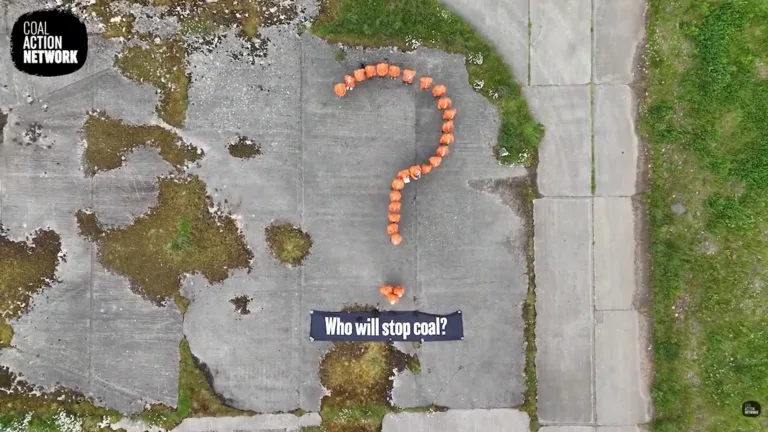
Coal Action Network asked Who will stop coal? last weekend in Whitehaven, West Cumbria. At the site of the proposed coal mine, members of the local community and supporters gathered to ensure that the question of the mine is being put to election candidates. Now we need you to crank up the pressure and make sure all election candidates across the UK faces this question as they could decide the fate of the coal mine if elected and legal challenges to the mine are successful next month...

It's not just about one coal mine...

The next Government may have the opportunity to not only stop the West Cumbria mine, but legislate an end to coal mining in the UK forever. We will be working hard behind the scenes to make that happen ­- but, the more you can help us, the better. Join us in writing to your local candidates (automatically selected) - this could be the first step in them helping to end coal mining in the UK for good.

Check out our action!

Welsh position on a coal ban needs to change

A response from the Welsh Climate Change Minister

Open letter to the Welsh Climate Change Minister... and their reply in full

(Click for PDF)

Open letter

Minister's reply

Background

On 23 October 2023, over 30 Wales-based NGOs, businesses, and community groups signed an open letter to Wales’ Climate Change Minister, Julie James, calling for the Welsh Government to ban coal mining once and for all (sent by Climate Cymru). On 10th January 2024, Julie James wrote back—but claims a ban isn’t needed, even though 1.6 million tonnes of CO2 could have been prevented since 2022 if the Welsh Government had adopted a ban. That failure has caused 362 additional deaths from climate change related causes. Julie James’ claims just don’t stack up against those lives lost. Here’s why:

What the Minister didn’t respond to

The open letter to Julie James highlighted that an issue with the current policy is that it is riddled with caveats and exceptions. Carmarthenshire County Council’s Planning Officer even wrote in September 2023 that it was “difficult to know for certain how to interpret the coal policy”. Julie James failed to respond to this point entirely. A clear ban would remove the existing ambiguity that makes the current policy challenging to apply.

Julie James also did not respond to our point that Merthyr (South Wales) Ltd would not have been able to mine 500,000 tonnes of coal from Ffos-y-fran over the past 1.5 years if there was a clear ban on coal mining. The mining company exploited the exceptions in existing policies to secure a de facto extension. To protect against this climate assault recurring by closing the loopholes, a clear coal ban is needed now.

In the open letter to Julie James, it’s stated “A coal mine ban can be drafted is such a way that allows for the safe winding down of existing coal mines, and Coal Authority access to fulfil its regulatory duties”. That didn’t stop Julie James trying to use that against a ban anyway: “we also have a duty to manage the safe closure and restoration of existing and historic mining infrastructure”. Julie James accompanies this with a reason that’s even more bizarre: “The incidental extraction of limited coal may also be required during the construction of infrastructure projects”. Those wouldn’t be coal mines so wouldn’t fall under a ban—the Coal Authority even licences this differently as an ‘incidental coal agreement’. The burden and hazards of historic mines across Wales would diminish under a coal ban, rather than risk being added to—a very real risk in light of Ffos-y-fran.

The Minister's presumptions against a coal mine ban

Julie James says “…coal licences may be needed in wholly exceptional circumstances and each application will be decided on its own merits”. But this creates exactly the problem that Julie James lamented in her letter in October 2011 to then Minister for BEIS Kwasi Kwarteng: "both the developer and the Coal Authority committing significant resources respectively to preparing and determining applications... before Welsh policy can properly be applied”. A coal ban would end the pipeline of applications, and the private and public funds they waste.

Julie James twice hails “the presumption being against extraction” in current policies. We hope it’s not presumptuous to argue for a commitment stronger than a ‘presumption’ in the face of catastrophic climate change. What justification could opening a new coal mine have in the face of the 362 lives that’ll be cut short due to the Welsh Government’s refusal to ban coal mines up until now? Climate vandalism over the past year shows nothing short of a ban on coal mining can protect the lives and ecosystems at stake.

Finally, Julie James concludes her letter by claiming the “Welsh Government has adopted and implemented the strongest policy opposition to coal extraction across the UK Governments”. Even if that were true, the Welsh Government clearly needs to go further given current policies have failed to prevent 1.6 million tonnes of avoidable CO2 in the past 1.5 years. But it’s also not true. Julie James’ claim to be leading on a progressive coal policy is based on her comparison to a similar one set out in the Scottish Parliament back in November 2021. She ignores the de facto ban that the Scottish Government more recently introduced in October 2022—as referenced in the open letter to Julie James. If Julie James actually wants the Welsh Government to boast the strongest policy opposition to coal mining, she’ll have to be bolder by committing to a ban on coal mining in Wales.

Coalition backing a coal mining ban in Wales

Over 30 Welsh NGOs and businesses call on Welsh Government to finally ban coal mining on Welsh soil.

Over 30 Welsh NGOs and businesses have signed a letter to Welsh Minister Julie James and Deputy Minister Lee Waters, demanding they draw a line in the sand and announce ban on any further coal mines on Welsh soil. The letter was sent to the Welsh Government on 11th October 2023.

Application to extend coal mine highlights existing policies causing confusion

The Welsh Government already has policies against new and extended coal mines but these are caveated and confusing. The renewed call for a clear coal mining ban comes less than a month after existing policies would have failed to stop a recent bid to reopen the shuttered Glan Lash opencast coal mine in Carmarthenshire. The coal mining company, Bryn Bach Coal Ltd, applied to double the size of the coal mine over six years. Controversially, Carmarthenshire County Council’s Planning Officer advised Councillors in the Officer’s Report, and at the Planning Hearing, that "Overall, it is considered that the proposals would largely meet the criteria of the coal policy" (p66). Ultimately, the application was rejected on the grounds of local ecological impacts—but it has exposed the weakness of existing policies, with the Planning Officer adding that it is “difficult to know for certain how to interpret the coal policy” (p66).

Call to follow Scotland’s coal mine ban

The open letter coincides with the first anniversary of Scotland’s announcement of its own de facto ban on coal mining, in October 2022. Daniel Therkelsen, campaigner at Coal Action Network says “The Welsh Government faces a choice—align itself with the backtracking and flip-flopping of the UK Government, or regain its international leadership position alongside Scotland, as a progressive country of confidence and stability for green industry to thrive.

Minister Julie James recognises resources being wasted

Welsh Minister for Climate Change, Julie James, wrote a letter to the UK Government in October 2021, lamenting the current policy situation, which “results in both the developer and the Coal Authority committing significant resources respectively to preparing and determining applications”. NGOs and businesses that signed the open letter to Ministers Julie James and Deputy Minister Lee Waters are calling for a clear coal ban that clears up the confusion Carmarthenshire Council identified and the caveats that creates uncertainty and potentially wasted resources for coal mining companies, such as Merthyr (South Wales) Ltd, which also applied for an extension in September last year but was conversely rejected due to the Welsh Government’s coal policies by Merthyr Tydfil County Borough Council.

Opinion

Daniel Therkelsen, Campaigner, Coal Action Network: “The Welsh Government has said their position is ‘clear’, that ‘they want to bring a managed end to the extraction and use of coal’—but their jigsaw of policies on coal is as clear as the coal dust that continues to plague communities living around mines in South Wales, ban new coal mines and extensions and be done with it. Nothing about a ban would prevent access by the Coal Authority to address safety issues.”.

Extra reading...

Overview and key facts on Glan Lash opencast coal mine extension application. The extension application was to extract a further 95,038 tonnes of coal (more than the original coal mine, licenced for just 92,500 tonnes).

Key Welsh Government policies relating to coal extraction include:

Planning Policy Wales (Edition 11) s.5.10.14 “Proposals for opencast, deep-mine development or colliery spoil disposal should not be permitted. Should, in wholly exceptional circumstances, proposals be put forward they would clearly need to demonstrate why they are needed in the context of climate change emissions reductions targets and for reasons of national energy security.”

Minerals Technical Advice Note 2: Coal “Government policies and planning guidance on the provision of coal have previously been set out in Mineral Planning Guidance Note 3 (MPG3) published in 1994 for England and Wales. MPG 3 (1994), apart from the Annexes, was cancelled by MPPW. This MTAN supersedes the 1994 Annexes, which are hereby cancelled… This coal MTAN sets out how impacts should be assessed and what mitigation measures should be adopted, and seeks to identify the environmental and social costs of coal operations so that they are properly met by the operator.”

Coal policy statement, 22 March 2021: “The opening of new coal mines or the extension of existing coaling operations in Wales would add to the global supply of coal, having a significant effect on Wales’ and the UK’s legally binding carbon budgets as well as international efforts to limit the impact of climate change. Therefore, Welsh Ministers do not intend to authorise new Coal Authority mining operation licences or variations to existing licences. Coal licences may be needed in wholly exceptional circumstances and each application will be decided on its own merits, but the presumption will always be against coal extraction.”

Published: 10.10.2023

New vacancy: Policy Change Campaigner

Vacancy: Policy Change Campaigner (UK Coal)

Term: 2 days/week (should be available Tuesdays)

Salary: £31,200 FTE (£12,480 pro-rata)/freelance £ 173 day rate

UK-based, work-from-home.

Application deadline: 0900 Mon 02nd October 2023

Background to the role

The UK currently has four coal mines at varying points in the planning pipeline. In December 2022, the UK Government surprised the nation by approving a new coal mine in Whitehaven, West Cumbria. In the same year, a coal mine in South Wales was licenced to operate for nearly 20 years more and double in size. The spectre of new coal mines looms as the UK Government’s opposition to coal weakens with senior politicians in the UK and Welsh Government increasingly repeating industry lies and throwing support behind UK coal mining—a disastrous shift that’ll reverberate through the world.

Purpose

You will create and deliver a political strategy to secure a moratorium (ban) on all forms of coal mining in the UK Government by January 2026, and the Welsh Government as a secondary goal.

You will work in a team alongside two other coal campaigners. In our non-hierarchical structure you will hold equal agency in decisions affecting the organisation, and, after your probationary period is passed, you will have the option to become a voluntary Co-Director, sharing legal responsibility for the organisation.

If aspects of the Role Description are unfamiliar to you, please see the 'Non-essential' section of the Person Specification for details of what you can learn on the job.

Responsibilities

  • Campaign Development
    • Create and deliver on a political strategy to deliver a ban on coal mining in the Senedd and Westminster.
    • Engage and network with allied organisations to increase our political leverage, impact, and opportunities.
  • Media and press
    • Stay up-to-date on developments relating to political developments that create opportunities for coverage of our demands for a ban on coal mining.
    • Work with supporters taking action to gain local and national media coverage
    • Amplify related media and press gained by other groups where relevant
    • Produce blog posts and articles relevant to CAN’s campaigns
  • Network building
    • Expand your network of allied MPs and convince those on the fence to support a ban on coal mining.
    • Work with frontline groups affected by coal mining to amplify their voices and lived experiences to guide political advocacy
    • Work across a network of allied organisations
    • Engage other allied organisations so that they might join our effort to secure a political ban on coal mining
    • Develop and engage CAN’s supporter base to sustain longer term pressure through regular emails, text messages, and social media posts
    • Attend meetings with allied organisations, movers, and shakers.
  • Actions
    • Build a ground-swell of political support for a ban on coal mining in the Senedd and Westminster.
    • Run digital actions using a diverse range of tactics to both engage supporters, and apply pressure on our targets
    • Support other groups wanting to organise their own actions
    • Create resources that can be used by local and frontline groups, both to support specific actions, and as templates going forward
    • Occasional public speaking at events, actions, or media appearances
  • Organisational
    • Participate in collective decision-making processes about strategy and the running of the organisation
    • Contribute to building funding bids and reporting back to funders
    • Take and/or share responsibility for a range of other short-term operational tasks which are shared and sometimes rotated among the CAN team e.g. organising an away day, improving internal comms, participating in hiring processes etc. These responsibilities can be tailored to your expertise and interests.
    • Any other appropriate tasks as agreed with the team

Person Specification

Essential

  • Experience of securing political change at the national level in the UK or Welsh Government.
  • Experience of inside-track engagement with Members of Parliament and their aides.
  • Ability to speak to senior politicians confidently and convincingly.
  • Experience of sustained campaigning and mobilising others to take action.
  • Proven ability to write, copy-edit and proofread using clear, persuasive, and plain language with good command of written English for a variety of contexts.
  • Ability to manage your own workload and use your initiative, working remotely, unsupervised with transparency
  • A get it done approach, not 3 months to draw up a strategy.
  • Experience of taking collective decisions or action in a non-hierarchical space such as a co-op, volunteer group, activist collective or flat-structured workplace
  • Understanding of, and/or ability to teach us more about environmental justice, solidarity work, environmental racism, and just transition
  • Willingness to learn new skills relevant to the job description
  • Willingness to travel to meetings and events, and to work some flexible hours alongside regular core hours, including occasional weekends and evenings, to be agreed as a team.

Non-essential

These skills and knowledge will help you in the role, and if you don’t have them we can arrange training for you to learn them:

  • Using Action Network to schedule email actions and events
  • Knowledge of the current landscape of coal campaigning in the UK

How to Apply

Please read the Job Description and Person Specification before applying for this role.

  • Provide a CV and up to two pages of text addressing point-by-point how you meet the person specification, giving examples of relevant experience (paid or voluntary).
  • Complete and return an Equal Opportunities Monitoring form (this will be processed anonymously)

Deadline for applications is 0900 Mon 02nd October 2023.

Please send all applications and queries to HR@coalaction.org.uk with the words ‘Policy Change Campaigner’ in the subject line.

Recruitment Process

  1. You will be contacted by Wednesday 04th October 2023 as to whether you have been shortlisted and offered an interview.
  2. Interviews will take place on Monday 16th and Tuesday 17th October 2023.
  3. If we are able to offer you the role will be notified by Friday 20th October 2023.
  4. Ideal start date for the role is ASAP.

Interviews will friendly and informal, taking no more than one hour and be held over Zoom. Please advise us if there are any accommodations you will require in order to attend the interview and participate fully in it.  We see the interview as a two-way process, so you’ll be invited to challenge us or ask questions at any point.

Inclusive Hiring Commitment

We particularly welcome applicants from backgrounds currently under-represented in paid roles in the UK environmental movement, including people from BAME and migrant backgrounds, refugee backgrounds, people who identify (or have identified in the past) as working class, gender diverse people, people with disabilities, and people from or based in the North of England, Wales and Scotland.

If our equal opportunities monitoring indicates that we have not received a diverse range of applications then we will re-open the application process, in which case you will be notified and your application will be automatically re-submitted.

If a final decision rests on two applications of equal standard, the principle of  ‘positive action’ will be applied with regard to protected characteristics.

Home and office working can be supported with equipment if necessary

We are committed to improving our commitment to diversity and inclusion, and to decolonising the environmental movement. We welcome applications from people who will challenge us to go further in doing this.

Please contact us if you have questions or comments regarding accessibility and inclusivity or about other aspects of the job advert or recruitment process.

Please inform us if you would need paid childcare cover or any adjustments relating to disability in order to attend an online interview.

Workplace details

We are a remote-working organisation of a 7-person staff team, becoming 8-people with this recruitment. This represents significant recent growth for us.

We meet on zoom once weekly as a whole team (Tue afternoon) and ad hoc regarding campaigns. In between we communicate using email and Signal. We meet in-person several times a year.

Apart from one staff member, we all work part time and are supportive of flexible working arrangements alongside core hours. We are sometimes required to work outside of normal office hours, for example to attend events.

We are a non-hierarchical organisation, so we do not have managers or bosses but make agreements and decisions by consensus, and direct our own workloads collectively and individually. We have equal say in decisions affecting our work.

We support our staff with a range of enhanced leave options and employment terms in our contract.

We are registered as a not-for-profit company limited by guarantee and as such are legally required to have directors who take legal responsibility for the organisation. To maintain a commitment to non-hierarchy, all employees are invited to become directors after passing probation, but this is entirely optional.

We recognise that non-hierarchical organisations are not immune to creating barriers to participation in the workplace, so we encourage people to challenge us to improve and adapt our workplace policies, structures, internal communications and working culture to become more inclusive.

Published: 13.09.2023 Updated 20.09.2023

Energy Bill - cut out coal!

The journey so far...

FIRST... Coal mining ban proposed by House of Lords

With a margin of 3 votes (197 for vs 194 against) in the House of Lords on 17th April 2023, Lord Teverson amended the Energy Bill to include a new clause on the 'prohibition of new coal mines' (a ban on the Coal Authority licencing any new coal mining in the UK). This wouldn't stop any coal mines already licenced, and would only apply 6 months after the bill had been passed - but it would cut off the pipeline of new coal mine applications. Just one Conservative Lord voted for this amendment - Lord Deben, Chairman of the UK's independent Committee on Climate Change.

Lord Teverson referred to the Whitehaven coal mine, approved in December 2022, when proposing the amendment, saying "If that happens once, it can happen again - that is why this amendment is so important," he said. He had previously believed a ban was not necessary because it was "totally and absolutely obvious" that building a new coal mine "would be a really stupid thing for a country to do".

THEN... Coal mining ban stripped out by UK Government

Back in the House of Commons, the UK Government Ministers stripped out the amendment banning new coal mines at the Committee-stage, before the revised Energy Bill could be debated and voted on in the House of Commons. MP Caroline Lucas said the Government's approach was "well and truly stuck in the last century...after endlessly repeating the importance of no new coal at COP26, its words have proved to be meaningless". Shadow energy secretary Ed Miliband had said Labour would back the ban.

Opposing the amendment, minister Lord Callanan said the government was committed to phasing out coal but argued that an outright ban could cause a "severe weakening of our security of supply".

NOW... Coal mining ban re-proposed by MPs Chris Skidmore & Wera Hobhouse

In the report stage, Conservative MP Chris Skidmore and Libdem MP Wera Hobhouse have attempted to re-introduce the coal mine ban by tabling similar wording as Lord Teverson's amendment to be put back into the Energy Bill (clause N2). MP Chris Skidmore also seeks to strengthen the UK Government's earler commitment to phase out coal being used to generate energy by tabling another clause (N3) - a prohibition of energy production from coal by 1 January 2025. This would change put the UK Government's policy commitment into legally-binding legislation, making it much harder for this or successive Governments to back-track on that commitment.

What needs to go into the Energy Bill

Amongst other important ammendments, the wording of the two amendments your MP needs to support are:

NC2 Tabled by: Chris Skidmore & Wera Hobhouse
To move the following Clause—“Prohibition of new coal mines
(1) Within six months of the day on which this Act is passed, the Secretary of State must by regulations prohibit the opening of new coal mines and the licensing of new coal mines by the Coal Authority or its successors.
(2) Regulations under this section are subject to the affirmative procedure.”

NC3 Tabled by: Chris Skidmore

To move the following Clause—“Prohibition of energy production from coal
(1) The Secretary of State must by regulations provide for the UK to cease energy production from coal from 1 January 2025.
(2) Regulations under this section may amend primary legislation (including this Act).”

Take action

The report stage for the Energy Bill is currently scheduled for Tue 5th September 2023, the day after the House of Commons returns from summer recess, at which point MPs will debate the various amendments tabled to the Energy Bill. The amendment will almost certainly be debated, however there’s no guarantee that it will be pushed to a vote – this depends on a range of different factors, including MPs’ priorities and whether the amendment is selected by the Speaker for a vote.

THE ASK: write to your MP, asking them to speak in favour of amendment NC2 and NC3 during the debate, and to vote for it, if it is "pushed to a division".

Senior Conservative Minister already admitted need for reform

We are now able to reveal correspondence between Welsh Minister for Climate Change, MS Julie James, and then UK Government Minister Minister of State for Energy, Clean Growth
and Climate Change, MP Greg Hands. In a letter dated 07 January 2022, Minister Greg Hands states:

"I do agree that the Coal Authority’s statutory duty to promote an economically viable coal industry, as set out in the Coal Industry Act 1994, is at odds with our climate leadership ambitions and policies on coal so we are looking at measures to review that duty. I understand our officials have agreed to meet to share our thinking on a future licencing regime that reflects our different administrations net zero and climate change goals."

The amendment(s) proposed by MP Chris Skidmore (and Wera Hobhouse) would achieve what Greg Hands admits is necessary to meet the Government's climate commitments. So why did the UK Government remove Lord Teverson's amendment to achieve the same? What has the UK Goverment done to change the "future licencing regime"?

Senior Welsh Labour Minister agrees on need for reform

Welsh Labour Minister for Climate Change in the Welsh Government Julie James wrote to then Secretary of State Department of Business, Energy & industrial Strategy Kwasi Kwarteng in the UK Government on 26 October 2021, stating:

"...we consider the statutory duty of the Coal Authority to develop and maintain a viable coal extraction industry must be removed if we are to achieve our policy ambitions." adding "I seek to understand how the [Coal Industry] Act will be amended to reflect the need for the Coal Authority to consider climate policy in its decisions". Julie James is looking for reform rather than dissolving the Coal Authority, saying "....the Coal Authority has an important role to play in rapidly winding down remaining mining operations and delivering long-term environmental protection. In doing so, the Coal Authority has an important role in ensuring those communities affected by the legacy of coal mining receive a just transition."

Welsh Labour clearly indicate the need to reform the Coal Authority in a way that would stop new coal mine applications being licenced and support existing operations winding down, with a just transition for workers involved.

Background

The need for law change: This year, Coal Action Network took the Coal Authority to the Cardiff Courts in a judicial review challenging the Coal Authority's insistence that it cannot consider matters such as climate change in determining whether to award a coal mining licence. The judge agreed with the Coal Authority, which confirms that legislative reform of the Coal Authority is needed to bring its licencing function in line with climate commitments - such as that proposed in amendment NC2 to the Energy Bill.

Time's running out: Since senior UK and Welsh Government Ministers admitted the need to cut off the pipeline of new coal mining applications, both the UK and the planet experienced its hottest ever days (2022 & 2023), June 2023 was the UK's hottest ever, and July 2023 was confirmed the hottest month worldwide since records began, and this year the world has been rocked by wild-fires, flooding, and storms. So the sense of urgency to ban coal mining and use has become even stronger.

Security of supply concerns: Alongside increasing this escalating urgency, TATA Port Talbot steelworks announcing it will imminently transition to recycling steel or else face closure, and British Steel reporting it will close its coke ovens. A credible home insulation plan would remove any energy security issues for keeping warm this - and future - winters, rather than spending more of my tax money propping up dirty coal power stations again. These are the only significant consumers of coal remaining in the UK so there is no energy security case to be made for continuing to mine coal in the UK.

Published: 18.08.2023 Updated: 22.08.2023

Campaigns on UK coal mines

UK & global coal mining & use

Santa delivers Christmas coal to Gove for Whitehaven approval

Cumbria mine puts gove on naughty list: santas deliver sacks of ‘coal’ to him at his whitehall office.

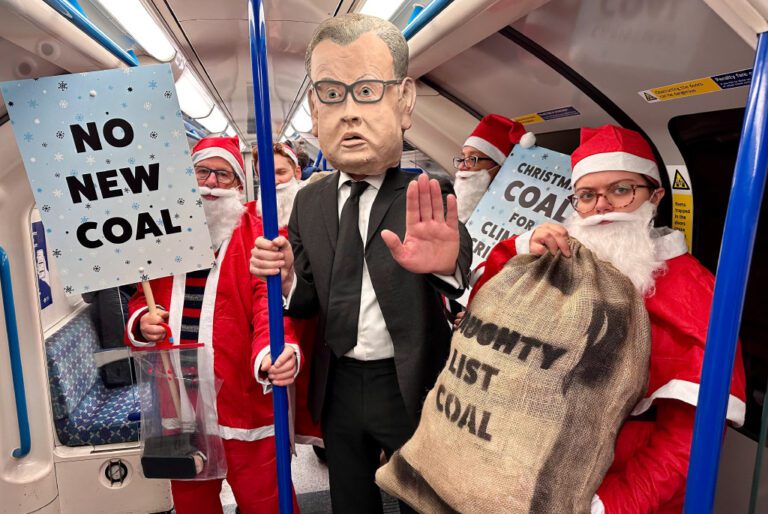
  • Michael Gove is put on the naughty list for Cumbria Whitehaven mine; a gang of Santas delivers coal to Gove’s Whitehall office on behalf of Coal Action Network and Lush Cosmetics in a festive protest.
  • Gove has been criticised by his own party, the Government’s own Climate Change Committee, Industry Leaders, and Environmental groups.

On Wednesday (21/12/2022) a gang of Santas delivered sacks of ‘naughty list coal’ to Michael Gove at his Department of Levelling Up, Housing, and Communities office in Whitehall on behalf of Coal Action Network and Lush cosmetics.  Holding signs reading “Christmas coal for climate criminal Gove ”, and “No new coal”, the festive action was in protest against the recent Whitehaven coal mine approval.

Since Gove announced his approval of the Whitehaven coal mine application on 7th December, he has been heavily criticised by members of his own party, the Government’s own Climate Change Committee, industry leaders, and environmental groups. Over the original coal mine timeline, the coal operator would mine 64 million tonnes of coal, resulting in 200 million tonnes of CO2, and 340 thousand tonnes of potent climate change accelerant, methane.

Gove’s 15-page letter outlining his reasons for approving the Whitehaven coal mine has already been left in tatters by steel industry leaders who have said British Steelworks can’t rely on Whitehaven coal as it’s too high in polluting sulphur. Gove’s justification was dealt another blow when Owen Hewlett, the chief technical officer of Gold Standard offsetting, called the idea of making the coal mine carbon-neutral through Gold Standard offsetting “obviously nonsense, morally nonsense and technically insane”.

Coal Action Network said “We’re here because Santa knows who’s been naughty and nice, and Gove’s top of the naughty list for approving the Whitehaven coal mine. If more coal mines are really Gove’s only levelling up offer, Santa’s got a message for him this Christmas: climate change only levels down. It’s a dead-end industry distracting from the levelling up potential of jobs with a future.”

Lush campaigns manager Andrew Butler says, “Lush will be Santa for lots of people this Christmas and while we usually provide nice presents, Gove is firmly on our naughty list. But to say Gove has been naughty is a gross understatement. His reckless decision to approve a new coal mine in West Cumbria puts us all on the path to climate catastrophe and makes extreme weather like the floods that displaced tens of millions of people in Pakistan more likely. Gove is not just naughty, he is a climate criminal.”

In a joint statement Coal Action Network and Lush Santas say, “We must remember that individuals are making these decisions that cost us billions, our quality of life, and our very future. Where is the individual accountability for that? Families are freezing in their homes this winter because someone in Government effectively stopped the home insulation programme around a decade ago. Instead of holding that person responsible and reversing that damage, Gove approves a coal mine for a steel industry that doesn’t want it, derailing our climate promises. Santa is all about individual accountability and doesn’t care if someone hides behind a Ministerial title—so these sacks of ‘coal’ are delivered to Michael Gove personally this Xmas.”

Published 23/12/2022

Informal briefing to Welsh Government on Aberpergwm and Welsh coal

This week Coal Action Network held an informal briefing in the Senedd (Welsh Parliament) sponsored by Jane Dodds, Member of the Senedd (MS).

The event was attended by MSs and their staff who heard why the proposal to extend Aberpergwm coal mine should be stopped and how Universal Basic Income could answer some of the issues for workers during the transition to a low carbon economy.

Haf Elgar from Friends of the Earth Cymru, Rhiannon Hardiman from the Future Generations Commission and Jane Dodds spoke alongside Anne Harris from Coal Action Network.

The court hearing for Coal Action Network’s Judicial Review of the Welsh Government and Coal Authority’s inaction and poor decision making, respectively, will take place in March 2022. We are hopeful that the decision will be returned to these authorities to re-decide.

Below is the summary text of the written briefing given out at the event and the full document can be downloaded in Welsh and English from below.

If in mobile view, scroll down for English language version and for PDF downloads of the briefings.

Crynodeb

Mae Cymru wedi cymryd camau pendant yn erbyn cloddio am lo yn y blynyddoedd diwethaf. Defnyddiwyd Deddf Cymru 2017 i rwystro estyniad i waith glo brig Nant Helen. Mae angen gweithredu tebyg nawr yn erbyn pwll glo tanddaearol Aberpergwm.

Mae Energybuild Cyf. yn ymestyn ei bwll glo golosg Aberpergwm ac am barhau i wneud hynny tan 2039. Mae hyn yn mynd yn groes i Ddeddf Llesiant Cenedlaethau’r Dyfodol drwy waethygu’r argyfwng hinsawdd a fyddai’n effeithio ar y genhedlaeth nesaf o amgylch y byd, yn ogystal â niweidio enw da Cymru’n rhyngwladol.

Mae gwaith dur Port Talbot yn bwriadu datgarboneiddio drwy drawsnewid i wneud dur newydd o fetel sgrap heb ddefnyddio glo; fel arall bydd yn rhaid iddo gau, gan ddiswyddo ei staff, a’r rhai mewn cadwyni cyflenwi. Does dim lle i fwy o gloddio am lo yn y Gymru fodern.

Mae glo’n cael ei gymysgu yng ngwaith dur Port Talbot ac, o’r herwydd, nid yw cloddio mwy o lo yng Nghymru’n lleihau’r swm a echdynnir mewn mannau eraill. Mae’n rhaid i fwy o lo gael ei fewnforio o hyd i’w gymysgu â glo Cymru mewn gweithfeydd dur, gan allforio rhai o’r problemau amgylcheddol a chynnal diwydiant anghynaliadwy yn hytrach na chwilio am atebion hirdymor.

Mae cyllid Energybuild Cyf. yn dangos y gallai’r cwmni hwn werthu’r pwll os yw’n gallu ymestyn. Gallai’r cwmni newydd wneud y mwyaf o echdynnu glo a gwerthu’r glo i’r cynigydd uchaf, neu ddiswyddo nifer fawr. Mae yna ffyrdd eraill o wneud dur a ffynonellau eraill o hidlo dŵr yn lle glo carreg.

Mae dau gynnig arall i ehangu pyllau glo yng Nghymru y mae angen i’r llywodraeth eu hatal, a hefyd sicrhau bod safleoedd mwyngloddio blaenorol yn cael eu hadfer yn llawn.

Glo yw treftadaeth Cymru, nid ein dyfodol.

Summary

Wales has taken decisive action against coal mining in recent years. The Wales Act 2017 was used to block the extension of Nant Helen opencast coal mine. Similar action is now required against Aberpergwm underground coal mine.

Energybuild Ltd are extending its Aberpergwm coking coal mine and want to continue to do so until 2039. This goes against the Well-being of Future Generations Act by worsening the climate crisis which would affect the next generation around the world, as well as damaging Wales’ reputation internationally.

Port Talbot steelworks is looking to decarbonise by converting to make new steel from scrap metal without using coal; otherwise it will have to close, making its staff, and those in supply chains, redundant. There’s no place for more coal mining in a modern Wales.

Coal is blended at Port Talbot steelworks and, as such, mining more coal in Wales does not reduce the amount extracted elsewhere. More coal still has to be imported to be blended with Welsh coal at steelworks, exporting some of the environmental problems and propping up an unsustainable industry rather than looking for long term solutions.

Energybuild Ltd’s finances show that this company may well sell on the mine if it is able to extend. The new company could maximise coal extraction and sell the coal to the highest bidder, or make a large number of redundancies. There are alternative ways to make steel and alternative sources of water filtration to anthracite coal.

There are two further coal mine expansion proposals in Wales which the government needs to prevent, while ensuring that previous mining sites are fully restored.

Coal is Wales’ heritage, it isn’t our future.