More major banks and insurers refuse to support EACOP: Lloyds syndicates silent

Four fewer banks and five fewer insurers on side with EACOP
Along with our partners in the #StopEACOP coalition, Coal Action Network has been targetting insurers to turn the tide on fossil fuel insurance. This month, QBE, Suncorp, Generali, Aspen and Helvetia stated that they will not be providing insurance support to the East Africa Crude Oil Pipeline (EACOP).
They follow five other insurance companies who ruled out the project in recent months, making 18 insurance companies who have ruled it out overall. QBE and Suncorp are two of Australia's biggest insurers. Generali is Italy's biggest insurer.
In addition, Italy’s largest bank Intesa Sanpaolo, Germany’s second largest bank DZ Bank, as well as Natixis from France, have joined the growing list of banks that have ruled out direct finance for the EACOP project, bringing the total to 24. Spanish bank Santander is also understood not to be financing the project, which would be precluded as part of the bank's Environmental, Social and Climate Change Risk Management Policy.
Pressure is growing
Is the EACOP project looking less and less viable? There are now no French banks backing EACOP (Total Energies being a French company), and these refusals are coming from the company's former backers.
“With so many of Total’s financiers out of the running to join the $2.5 billion project loan the EACOP needs to proceed, the pressure is growing on those few that remain. This includes South Africa’s Standard Bank, Japan’s SMBC and MUFG, Industrial and Commercial Bank of China and Bank of China, as well as UK’s Standard Chartered, which as chair of the Net Zero Banking Alliance should not be going anywhere near new oil projects of any kind, especially not one as mired in human rights and environmental damage as this.”
-Ryan Brightwell, Campaign Lead Banks and Human Rights at BankTrack
"On the side of human rights violators"
EACOP has been condemned by the European parliament for its associated human rights abuses in Uganda and Tanzania. The pipeline and associated Tilenga oil field are expected to displace almost 118,000 people in Uganda and Tanzania, and since last week nine peaceful protestors were arrested following a student-led peaceful demonstration against EACOP in Kampala, Uganda.
“Lending or underwriting to projects that are mired in human rights violations, lacking in free prior and informed consent is wrong, shameful and unacceptable. The (re)insurers and banks that are still considering or are committed to underwriting EACOP cannot claim innocence, they are on the side of the human rights violators and this therefore makes them complicit.”
-Omar Elmawi, co-ordinator of the StopEACOP
Many of the insurance companies which have failed to rule out insurance for EACOP have syndicates at Lloyd’s of London, where the companies behind EACOP have reportedly been looking for insurance cover. These include Arch, AIG, and Chubb to name a few. These insurers must rule out EACOP immediately, to stand against the human rights abuses that are taking place in the name of this climate-wrecking pipeline. Lloyd’s Council urgently needs to commit the marketplace to policies ruling out new fossil fuel projects in alignment with the science on keeping global temperatures below 1.5C warming.
Who are the targets now?
Companies who have not responded to the campaign's requests for comment are:
Aegis London, AIG, Arch, Brit, Canopius, Chaucer, Chubb, Cincinnati, Liberty Mutual, Lancashire Syndicates and Tokio Marine Kiln.
All of these have syndicates at Lloyds of London. The Lloyds council is responsible for regulating the Lloyds Marketplace (see Lloyds explainer here), and could bring in measures to stop fossil fuel projects, and those with human rights abuses, from being targetted.
Take Action with us!
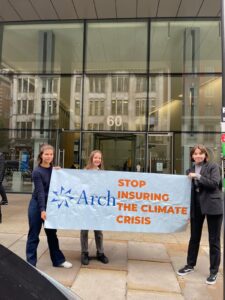
We can see these tactics are working. But we need all insurance companies to rule out EACOP, and stop the toxic pipeline at its source. Next, we want Arch insurance to rule it out, and we know that constant pressure works.
Sign up here to commit taking regular action with us - it's easy to do from home!