Damning new report reveals the indigenous communities torn up by coal imports that continue to power Europe and its steel industry
Today, Tuesday 30th March, Still Burning - a network against hard coal and neocolonialism – releases a new report Still Burning. The report shines a spotlight on Europe's continued coal imports in the run-up to COP26. It also tells the harrowing but little-known stories of the communities from Russia, Colombia, the USA, and Australia whose homes and way of life are literally torn up to mine the coal beneath them, suffering widespread human rights abuses.
Coal production around Europe is falling, but in Russia it’s rising to compensate and to extend the market eastwards.
Some European governments have announced coal power phase-outs, but some like in Germany are so far away (2038) as to be almost meaningless. Even in countries where coal for electricity has been phased out - such as Austria - are consuming coal to make steel. In fact in Austria coal-fired blast furnaces, are the single biggest site emitters of CO2 in the country.
There is an urgent need to stop all coal extraction and decarbonise the electricity and steel making industries.
You can download the report from https://stillburning.net/book/
Still Burning concludes that European utilities and governments must bear more responsibility for the disaster that is unfolding in coal producing regions, and so must act to halt and reverse the damage as well as compensate those impacted.
Our high energy lifestyles are fuelled by coal mines abroad forced on people unfortunate enough to live close to large coal deposits. These people rarely see any of the financial wealth raised from the exports to Europe of coal from under their homes. Instead, they are left with all the local harms and often the worst impacts of climate change.
Continues below...
Russia is the biggest exporter of coal to Europe supplying 41% of the coal imported into the European Union in 2017. 76% of Russia’s coal is mined in Kuzbass – an area in southwest Siberia and most of the coal produced there is shipped to Europe and Asia.
Valentina Bekrinova, a native Shor person living in the village of Chuvashka, Kuzbass, Siberia says, “In front of the house is the Sibirginsky mine. On the other side of the house there is a waste tip from another mine. Our village is surrounded by coal mining, and the dust which blows from the mines and waste heaps coats everything…I’m afraid that Shor people will soon become extinct. This is why the most important thing is the protection of our ecology, our rivers, our taiga for the protection of our nation. We cannot live without [them].”
While the impacts of burning coal in power station on our climate receives some attention the human and local ecological consequences are almost always overlooked. But the consequences are dire:
“I wish that people became more aware of where their coal comes from. And about the consequences” says Luz Angela Uriana Epiayu, mother of Moisés Daniel, a young child who is seriously ill with lung disease living next to the Cerrejón coal mine, owned by foreign interests.
The giant open-pit Cerrejón coal mine in La Guajira, northern Colombia. The mine is the biggest of its kind in the world and is jointly owned by Anglo American, BHP and Glencore. The Cerrejón mine is in Wayúu indigenous territory and when mining began over 30 years ago, local people were not consulted. Instead their lands were seized, and communities were forcibly displaced, violating their constitutional land rights. The Colombian government has failed to adequately compensate any of the affected communities. Pollution and dust from the coal mine has caused the contamination of water supplies and the air.
Narlis Guzmán Angulo a human rights defender from Cesar in Colombia living near the Drummond coal mine says, “In La Sierra we have always been able to feed ourselves with our agriculture, but that is over... Opencast coal mining ruined everything. It has brought us all this: the collapse of the social fabric, unemployment, death, missing persons, displaced persons, political corruption, the loss of the vocation of our ancestors, the loss of our roots, environmental pollution, disease, prostitution, the sexual commercialisation of children, drug addiction, and poisoned water...”.
The answer to these problems is not to open more coal mines in Europe. True solidarity with people at the front-lines of coal extraction means closing all coal mines globally and to move rapidly away from technology which relies on coal and produces vast emissions.
Read the full report https://stillburning.net/book/ and also see films about these issues by Still Burning here.
Coal Action Network is proud to present our 2026 manifesto for Wales. With the Senedd elections taking place in May this year, Wales stands at a decisive moment. For over a century, coal has shaped Welsh landscapes, communities, and politics. Today, Wales has the opportunity to shape something very different…
As part of our Politics Unspun series we are unpacking politicians’ public comments on coal to challenge any misleading or incorrect messages. Todays’ focus is on comments made during a Westminster Hall debate in December 2025 about the oil refining sector. During the debate, Lee Anderson MP made some statements about coal…
The Government is reforming planning policy in England and thanks to thousands of our supporters asking for an end to coal extraction in the last consultation in 2024, they are now recommending that planners “should not identify new sites or extensions to existing sites for peat or coal extraction”…
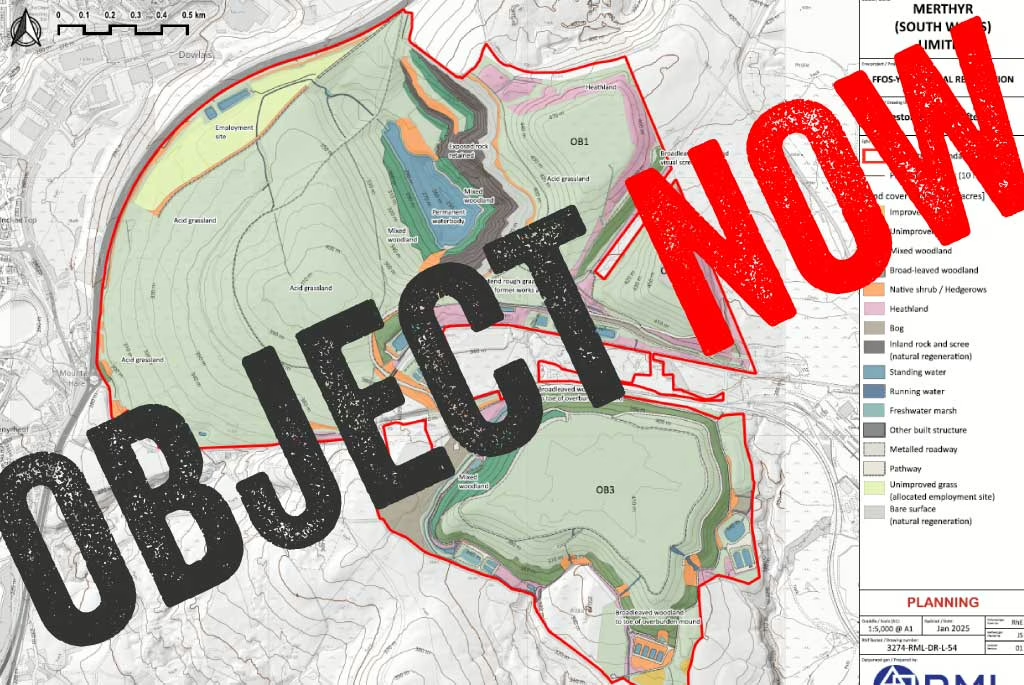
Merthyr (South Wales) Ltd mined for over a year illegally after planning permission for the Ffos-y-fran opencast coal mine ended in September 2022. During that year, it made record-breaking profits due to sanctions on Russia and other factors driving up the price of coal. But rather than using some of the profits from that ill-gotten coal…
In November 2024, the new UK Government announced its intention to legislate a ban of new coal mining licences – which we welcomed. Over a year later, the legislation is yet to be introduced, and the Government is not planning to include all types of extraction…
The UK steel and cement sectors (and to a lesser extent, bricks) are the largest users of coal following the closing down of the UK’s last coal-fired power station in September 2024. Check out our coal dashboard for our most recent coal stats including an industry break-down. We support the UK Government’s commitment to ban…
The steel industry produces 9-11% of the annual CO2 emitted globally, contributing significantly to climate change. In 2024, on average, every tonne of steel produced led to the emission of 2.2 tonnes of CO2e (scope 1, 2, and 3). Globally in 2024, 1,886 million tonnes (Mt) of steel were produced, emitting…
Last month we worked with Members of Parliament from various parties on a Westminster Hall debate about coal tip safety and the prohibition of new coal extraction licences. The debate happened 59 years and one day after the Aberfan tragedy which killed 116 children and 28 adults…
Successful, at-scale, examples already exist of cement works burning 100% fuel alternatives to traditional fossil fuels, including pilot projects using combinations of hydrogen and biomass (UK) and hydrogen and electricity (Sweden). Yet, innovations such as use of hydrogen and kiln electrification are…