
Coal mining in the Pont Valley to end August 2020
Campaign to Protect Pont Valley and other local people are delighted that Banks plans to further exploit the Pont Valley were dashed.
On the 1st July Durham County Council planning committee voted to reject Banks Group’s controversial proposal for ‘West Bradley’ an extension to the current ‘Bradley’ opencast coal site between Dipton and Leadgate which would have caused another 90,000 tonnes of coal to be extracted over a further 1 year period. Had it been approved it would have added further disruption to people living in the area and worsening the local and international environment.
H2 TITLE
The written particulars of the decision said, “The proposed development would not be environmentally acceptable with respect to landscape and visual impacts and residential amenity impacts, and could not be made so by planning conditions or obligations contrary to saved County Durham Minerals Local Plan Policies M7a, M23, M24, M36 and M37, Paragraph 211a) of the National Planning Policy Framework and Emerging County Durham Plan Policy 54.”
Although the planning officer for the council considered the County Durham Minerals Local Plan(2008) out of date, she chose to ignore that several of the restrictions it contained which went against this application are also expected to be included in the forth coming County Durham Plan.
H2 TITLE
Councillor Mark Wilkes who proposed the motion to refuse the opencast explained, said “Is it in the national interest to pump out more CO2 and other pollutants into atmosphere and stymie the development of alternative technologies? The government have committed to a Clean Steel Fund. We have to protect the local community and the nation from the adverse environmental impacts.”
Of the local impacts, a key contentious issue was that the site would be 33m from the nearest homes, where 250 metres had been the acceptable standard in the past, where opencast coal mining includes blasting rock with explosives and releasing dust particles into the surrounding area. Of this point Councillor Wilkes added: “This is where people live and sit in their gardens and want to breathe clean air. This is 2020 not 1820.”
H2 TITLE
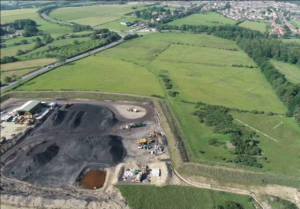
Previous opencast coal mine applications have covered the contested area, and always been rejected. The area consisted of two fields which sustained wildlife as they had been left in a fairly natural condition, and a strip of trees at the top of a woodland in an area of High Landscape Value.
Speaking at the hearing, Alan Holmes of Campaign to Protect Pont Valley argued that approval was inconsistent with Durham’s future plans including climate mitigation plans: “The County Durham Plan asserts climate change issues should be considered in every aspect of strategy and decision making. The Officer’s Report recommends no weight is afforded to the emergent County Plan, even though it will form the basis of decision making well into the future.”
H2 TITLE
Michael Litchfield of Derwent Valley Protection Society also spoke against the mine at the hearing saying “There is no national need for the open cast coal that could possibly outweigh the environmental and social cost of this opportunistic scheme.”
Banks Group had submitted two planning applications, the first to extend the area of coal extraction and the second to change the conditions of the current permit. Both were rejected. As such the opencast has to stop extracting coal in August 2020 and back fill the site, remove the bunds, demolish the facilities and landscape the area by August 2021.
H2 TITLE
Anne Harris from Coal Action Network said that “We must leave the coal in the ground, here and at the other sites Banks Group wishes to destroy. Communities Secretary Robert Jenrick should take note and decisively reject Druridge Bay, a 3 million tonne coal mine in Northumberland which is still awaiting his decision.
“In contrast to the dodgy developer lobbying we have seen in the news in recent weeks, the community groups and individuals who have petitioned, door-knocked, written letters, have managed to convince planners that a coal mine is not in anyone’s interest. We applaud the councillors who listened to the community and took the only right course of action in a climate emergency. The impact of this decision will be felt nationally as more mines are set to go before planning committees.”
Banks Group’s proposal for another opencast coal site, Dewley Hill near Newcastle, is awaiting a planning hearing date, and has also been countered by a strong community campaign, Defend Dewley Hill.