Coal Action Network is proud to present our 2026 manifesto for Wales. With the Senedd elections taking place in May this year, Wales stands at a decisive moment. For over a century, coal has shaped Welsh landscapes, communities, and politics. Now Wales has the opportunity to shape something very different: a future defined not by extraction, but by restoration, innovation, and justice.
Our recommendations are:
We urge all parties to prioritise a bolder, brighter Wales, by adopting these recommendations.
Download a copy in Welsh or English by clicking on either of the images above.

The Government is reforming planning policy in England and thanks to thousands of our supporters asking for an end to coal extraction in the last consultation in 2024, they are now recommending that planners "should not identify new sites or extensions to existing sites for peat or coal extraction". The Government is now running a consultation on its latest draft which includes this wording.
So it's time for our supporters to take action again and prove that the Government is well supported to prohibit coal extraction. If we flood the consultation with supportive submissions for this particular policy, we will certainly drown out any pro fossil fuel voices seeking to change the Government's mind.
Please take two minutes of your time to send our template submission by the deadline of 10th March 2026.

In November 2024, the new UK Government announced its intention to legislate a ban of new coal mining licences – which we welcomed. Over a year later, the legislation is yet to be introduced, and the Government is not planning to include all types of extraction.
2026 needs to be the year that ALL coal extraction is banned. Here’s Why that is, and How it can be done:
May’s local authority and devolved Government elections will possibly see gains for pro coal candidates. This could result in local authorities across the UK and possibly even the Welsh Government being run by Councillors and Members who are part of a party that has stated its aim to re-open coal mines. While this is impossible in many circumstances; Britain’s 5,000 coal tips are within reach.
The current Welsh Government’s Coal Policy adds a level of scrutiny to potentially prevent coal tip extraction, but a new Government could abandon this policy and approve many of Wales’ 2,590 coal tips to be mined if they have been given approval by local authorities. In England, only local authorities need to approve coal tip extraction- using the same framework which Cumbria County Council used to approve the West Cumbria coal mine.
With more local authorities likely to be led by pro coal Councillors, now is the time to ensure that ALL types of coal extraction are treated equally, banned nationally and that the ban is legislated before any coal tips are approved to be mined by local authorities.
Coal Action Network commissioned leading environmental Barristers Rowan Clapp and Estelle Dehon KC to draft the precise wording of amendments to the Coal Industry Act 1994. This advice showed that relatively minor amendments could be made whilst legislating the coal licence ban to achieve this aim. This advice has been shared with the Government.
Referring to the coal policies of devolved Governments, Energy Minister Michael Shanks told us during a Westminster Hall debate in October; “Their firm view is that they can bring into effect the aim of the Welsh Government and the UK Government to make sure that extraction of coal is a thing of the past. Their view is that their existing powers do that.”
Coal Action Network does not agree that existing powers do prevent further extraction due to the reasons mentioned above. Therefore, we are reaching out to Westminster and the devolved Governments. The Welsh Government in particular needs to consider the wider implications of banning coal tip extraction across the UK. While their coal policy could prevent 2,590 coal tips in Wales from being exploited whilst it is adhered to by a Government which seeks the end of coal; their advocacy for the inclusion of coal tips in this Westminster legislation could almost double their impact by expanding that ban to the other 2,400 coal tips throughout the rest of the UK.
Members of Parliament
Members of the Senedd
Members of the Scottish Parliament

Last month we worked with Members of Parliament from various parties on a Westminster Hall debate about coal tip safety and the prohibition of new coal extraction licences.
The debate happened 59 years and one day after the Aberfan tragedy which killed 116 children and 28 adults. Rooted in this context, the debate highlighted the need to prioritise coal tip safety whilst also preventing the extraction of coal from these tips.
Plaid Cymru MP, Ann Davies, led the debate and highlighted that ‘because of increasingly violent storms caused by climate change, we have experienced further coal tip slips’. This is an important point in this debate as the further exacerbation of climate change, via the extraction and use of more coal, would lead to further slips.
She added ‘The UK Government have pledged to ban new coalmining licences, but they have confirmed their belief that re-mining coal from the tips does not require a licence, meaning that such activity falls outside the scope of the proposed ban. Although the Welsh Government believe that their own planning policies will prevent re-mining, a loophole allowing coal extraction in “wholly exceptional circumstances” has raised concern’.
Labour MP, Gerald Jones, discussed mining companies failing to comply with their legal obligations – a danger which could happen again with coal tip extraction. He used the example of the Ffos - Y - Fran opencast mine in his constituency: ‘When it first opened, the company running the mine, Merthyr (South Wales) Ltd, pledged to fully restore the site after it finished operations. I call on it to honour that pledge.’
Liberal Democrat MP, David Chadwick, reflected on the Reform party policy to re-open the pits earlier in the year. A move which, in many cases is not possible, but would be a clear abandonment of our responsibilities to future generations. He said: ‘The people of the south Wales valleys have given more than enough, and we are still waiting for our new south Wales to emerge. We deserve safety, fairness and a future built on renewal, not nostalgia.’
Labour MP, Steve Witherden, made a passionate and precise demand that the Government include coal tips within its coal licence ban: ‘Mining companies offering to remove coal tips in return for commercial access to coal is an easy answer to a difficult question, which we cannot allow, so I ask the Minister this. If the Government truly believe that the Welsh Government’s coal policy and England’s and Scotland’s planning policies are robust enough to prevent coal extraction, why do investors think otherwise? ERI Reclamation is actively seeking to extract 468,000 tonnes of coal from tips in Bedwas, Caerphilly. It clearly believes that the law allows that, and it is putting serious capital behind the belief. If this is approved—it is an “if”—it could set a dangerous precedent, whereby private profits determine which coal tips are removed and others, with less content, are left. It would be a precedent categorising coal tips by their value rather than their potential impact on public safety. Could we see landowners, burdened by maintenance costs, encouraged to sell access to these sites?
We cannot and must not rely on the private sector to make coal tips safe. That duty falls on us. The Government’s coal licensing ban must be strengthened to include coal tip mining.’
Liberal Democrat spokesperson for energy security and net zero, Pippa Heylings MP, eloquently highlighted Coal Action Network’s legal advice which shows how to include coal tips in the coal licence ban: ‘In practice, extracting coal from a tip is no different from open-cast mining. The method is the same, the disruption is the same, the risks are the same and the emissions are the same. The contradiction can be easily resolved. Leading environmental lawyers, working with the Coal Action Network, have proposed an amendment to the Coal Industry Act 1994 to clarify that the mining of coal from coal tips also requires a licence. That small change would ensure that the Government’s coal ban is comprehensive and future-proof.’
Energy Minister, Michael Shanks MP, concluded the debate, summarising that ‘We acknowledge the suggestion to make this type of coal extraction a licensable activity under the MRA, which would allow for a licensing prohibition, but our view is that the current planning policies around the regulations set by devolved Governments already provide robust frameworks.
We are a Government who believe in devolution. We created devolution in Scotland, Wales and Northern Ireland because we believe in devolving power to those authorities, so they are closer to people and to individual circumstances. It is right that we take their lead on these questions. Their firm view is that they can bring into effect the aim of the Welsh Government and the UK Government to make sure that extraction of coal is a thing of the past. Their view is that their existing powers do that.’
While we at Coal Action Network hope that the Minister’s faith in devolved powers to make coal extraction a thing of the past is well founded; we fear that a different Welsh Government could have an opposing aim and would be able to achieve that under current circumstances. The English National Planning Policy Framework (NPPF) was also not considered by the Minister, which allowed the West Cumbria coal mine to gain planning permission and would also allow coal tip extraction throughout England’s coal fields.
We would like to thank each of the Members for taking part in the debate and making the case for banning coal tip extraction.
Coal Action Network will continue to campaign for the inclusion of coal tip extraction in the coal licence ban.

After the tragic passing of Hefin David MS, a by- election is being held in the Senedd seat of Caerphilly on October 23rd 2025.
Within the borders of the Caerphilly constituency is the proposed Bedwas coal tips re-mining project. In the lead up to the Senedd by-election, Coal Action Network has carried out a survey of the by-election candidates asking for their views about the re-mining of the Bedwas and other Welsh coal tips.
We asked the same two questions to each candidate:
Of the eight candidates, six responded. Each candidates response is published in full here, in order of when we received their response:
“The coal tips of Bedwas represent not only a legacy of our industrial past but a potential resource for our future, if approached with care, innovation, and community oversight.
“I support the responsible re-mining of these tips, provided it is done safely and transparently. After all, this isn’t about returning to the past, it’s about using what remains to build a stronger, fairer future for Bedwas and wider communities across Caerphilly.
“If carried out correctly, coal tip mining can be a bridge between our heritage and our progress.”
"I am opposed to Private enterprise using this just to make a profit. I do not trust them. Yes I want the colliery waste taken away. I want it taken by rail and not road. No to 50 lorries a day for years. There is a rail link close and could be accessed without driving through the villages."
“I have young children similar in age to those children that lost their lives in the 1966 Abervan disaster. That disaster was brought home to me following the coverage of the Cwmtillery coal tip slip, following storm Bert in December 2024. Not that long ago. Fortunately no one was hurt, but the slurry came very, very close to the houses.
Also, a very good friend of mine lives in the western end of the South Wales Coal field, and he tells me that another problem with abandoned coal tip's are, that they are susceptible to catching fire.
Whilst improved drainage may be a solution, it is not a guarantee and it will not stop a fire. There is also the issue of pollutants from the tip running off into the River Rhymney. The present weather pattern is showing more rain, while the Fire Service is telling us that there are more fires on open common ground to which abandoned coal tips form part of that landscape.
To quarry for coal on Bedwas coal tips will we be making the problem worse by churning up the landscape, tempting fate with the possibility of an accident waiting to happen, heavens forbid. There needs to be guarantees that the area is returned safely and with the tips removed.
The question is do we do nothing, and allow our friends, and families, to remain at risk, and that risk be handed down to our children and grandchildren, or do we do something now and remove the present danger?
It's crucial that any actions proposed during the coal extraction and tip removal works have actions in place to mitigate the negative effects on local communities and surrounding areas, such as the country parks.
While I see the potential for positive outcomes, the most important one being the removal of the unsafe tips, I want to emphasize the importance of ensuring that communities such as Bedwas are not negatively impacted. We must hold those responsible for this project accountable and ensure that all proposed mitigation measures are fully and effectively implemented to protect local residents and the surrounding environment.
I believe it's important to find a balance between addressing the long standing issues of these sites and ensuring that any development works benefit, rather than harm, the local area.
"Bedwas Tips: Safety First, but Concerns Remain. The coal tips above Bedwas are classed as high-risk under Welsh Government assessments, with dangers including landslip, fire and water pollution, risks which made worse by climate change. Maintaining and ensuring safety of the tips currently costs CCBC a significant amount of money – money which could be spent on keeping Libraries open and properly funding our schools.
ERI Ltd has proposed a major remediation project: removing spoil and coal, re-profiling the tips, and restoring the land to grassland and moorland. The scheme could last up to ten years and would be funded by selling extracted coal.
Local people rightly want the tips made safe. But the Liberal Democrats believe three key concerns must be addressed before this scheme proceeds.
Coal extracted from Bedwas must only be used where it would displace coal which would otherwise be imported, it should only be used in UK industries that have no current coal-free alternative.
This cannot be controlled through the planning application, only through the contractual agreement between ERI and CCBC. We have questioned ERI and they have confirmed that their current proposal would not restrict how the coal would be used, and therefore that it could be exported or used in power generation – uses which we cannot support.
Before the scheme goes ahead, and before planning is granted:
The role of Caerphilly Council - The tips are owned by Caerphilly County Borough Council (CCBC). That means the council is central to ensuring safeguards on finance, coal use and environmental restoration.
We note that CCBC recently issued a statement “setting the record straight”, implying there is no existing relationship between the council and ERI. We think it’ highly unusual for a private company to propose such a major scheme on council-owned land without detailed discussions. Residents deserve more transparency about what has — or has not — been agreed.
It is only CCBC who can control how any coal extracted from the tips can be used and ensure that any remediation project is well managed to completion – the statement that they issued gives us no confidence in their willingness or ability to control these matters.
The Lib Dems call on
Our position - We recognise the importance of making the Bedwas tips safe. But this cannot come at the cost of the climate, country park users or local residents. With transparency, strong safeguards and genuine community involvement, the project could deliver safety and restoration. Until such safeguards are in place we cannot and do not support the project.
The Liberal Democrats will keep pressing for a balanced, fair approach that puts people and the environment first.”
"We are in a climate and nature emergency and the response must be swift and serious, so we can pass on a Wales we are proud of to future generations. That means a managed end to the extraction and use of coal. As I understand it, a planning application for the proposed scheme has not yet been submitted to Caerphilly Council.
If a planning application is put forward, I would be open to meeting with Energy Recovery Investments Ltd and with campaigners to hear their points of view.
However, any proposal for the extraction of coal from disused tips falls under Welsh Government's Coal Policy Statement, which dictates that coal licences may be needed in wholly exceptional circumstances, and each application will be decided on its own merits, but the presumption will always be against coal extraction.
I support the Welsh Labour position to issue no new licences to explore new coal fields because they will not take a penny off bills, cannot make us energy secure, and will only accelerate the worsening climate crisis.
The climate and nature crisis is the biggest long-term challenge of our time. But the clean energy transition is our chance to grow the economy, cut bills, and make Britain energy independent again. Like my Labour colleagues, I’m committed to the mission to deliver clean energy by 2030."
“All coal tips must be made safe, but the extraction of coal from them should never happen. Fossil fuels must remain in the past – especially when our planet is in such a perilous state.”
Reform were asked to respond to the same questions as all other candidates, but did not provide any response.
UKIP were asked to respond to the same questions as all other candidates, but did not provide any response.

In November 2024, the UK Government announced its commitment to legislating a ban of new coal mining licences. This was a commitment that Coal Action Network had previously secured in the Government's pre-election manifesto, along with four other major parties.
Despite this, one loophole remains in the legislation which could still allow millions of tonnes of coal to be extracted from coal tips throughout the UK. Since the announcement we have continued to pressure the Government to ensure that this loophole is closed and that all types of coal extraction are banned.
The next step in this work is to provide the Government with the precise wording that could be used to ensure that coal tips do not remain the sole place where coal can be mined at commercial scale. To do this we commissioned advice from leading environmental barristers Estelle Dehon KC and Rowan Clapp.
The advice has been sent to the Secretary of State for Energy Security and Net Zero, Ed Miliband MP; Energy Minister Michael Shanks MP; and the Department for Energy Security and Net Zero.
The advice we received sets out how to change the Coal Industry Act 1994 so the ban of new coal mining licences also clearly covers coal-tip extraction.
Until now, the wording of the Act has been ambiguous. Without being made clearer, tip coal has been entering the energy market and could continue to do so if the legislation does not remove this ambiguity. In turn, this would undermine the ban’s purpose. A small, targeted, amendment to sections 65(1) and 25(2) will align the licencing regime with the ban’s intent.
“winning, working and or otherwise getting coal (whether underground, or in the course of opencast operations, or in the course of obtaining coal deposited as or as part of waste material from coal mining operations)”
Ensuring Coverage in Wales
Incidental Coal Agreements (ICAs) are a mechanism which already exists – to allow coal to be extracted for safety or remediation purposes. This will still be needed to ensure that the removal of coal for these purposes can continue. Fee bands for ICAs top out at 1,000 tonnes, yet many tip-reclamation schemes propose extracting well over 100 times that amount, undermining any claim that coal removal is merely “incidental.”
Without a clear licensing requirement, millions of tonnes of coal could legally flow from tips across the UK, undermining the licence ban’s aim.
On July 1st, 2025, CAN organised an impactful drop-in session at the Senedd to reinforce the urgent need for action on Wales' coal legacy issues. The event, sponsored by Delyth Jewell MS, saw strong cross-party engagement, with Members of the Senedd (MSs) from Labour, Plaid Cymru, the Conservatives, and the Liberal Democrats in attendance.
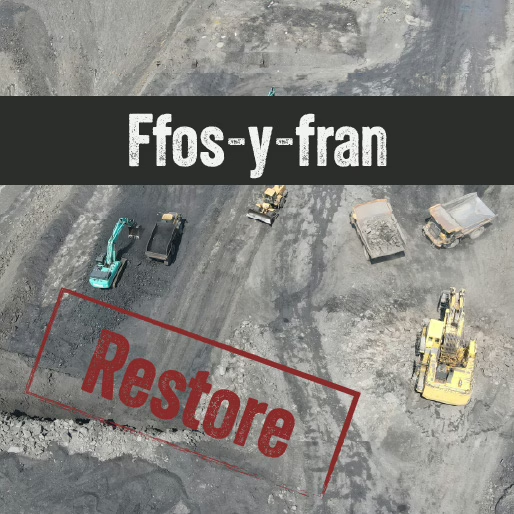
Framed as a call to action on two interconnected issues—the future of coal tips and the restoration of the Ffos-y-fran opencast site—the session demonstrated growing momentum for change across the political spectrum.


CAN supported Delyth Jewell’s proposed amendment to the Disused Mine and Quarry Tips (Wales) Bill, which would rule out the sale of coal from disposed land for the purpose of burning. This simple but powerful clause would ensure that coal removed during the management of old coal tips cannot be fed back into fossil fuel supply chains—closing a loophole that could otherwise undermine climate commitments.
We also spoke with MSs to urge the Welsh Government to work constructively with the Department for Energy Security and Net Zero (DESNZ) in Westminster to ensure the UK-wide coal mine ban currently under development includes coal extraction from coal tips. As it stands, tip-extracted coal is not covered—a glaring omission that risks opening the door to a new phase of coal exploitation under the guise of legacy management.
Merthyr (South Wales) Ltd, which operated the Ffos-y-fran coal mine, is seeking to drastically reduce its contracted restoration obligations by up to £110 million. This is despite public filings showing £91.2 million already allocated for the site's restoration by the mining company. MSs attending our drop in session spoke with local residents we invited, viewed our gallery images of the coal mine site, and explored it for themselves via our 360 drone photos.
This raises serious concerns about transparency and risk—particularly given the site's proximity to local communities and the significant safety and environmental hazards involved. See our brief to find out what actions MSs can take today to deliver justice for Merthyr Tydfil.


Attendance at the drop in session by every Senedd party shows there is political appetite for action. Members across party lines recognised the urgency and legitimacy of the issues we raised. This is not about party politics—it’s about public safety, environmental justice, and the integrity of our climate commitments.
We thank every MS who took time to attend, engage with our materials, and listen to affected communities. We will continue to campaign so that Wales does not repeat the mistakes of its past but instead leads the way in managing its coal legacy responsibly.
This is what the 58,000 residents of Merthyr Tydfil face every day...and with a new plan by mining company, Merthyr (South Wales) Ltd, to evade its responsibility to restore the site, this risks becoming a permanent reality. This would set a dangerous precedent for other quarries and large infrastructure projects too, with other companies also flaunting planning control and conditions with impunity. The Welsh Government must bring this disreputable mining company to heel and deliver the restored, safe, and green landscape promised to Merthyr Tydfil and Commoners for over 16 years.
If you're a Senedd Member, see our brief for what you can do today.

Find out more about Ffos-y-fran opencast coal mine and join the campaign to get it restored.
Published: 02. 07. 2025
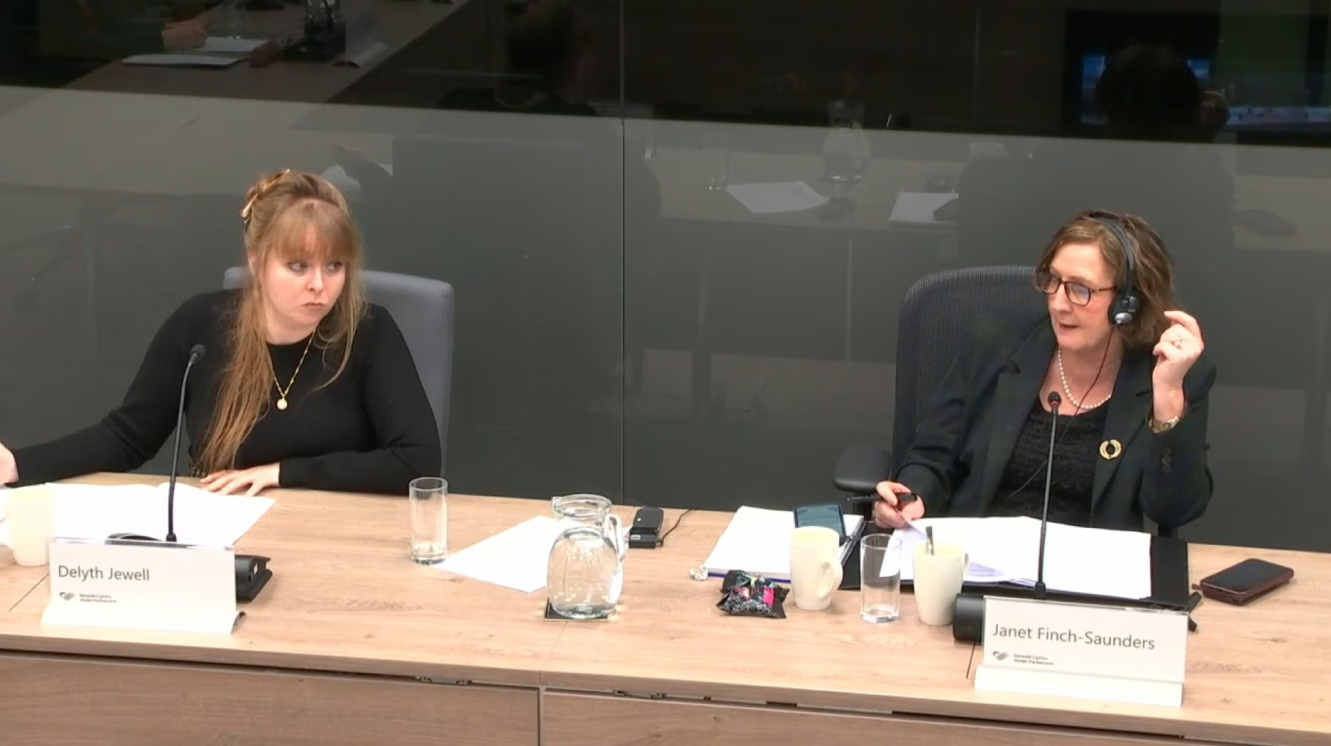
In February, CAN gave oral testimony to the Climate Change, Energy, and Infrastructure Committee (CCEIC) on the Disused Mine and Quarry Tips (Wales) Bill. Alongside FOE Cymru, we gave a candid account of the strengths, weaknesses, and pitfalls of the Bill. Watch our session in full.
The CCEIC is the first committee scrutinising The Disused Mine and Quarry Tips (Wales) Bill passing through the Senedd, giving it significant scope to shape the Bill at an early stage. CAN successfully persuaded the CCEIC during our oral testimony to make key recommendations to the Welsh Government to improve the Bill in its Stage 1 report:
The Welsh Government should provide further assurance that:
Coal Action Network was invited to attend Westminster where we gave evidence to the Welsh Affairs Committee in their inquiry about the environmental and economic legacy of Wales’ industrial past, alongside Friends of the Earth Cymru.
This inquiry was opened in December 2024 to examine the environmental legacy and economic impact of Wales’ historical heavy industries. You can find our written evidence here.
In our submission, we focused on the consequences today of old coal mines. Whilst we recognise the wealth it generated, much of that was kept by the Directors of mining companies whilst abandoning their restoration responsibilities to host communities. Our 2022 report ‘Coal mine restoration in South Wales’ documents this pattern in Wales’ recent past. We also highlighted the threat of new coal mining under the guise of remediation, as proposed in Bedwas, South Wales.